

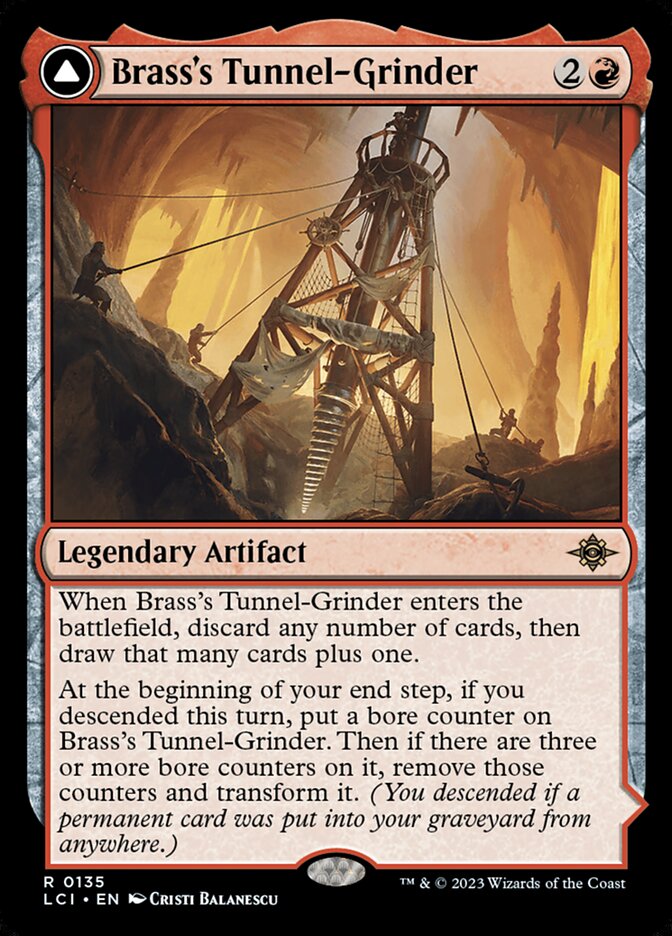
Brass's Tunnel-Grinder // Tecutlan, the Searing Rift is one of those cards players keep asking about. Here is, in plain words, what its official text says, the rulings published by Wizards of the Coast, and the combos players actually run.
Official card text
When Brass's Tunnel-Grinder enters, discard any number of cards, then draw that many cards plus one. At the beginning of your end step, if you descended this turn, put a bore counter on Brass's Tunnel-Grinder. Then if there are three or more bore counters on it, remove those counters and transform it. (You descended if a permanent card was put into your graveyard from anywhere.) (Transforms from Brass's Tunnel-Grinder.): Add
. Whenever you cast a permanent spell using mana produced by Tecutlan, discover X, where X is that spell's mana value.
Complete guide
Brass's Tunnel-Grinder is a versatile red legendary artifact that offers excellent card selection early on and transforms into a powerful land. Once it becomes Tecutlan, the Searing Rift, it turns your permanent spells into repeatable value engines using the discover mechanic.
Filtering and Digging
When Brass's Tunnel-Grinder enters the battlefield, its first ability allows you to discard any number of cards. Crucially, you then draw that many cards plus one. This means even if you have zero cards in hand, you will still draw one card. This ability is perfect for fueling 'descend' mechanics by putting permanent cards into your graveyard.
Descending to Transform
To transform this artifact into Tecutlan, the Searing Rift, you must have descended during your turn. You descend whenever a permanent card (like a creature, land, or artifact) is put into your graveyard from anywhere. At the beginning of your end step, if you descended, the Tunnel-Grinder gets a bore counter. Once it hits three counters, it transforms. Note that tokens do not count as cards, so a token dying will not trigger descend.
Mastering Tecutlan
The back side, Tecutlan, the Searing Rift, taps for red mana. Whenever you cast a permanent spell using this mana, you discover X, where X is that spell's mana value. The discover ability resolves before the spell that triggered it. You exile cards from the top of your library until you find a nonland card with a mana value of X or less, then choose to cast it for free or put it into your hand.
Common Pitfalls
A common mistake is forgetting that descend check happens at the very start of the end step. You cannot put a card into your graveyard during the end step to trigger the bore counter; it must have happened previously in the turn. Additionally, for Tecutlan's trigger, the mana must be spent specifically on a permanent spell (artifact, creature, enchantment, etc.), not an instant or sorcery.
Interaction examples
 Arcane Signet
If you have an Arcane Signet in hand but need a specific land or removal spell, you can play Brass's Tunnel-Grinder and discard the Signet. Because the Signet is a permanent card, this counts as descending. At your end step, the Tunnel-Grinder will check that you descended and receive its first bore counter.
 Swiftfoot Boots
With Tecutlan, the Searing Rift on the battlefield, you tap it to produce red mana and use that mana to help cast Swiftfoot Boots (mana value 2). This triggers Tecutlan's ability. Before the Boots resolve, you discover 2, exiling cards until you find a nonland card with mana value 2 or less. You may then cast that card for free before the Boots even enter the battlefield.
Guide written with AI from the official text and rulings. Official English text prevails.
How it works : Brass's Tunnel-Grinder // Tecutlan, the Searing Rift
Original English text — Wizards of the Coast / Scryfall
- #1· Wizards of the Coast
You choose how many cards to discard as the first ability of Brass's Tunnel-Grinder resolves. You may choose to discard no cards and just draw a card.
No other card is named in this ruling.
- #2· Wizards of the Coast
If a permanent spell cast using mana produced by Tecutlan, the Searing Rift has
 in its mana cost, use the value chosen for X when calculating that spell's mana value.
No other card is named in this ruling.
- #3· Wizards of the Coast
Tecutlan, the Searing Rift's triggered ability will resolve before the spell that caused it to trigger.
No other card is named in this ruling.
- #4· Wizards of the Coast
A spell's mana value is determined only by its mana cost. Ignore any alternative costs, additional costs, cost increases, or cost reductions.
No other card is named in this ruling.
- #5· Wizards of the Coast
When you discover, you must exile cards. The only optional part of the ability is whether you cast the exiled card or put it into your hand.
No other card is named in this ruling.
- #6· Wizards of the Coast
You exile the cards face up. All players will be able to see them.
No other card is named in this ruling.
- #7· Wizards of the Coast
If you cast a spell "without paying its mana cost", you can't choose to cast it for any alternative costs. You can, however, pay additional costs. If the spell has any mandatory additional costs, you must pay those to cast it.
No other card is named in this ruling.
- #8· Wizards of the Coast
If the discovered card has
in its mana cost, you must choose 0 as the value of X when casting it without paying its mana cost.No other card is named in this ruling.
- #9· Wizards of the Coast
If you can't cast the discovered card (perhaps because there are no legal targets for the spell), you'll put it into your hand.
No other card is named in this ruling.
- #10· Wizards of the Coast
Some spells and abilities that cause you to discover may require targets. If each target chosen is an illegal target as that spell or ability tries to resolve, it won't resolve and you won't discover.
No other card is named in this ruling.
- #11· Wizards of the Coast
The mana value of a split card is determined by the combined mana cost of its two halves. If discover allows you to cast a split card, you may cast either half (as long as its mana value is less than or equal to the effect's discover value) but not both halves.
No other card is named in this ruling.
- #12· Wizards of the Coast
If you discover an adventurer card, split card, or modal double-faced card, you might be able to cast that card with either set of characteristics depending on the effect's discover value. For example, if you discover 4 and reveal Galvanic Giant (an adventurer card from Wilds of Eldraine with a mana value of 4), you could cast Galvanic Giant, but not Storm Reading (its Adventure, which has a mana value of 7). If you discover 7 and reveal Galvanic Giant, you could cast either Galvanic Giant or Storm Reading.
No other card is named in this ruling.
- #13· Wizards of the Coast
Some cards refer to a player who has "descended this turn." This means that a permanent card has been put into that player's graveyard from anywhere this turn.
No other card is named in this ruling.
- #14· Wizards of the Coast
Some cards refer to the number of times a player descended this turn. Those cards care about the number of permanent cards put into that player's graveyard from anywhere this turn.
No other card is named in this ruling.
- #15· Wizards of the Coast
In either case, it doesn't matter if those cards are still in that player's graveyard.
No other card is named in this ruling.
- #16· Wizards of the Coast
A permanent card is an artifact, battle, creature, enchantment, land, or planeswalker card. Tokens are not cards, and while tokens are put into the graveyard before ceasing to exist, that action doesn't count as a player having descended.
No other card is named in this ruling.
- #17· Wizards of the Coast
Multiple cards have abilities that begin with "At the beginning of your end step, if you descended this turn." These cards don't need to have been under your control at the time you descended. For example, if a permanent card is put into your graveyard during your first main phase and you cast Stalactite Stalker your second main phase, its ability will trigger at the beginning of your end step.
No other card is named in this ruling.
- #18· Wizards of the Coast
Abilities that begin with "At the beginning of your end step, if you descended this turn" will trigger only once during your end step, no matter how many times you descended this turn. However, if you haven't descended this turn as your end step begins, the ability won't trigger at all. It's not possible to put a permanent card into your graveyard during the end step in time to have the ability trigger.
No other card is named in this ruling.
Legal formats
Commentaires
- Sois le premier à commenter cette carte.
Read next
Meta decks with Brass's Tunnel-Grinder // Tecutlan, the Searing Rift
No archived Top 8 deck with this card yet.