

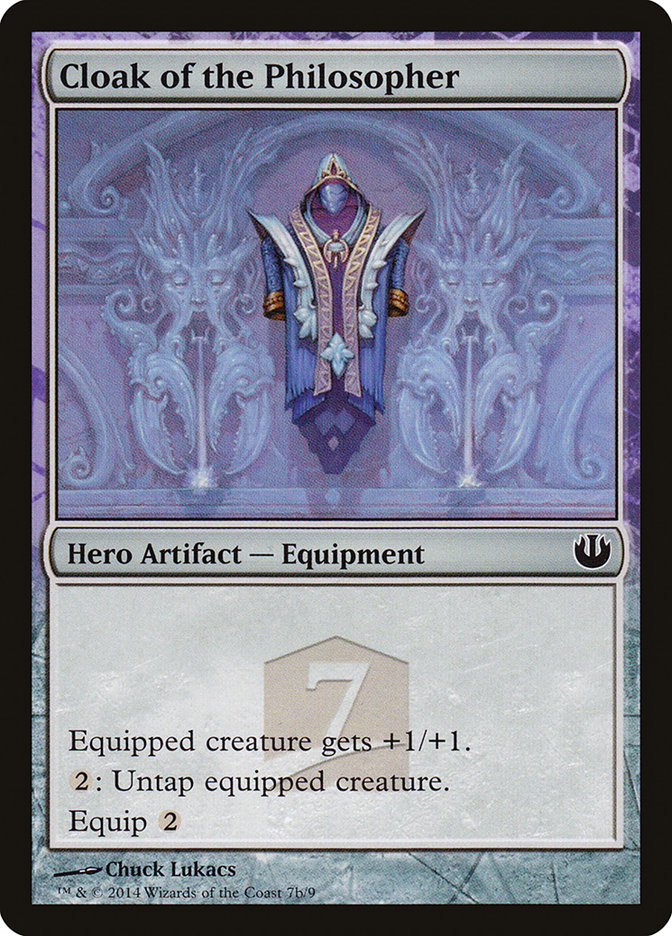
Cloak of the Philosopher is one of those cards players keep asking about. Here is, in plain words, what its official text says, the rulings published by Wizards of the Coast, and the combos players actually run.
Official card text
Equipped creature gets +1/+1.: Untap equipped creature. Equip
Complete guide
Cloak of the Philosopher is a versatile Hero Artifact that provides both a combat boost and a powerful utility effect. By allowing you to untap your creature for a small mana investment, it opens up numerous tactical possibilities during both your turn and your opponent's. Whether you need an extra blocker or a way to reuse an activated ability, this equipment has you covered.
What It Does
This equipment provides two distinct benefits to the creature it is attached to. First, it grants a static +1/+1 bonus to power and toughness, making the creature more formidable in battle. Second, it grants the equipped creature an activated ability that costs {2} mana to untap it, which can be used any number of times as long as you have the mana to pay for it.
How It Resolves Step by Step
To utilize Cloak of the Philosopher, you must first pay the Equip {2} cost to attach it to a creature you control. Once attached, the +1/+1 bonus is applied immediately as a continuous effect. To use the untap ability, you activate it by paying {2} generic mana. When the ability resolves, the creature becomes untapped, potentially allowing it to attack again if there are additional combat phases, or simply to stand ready as a blocker.
Common Mistakes
Players often forget that the untap ability is an activated ability belonging to the creature, not the equipment itself. However, because the cost is purely mana and does not require the tap symbol {T}, you can actually activate this ability even if the creature is already untapped—though doing so usually has no effect. Also, remember that moving the Cloak to another creature requires paying the Equip cost again during your main phase when the stack is empty.
When to Play It
Cloak of the Philosopher is best utilized in decks that rely on creatures with powerful tap abilities or in defensive strategies. Since the untap ability is available at any time you could cast an instant, you can attack with a creature and then untap it after the declare attackers step to ensure you have a defender during your opponent's next turn.
Interaction examples
 Sol Ring
With Sol Ring on the battlefield, you can tap it to add {C}{C} to your mana pool. This provides exactly the amount of mana needed to activate the Cloak of the Philosopher's ability to untap the equipped creature, effectively turning your artifact mana into creature readiness.
 Skullclamp
If you have a 1/1 creature, attaching Skullclamp would normally cause it to die due to the -1 toughness. However, if Cloak of the Philosopher is already equipped, the creature gets +1/+1 first. Adding Skullclamp then results in a net +2/0 bonus, keeping the creature alive at 3/1 while still allowing you to draw cards if it eventually dies.
You attack with a creature equipped with Cloak of the Philosopher. During your post-combat main phase, or even during your opponent's turn, you spend {2} mana to activate the Cloak's ability. The creature untaps, allowing it to block an incoming attacker that your opponent thought was safe to send.
Guide written with AI from the official text and rulings. Official English text prevails.
How it works : Cloak of the Philosopher
Original English text — Wizards of the Coast / Scryfall
No additional ruling has been published for this card.
Commentaires
- Sois le premier à commenter cette carte.
Read next
Meta decks with Cloak of the Philosopher
No archived Top 8 deck with this card yet.