

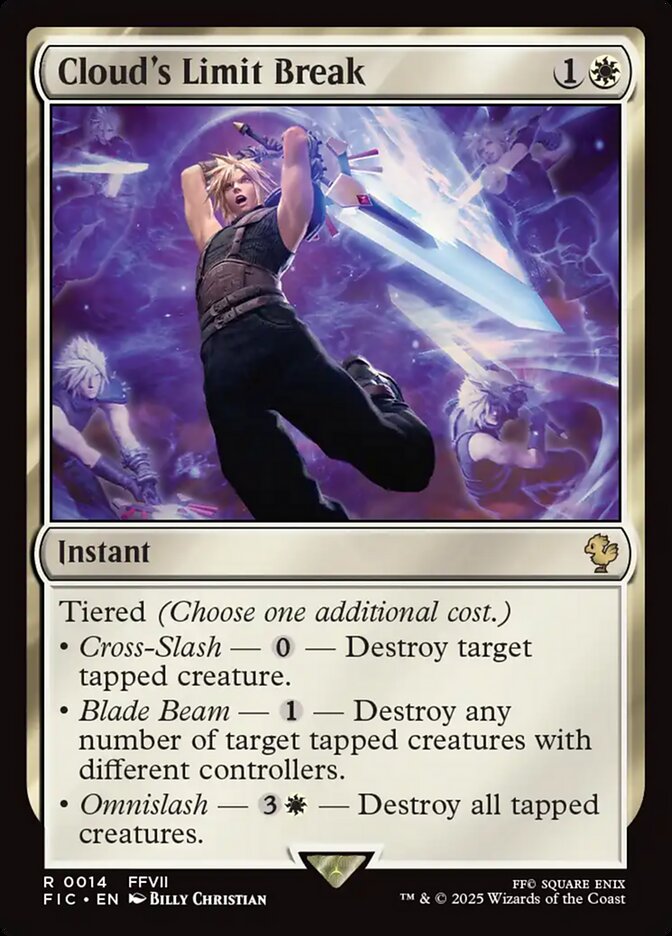
Cloud's Limit Break is one of those cards players keep asking about. Here is, in plain words, what its official text says, the rulings published by Wizards of the Coast, and the combos players actually run.
Official card text
Tiered (Choose one additional cost.) • Cross-Slash —— Destroy target tapped creature. • Blade Beam —
— Destroy any number of target tapped creatures with different controllers. • Omnislash —
— Destroy all tapped creatures.

Complete guide
Cloud's Limit Break is a versatile white instant that rewards you for timing your strikes perfectly against your opponent's forces. Utilizing the Tiered mechanic, this spell allows you to scale its impact from a surgical strike to a full-scale board wipe depending on the mana you invest. Whether you are facing a single threat or a literal army, this card adapts to the battlefield's needs.
What It Does
Cloud's Limit Break is a removal spell that focuses exclusively on tapped creatures. Its unique Tiered keyword requires you to choose exactly one of three modes as you cast the spell: Cross-Slash, Blade Beam, or Omnislash. Each mode comes with a specific additional cost that must be paid in addition to the standard {1}{W} mana cost, altering the spell's scope from a single target to every tapped creature on the board.
How It Resolves Step by Step
When you cast the spell, you first choose one of the three Tiered modes. If you choose Cross-Slash or Blade Beam, you must select the appropriate number of legal targets that are currently tapped; if you cannot provide valid targets for these modes, you cannot choose them. After targets are set, you pay the total cost (the mana cost plus the additional Tiered cost). Upon resolution, the spell checks if the targets are still legal (if applicable) and destroys the designated creatures. Note that the mana value of the spell remains 2 regardless of which mode is selected.
Common Mistakes
One common misconception involves the mana value; even if you pay the {3}{W} additional cost for Omnislash, the spell's mana value is always 2, which matters for effects like Counterspell or Disdainful Stroke. Additionally, if an effect allows you to cast this spell 'without paying its mana cost,' you still must choose one mode and pay that mode's specific additional cost. Finally, remember that you cannot choose the Blade Beam mode to target two creatures owned by the same player; each target in that mode must have a different controller.
When to Play It
This card is most effective during your opponent's turn after they have declared attackers, as their creatures will be tapped and vulnerable. It serves as an excellent comeback tool in the late game when you have the mana to fuel Omnislash, turning a losing board state into a clean slate. Because it is an instant, you can wait until the end of combat or the end of your opponent's turn to maximize the number of tapped creatures you can destroy.
Interaction examples
 Swords to Plowshares
If your opponent attacks with a single powerful creature, you can cast Cloud's Limit Break choosing Cross-Slash for a total of {1}{W}. This functions similarly to other white removal like Swords to Plowshares, but it specifically targets a tapped creature and destroys it rather than exiling it. If you have both in hand, you might use the Limit Break first to save your exile effects for creatures with Indestructible.
 Path to Exile
Imagine two different opponents each attack you with one creature. You can cast Cloud's Limit Break choosing Blade Beam by paying {1}{W} plus the {1} additional cost. You target both creatures since they have different controllers. Unlike Path to Exile, which would give your opponents lands, this allows you to remove both threats simultaneously for a single card, provided you have the {2}{W} total mana available.
Guide written with AI from the official text and rulings. Official English text prevails.
How it works : Cloud's Limit Break
Original English text — Wizards of the Coast / Scryfall
- #1· Wizards of the Coast
If an effect allows you to cast a spell with tiered "without paying its mana cost," you must still choose exactly one mode and pay the associated additional cost.
No other card is named in this ruling.
- #2· Wizards of the Coast
You choose the mode as you cast the spell with tiered. Once the mode is chosen, it can't be changed.
No other card is named in this ruling.
- #3· Wizards of the Coast
If a mode requires a target, you can select that mode only if there's a legal target available. Ignore the targeting requirements for modes you don't choose.
No other card is named in this ruling.
- #4· Wizards of the Coast
The mana value of a spell with tiered is determined only by its mana cost (in the upper right corner of the card). It doesn't matter which mode you choose or which additional costs you pay, including any additional costs imposed by other effects.
No other card is named in this ruling.
- #5· Wizards of the Coast
You must choose exactly one of the listed modes and pay its associated additional cost in order to cast a spell with tiered.
No other card is named in this ruling.
- #6· Wizards of the Coast
If a spell with tiered is copied, the effect that creates the copy may allow you to choose new targets. You cannot choose a new mode.
No other card is named in this ruling.
Legal formats
Commentaires
- Sois le premier à commenter cette carte.
Read next
Meta decks with Cloud's Limit Break
No archived Top 8 deck with this card yet.