
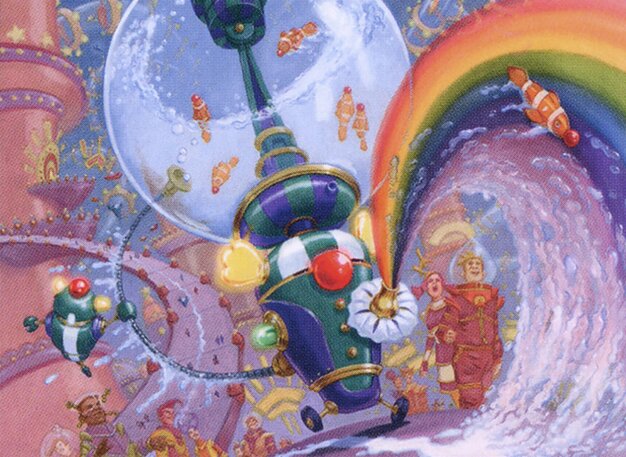
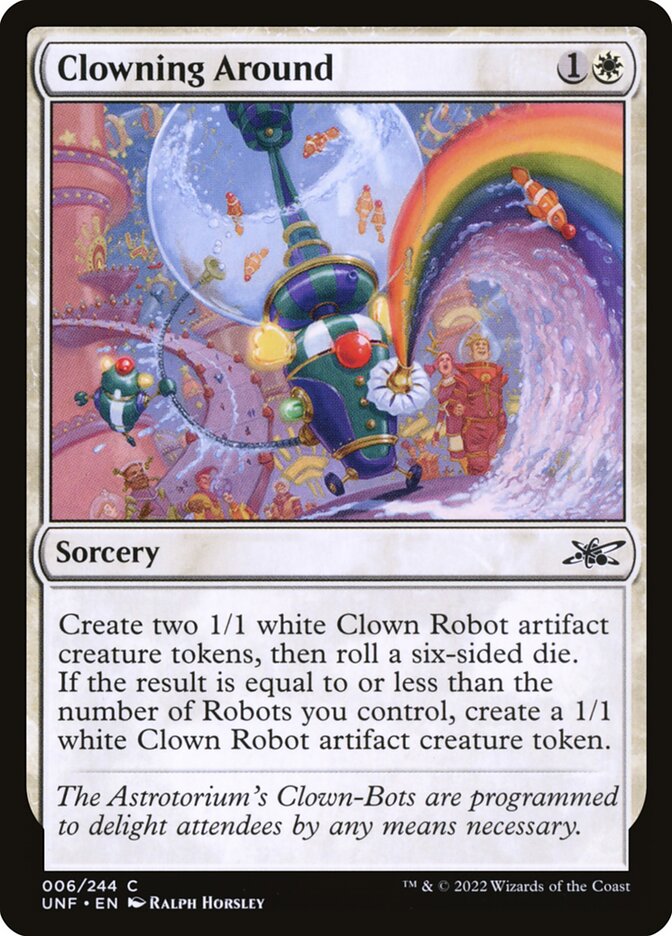
Clowning Around is one of those cards players keep asking about. Here is, in plain words, what its official text says, the rulings published by Wizards of the Coast, and the combos players actually run.
Official card text
Create two 1/1 white Clown Robot artifact creature tokens, then roll a six-sided die. If the result is equal to or less than the number of Robots you control, create a 1/1 white Clown Robot artifact creature token.
Complete guide
Step right up and witness the chaotic efficiency of Clowning Around, a white sorcery that guarantees a mechanical audience. This card blends consistent token generation with a chance for a bonus, rewarding players who lean into the Robot subtype.
What it Does
For two mana, this sorcery grants you two 1/1 white Clown Robot artifact creature tokens immediately. After these enter the battlefield, you roll a six-sided die (d6). If the result of that roll is equal to or less than the current number of Robots you control, you are rewarded with a third 1/1 Clown Robot token.
How it Resolves Step by Step
First, you place two Clown Robot tokens onto the battlefield. Second, you check the board state and roll a d6. Crucially, the check for how many Robots you control happens after the first two tokens are created and any dice-roll modifiers are applied. If you started with zero Robots, you now have at least two, making a roll of 1 or 2 a guaranteed success for the third token. If you control other Robots from previous turns, your window for success increases significantly.
Common Mistakes
A common error is forgetting that 'Robot' is a specific creature type. Only creatures with the 'Robot' subtype contribute to the count; having 'artifact creatures' that are not Robots will not help you meet the die roll requirement. Additionally, remember that any effect that modifies the die result is calculated before comparing it to your Robot count. If a result is modified to a 0 or a 7, the game checks that final number against your total.
When to Play it
Clowning Around is best utilized in decks that care about artifact count or go-wide strategies. Because the tokens are both Clowns and Robots, they trigger a variety of subtype-specific synergies. It is most effective when you already have at least one or two Robots on the board, as this pushes the 'success' threshold on your d6 roll to 4 or higher, making the third token almost certain.
Interaction examples
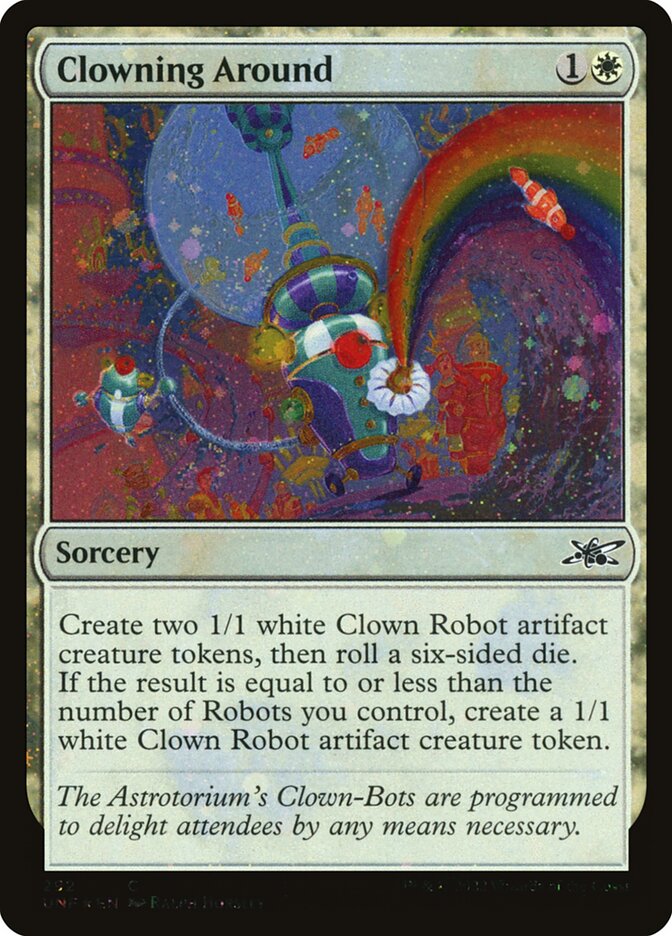 Clowning Around
If you cast Clowning Around while controlling no other creatures, you first create two Clown Robot tokens. You then roll a d6. Because you now control 2 Robots, rolling a 1 or a 2 will trigger the creation of a third Clown Robot token. Rolling a 3, 4, 5, or 6 results in no additional token.
 Sevinne's Reclamation
If Clowning Around is in your graveyard, you can use Sevinne's Reclamation to bring it back since it has a mana value of 2. If you cast Reclamation for its Flashback cost, you could even target two copies of Clowning Around (if both are in the grave), potentially generating up to six Clown Robots in a single turn. Each resolution of Clowning Around counts the Robots currently on the field, so the second resolution will have a much higher chance of success than the first.
Guide written with AI from the official text and rulings. Official English text prevails.
How it works : Clowning Around
Original English text — Wizards of the Coast / Scryfall
- #1· Wizards of the Coast
Robot is a creature type. There may be creatures that appear to be robotic in nature that don't have the Robot creature type. They don't count.
No other card is named in this ruling.
- #2· Wizards of the Coast
Each die is identified by the number of faces it has. A six-sided die is a die with six equally likely outcomes: 1, 2, 3, 4, 5, and 6. The roll must be fair. Although physical dice are recommended, digital substitutes are allowed except in cases where the physical die is required for the effect.
No other card is named in this ruling.
- #3· Wizards of the Coast
If an ability triggers "whenever you roll a die," it will trigger whenever you roll any die, including the planar die. This is a change from previous Un- rules. Some abilities use the result to determine part of the effect. If you get a non-numerical result (currently just the planar die, but the future is long), that part of the effect won't do anything.
No other card is named in this ruling.
- #4· Wizards of the Coast
Something in the game must tell you to roll a die. If you roll a die for any other reason (to simulate a coin flip, to choose pizza toppings, to create alternate timelines), that roll doesn't count.
No other card is named in this ruling.
- #5· Wizards of the Coast
Some effects may modify the result of a die roll. This may be part of the instruction to roll a die, or it may come from other cards. Anything that references the "result" of a die roll is looking for the result after these modifications.
No other card is named in this ruling.
- #6· Wizards of the Coast
If a die is rerolled, the original roll essentially never happened: it doesn't cause any abilities to trigger, and no effect that cares about die rolls will consider it.
No other card is named in this ruling.
- #7· Wizards of the Coast
Results can be numbers not ordinarily possible on a six-sided die. Spells like Scooch can change the result to 0 or 7, for example.
No other card is named in this ruling.
Related cards and tokens
Legal formats
Commentaires
- Sois le premier à commenter cette carte.
Read next
Meta decks with Clowning Around
No archived Top 8 deck with this card yet.