
Contest of Claws is one of those cards players keep asking about. Here is, in plain words, what its official text says, the rulings published by Wizards of the Coast, and the combos players actually run.
Official card text
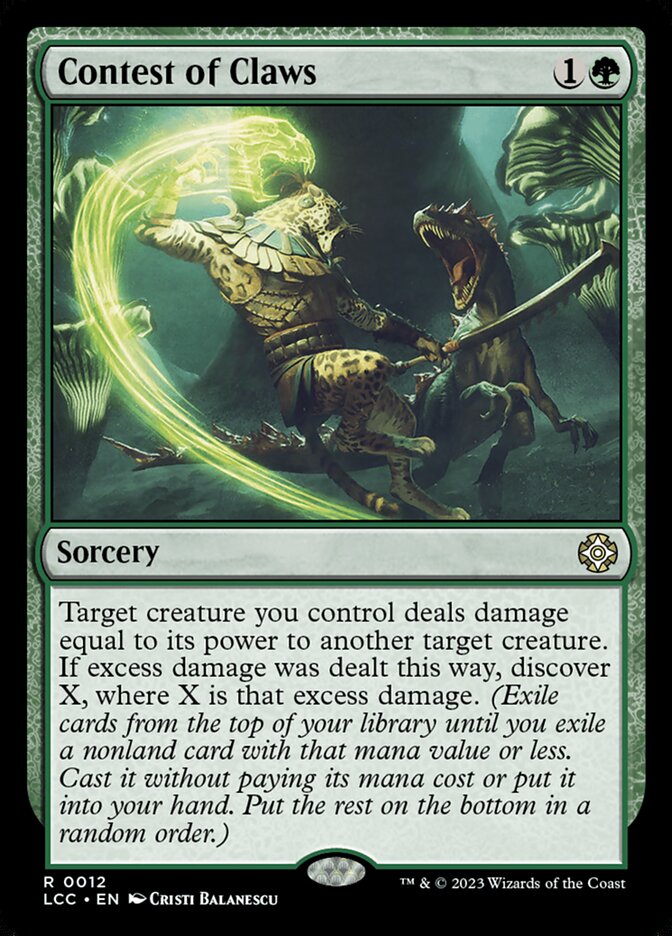
Target creature you control deals damage equal to its power to another target creature. If excess damage was dealt this way, discover X, where X is that excess damage. (Exile cards from the top of your library until you exile a nonland card with that mana value or less. Cast it without paying its mana cost or put it into your hand. Put the rest on the bottom in a random order.)
Complete guide
Contest of Claws is a versatile green sorcery that combines targeted removal with the powerful Discover mechanic. By using your strongest creatures to take down smaller foes, you can generate significant card advantage and cast extra spells for free.
Lethal Force and Excess Damage
The primary goal of Contest of Claws is to deal damage from your creature to an opponent's creature. The spell checks for 'excess damage,' which is any damage dealt beyond what is required to be lethal. Typically, this is damage greater than the target's current toughness. If the target already has damage marked on it from earlier in the turn, that is taken into account when calculating what counts as excess.
How to Resolve Contest of Claws
First, you choose two targets: a creature you control and another target creature. Upon resolution, your creature deals damage equal to its current power. If the damage exceeds the target's toughness, you immediately Discover X. You exile cards from the top of your library until you find a nonland card with a mana value of X or less. You then choose to either cast that card for free or put it into your hand, placing the remaining exiled cards on the bottom of your library in a random order.
Common Mistakes to Avoid
A frequent error is targeting a creature with a high toughness that prevents excess damage from occurring. If your creature's power is equal to or less than the target's toughness, you will not Discover at all. Additionally, remember that if your creature is removed from the battlefield before the spell resolves, the spell will fail to deal damage because the source is gone. If the opponent's creature becomes an illegal target, the entire spell fizzles and no Discover action happens.
When to Cast
This spell is best utilized when you have a high-power creature and your opponent has a small utility creature or a token. This maximizes the 'X' value for your Discover trigger. It is also a great way to trigger 'enters the battlefield' effects or to dig for specific answers in your deck during your main phase.
Interaction examples
 Farseek
Imagine you control a creature with 4 power and your opponent controls a 2/2 creature. You cast Contest of Claws targeting both. Your creature deals 4 damage to the 2/2, resulting in 2 excess damage. You then Discover 2. You exile cards until you hit Farseek (mana value 2). You may cast Farseek for free to search for a land, effectively removing a threat and ramping your mana in one move.
 Cultivate
You control a creature with 6 power and target an opponent's 3/3 creature. Contest of Claws deals 6 damage, creating 3 excess damage. You Discover 3 and reveal Cultivate. Since Cultivate has a mana value of 3, which is equal to the excess damage, you can cast it immediately without paying its mana cost to fix your mana base and draw an extra land.
Guide written with AI from the official text and rulings. Official English text prevails.
How it works : Contest of Claws
Original English text — Wizards of the Coast / Scryfall
- #1· Wizards of the Coast
Excess damage has been dealt to a creature if the damage dealt to it is greater than lethal damage. Usually, this means damage greater than its toughness, although damage already marked on the creature is taken into account.
No other card is named in this ruling.
- #2· Wizards of the Coast
A spell's mana value is determined only by its mana cost. Ignore any alternative costs, additional costs, cost increases, or cost reductions.
No other card is named in this ruling.
- #3· Wizards of the Coast
When you discover, you must exile cards. The only optional part of the ability is whether you cast the exiled card or put it into your hand.
No other card is named in this ruling.
- #4· Wizards of the Coast
You exile the cards face up. All players will be able to see them.
No other card is named in this ruling.
- #5· Wizards of the Coast
If you cast a spell "without paying its mana cost", you can't choose to cast it for any alternative costs. You can, however, pay additional costs. If the spell has any mandatory additional costs, you must pay those to cast it.
No other card is named in this ruling.
- #6· Wizards of the Coast
If the discovered card has
 in its mana cost, you must choose 0 as the value of X when casting it without paying its mana cost.
No other card is named in this ruling.
- #7· Wizards of the Coast
If you can't cast the discovered card (perhaps because there are no legal targets for the spell), you'll put it into your hand.
No other card is named in this ruling.
- #8· Wizards of the Coast
Some spells and abilities that cause you to discover may require targets. If each target chosen is an illegal target as that spell or ability tries to resolve, it won't resolve and you won't discover.
No other card is named in this ruling.
- #9· Wizards of the Coast
The mana value of a split card is determined by the combined mana cost of its two halves. If discover allows you to cast a split card, you may cast either half (as long as its mana value is less than or equal to the effect's discover value) but not both halves.
No other card is named in this ruling.
- #10· Wizards of the Coast
If you discover an adventurer card, split card, or modal double-faced card, you might be able to cast that card with either set of characteristics depending on the effect's discover value. For example, if you discover 4 and reveal Galvanic Giant (an adventurer card from Wilds of Eldraine with a mana value of 4), you could cast Galvanic Giant, but not Storm Reading (its Adventure, which has a mana value of 7). If you discover 7 and reveal Galvanic Giant, you could cast either Galvanic Giant or Storm Reading.
No other card is named in this ruling.
Legal formats
Commentaires
- Sois le premier à commenter cette carte.
Read next
Meta decks with Contest of Claws
No archived Top 8 deck with this card yet.