


Criminal Past is one of those cards players keep asking about. Here is, in plain words, what its official text says, the rulings published by Wizards of the Coast, and the combos players actually run.
Official card text
Commander creatures you own have menace and "This creature gets +X/+0, where X is the number of creature cards in your graveyard." (A creature with menace can't be blocked except by two or more creatures.)
Complete guide
Criminal Past is a legendary Background enchantment that transforms your commander into a terrifying threat fueled by the fallen. By granting both evasion and scaling power based on your graveyard's size, it serves as a cornerstone for graveyard-centric strategies. This card is particularly potent in decks that aim to win through commander damage.
What Criminal Past Does
Criminal Past is a Background enchantment that provides a static buff to any commander creatures you own. It grants two distinct benefits: the menace keyword and a triggered ability that increases the creature's power. The power boost, defined as +X/+0, scales dynamically with the number of creature cards currently residing in your graveyard. Because it applies to 'commander creatures you own,' it will affect both of your commanders if you are playing with a partner-style pairing, provided they are currently on the battlefield as creatures.
Step-by-Step Resolution
When Criminal Past is on the battlefield, its effect is continuous. First, it identifies all commander creatures you own on the battlefield. Second, it applies the menace keyword, meaning those creatures can only be blocked by two or more creatures. Third, it calculates X by counting the creature cards in your graveyard. If a creature card leaves or enters your graveyard, X is updated immediately. Note that if an opponent gains control of your commander creature, the value of X is determined by the number of creature cards in the graveyard of the player who currently controls the creature, not yours.
Common Mistakes
A common point of confusion involves the 'commander' status. A Background enchantment itself is a commander, but it typically does not receive the +X/+0 bonus because it is not a creature. The bonus only applies to 'commander creatures.' Additionally, remember that menace only works during the declare blockers step; if your commander is already blocked by a single creature and you somehow flash in Criminal Past, the block remains legal. Finally, only 'creature cards' count—tokens dying do not increase X as they are not cards and cease to exist shortly after hitting the graveyard.
When to Play It
This card shines in black-aligned decks that utilize self-mill or sacrifice outlets. It is best played mid-to-late game once your graveyard is sufficiently stocked to provide a significant power boost. Since it provides menace, it is an excellent tool for pushing through lethal commander damage against opponents who are trying to hide behind a single large blocker.
Interaction examples
 Black Market Connections
You use Black Market Connections to choose the 'Hire a Mercenary' mode, creating a 3/2 Shapeshifter token. Later, that token is destroyed. While the token goes to the graveyard briefly, it is not a card and does not count toward the X value for Criminal Past. However, if you used 'Buy Information' to draw creature cards and then discarded them to your hand size limit, those cards would immediately increase your commander's power.
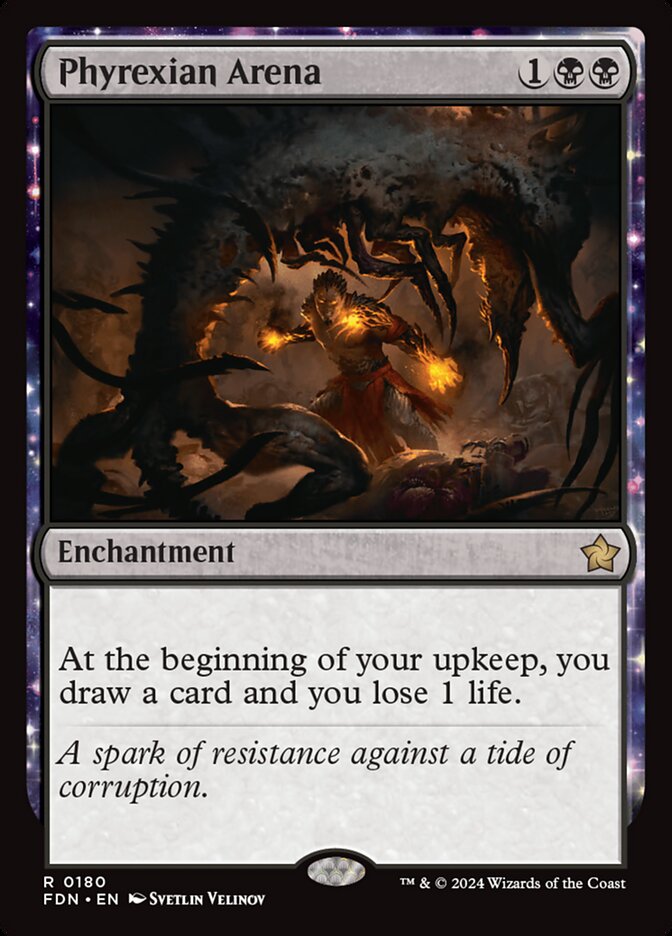 Phyrexian Arena
With Phyrexian Arena providing extra card draw each turn, you are more likely to find creature cards to play or discard. If you have Criminal Past on the battlefield and your commander out, drawing into more creatures allows you to either cast them to pressure the board or use them as fuel for Criminal Past's power boost if they are countered or destroyed and sent to the graveyard.
Guide written with AI from the official text and rulings. Official English text prevails.
How it works : Criminal Past
Original English text — Wizards of the Coast / Scryfall
- #1· Wizards of the Coast
If an opponent controls a commander creature you own while you control Criminal Past, X will be the number of creatures cards in that player's graveyard, not yours.
No other card is named in this ruling.
- #2· Wizards of the Coast
Choose a Background is a variant of the partner ability. You may have two commanders if one of them is a legendary creature with the choose a background ability and the other is a legendary Background enchantment. Backgrounds and cards with choose a Background do not interact with cards which have any other partner ability.
No other card is named in this ruling.
- #3· Wizards of the Coast
If your Commander deck has two commanders, you can include only cards whose own color identities are also found in your commanders’ combined color identities.
No other card is named in this ruling.
- #4· Wizards of the Coast
Both commanders start in the command zone, and the remaining 98 cards (or 58 cards in a Commander Draft game) of your deck are shuffled to become your library.
No other card is named in this ruling.
- #5· Wizards of the Coast
If your commander loses the choose a Background ability or stops being a Background during the game, as appropriate, it is still your commander.
No other card is named in this ruling.
- #6· Wizards of the Coast
Once the game begins, your two commanders are tracked separately. If you cast one, you won’t have to pay an additional
 the first time you cast the other. A player loses the game after having been dealt 21 combat damage from any one of them, not from both of them combined (although your Background won’t usually be a creature anyway).
No other card is named in this ruling.
- #7· Wizards of the Coast
If something refers to your commander while you have two commanders, it refers to one of them of your choice. If you are instructed to perform an action on your commander (e.g. put it from the command zone into your hand due to Command Beacon), you choose one of your commanders at the time the effect happens.
No other card is named in this ruling.
- #8· Wizards of the Coast
An effect that checks whether you control your commander is satisfied if you control one or both of your two commanders.
No other card is named in this ruling.
- #9· Wizards of the Coast
You can choose two commanders that are the same color or colors.
No other card is named in this ruling.
- #10· Wizards of the Coast
If a card refers to a commander creature you own, a Background won't usually be counted or included for that effect. If another spell or ability causes your Background to become a creature, however, it will be included. Any effect that refers to your commander or a commander you own or control without specifying creature will apply to a Background that is your commander, as appropriate.
No other card is named in this ruling.
- #11· Wizards of the Coast
If you control a Background that grants an ability to commander creatures you own, and you own more than one commander creature, each of them will have that ability.
No other card is named in this ruling.
Legal formats
Commentaires
- Sois le premier à commenter cette carte.