

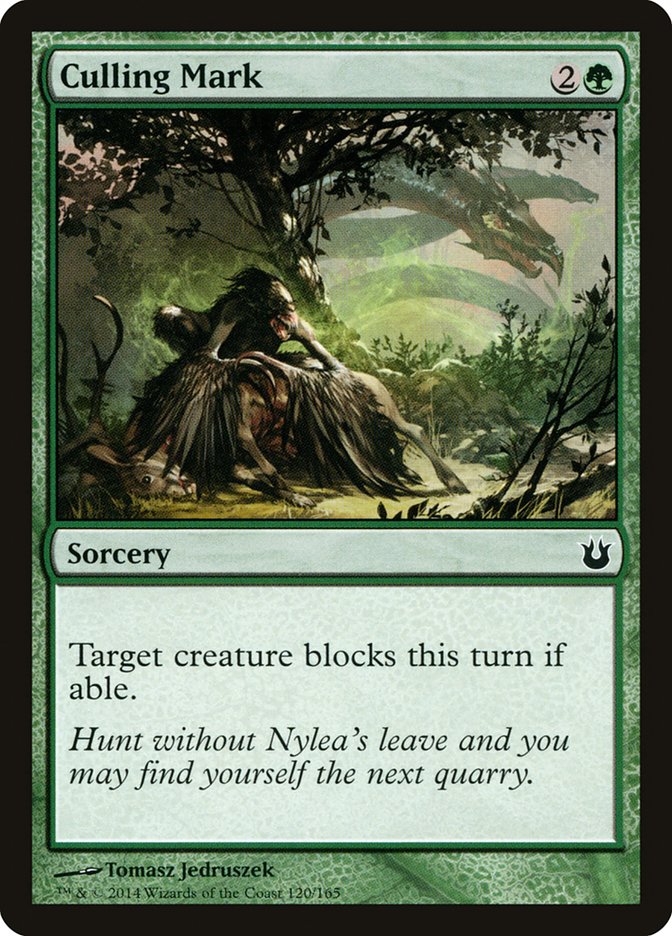
Culling Mark is one of those cards players keep asking about. Here is, in plain words, what its official text says, the rulings published by Wizards of the Coast, and the combos players actually run.
Official card text
Target creature blocks this turn if able.
Complete guide
Culling Mark is a strategic green sorcery that forces your opponent's hand during the combat phase. By marking a specific target, you compel a creature to step into the fray whether its controller wants to or not.
Making the Mark
When you cast Culling Mark, you choose one target creature. For the remainder of the turn, that creature is under a requirement to block during the declare blockers step. It is important to note that this is a sorcery, so you must cast it during your main phase before you move to combat.
The Rules of Engagement
The requirement to block only applies if the creature is able to do so. If the creature is tapped, affected by a 'can't block' effect, or if no creatures are attacking its controller (or their planeswalkers), the requirement fails. Furthermore, if blocking requires paying a cost, such as mana or life, the controller is not forced to pay; if they choose not to pay, the creature simply doesn't block.
Choosing the Target
While Culling Mark forces a creature to block, it does not specify which attacking creature it must block. The defender still chooses which of your attacking creatures the marked creature will stand against. This means if you attack with multiple creatures, your opponent can choose the most favorable trade for them.
Strategic Timing
Since this spell costs three mana and is a sorcery, you need to ensure you have the resources to follow up. Playing this when you have a high-power creature or a creature with Deathtouch ensures that the forced block results in the destruction of the marked target.
Interaction examples
 Farseek
On turn two, you cast Farseek to pull a Forest onto the battlefield. On turn three, you now have the three mana required to cast Culling Mark on your opponent's utility creature, ensuring that when you attack with your 3/3, their small creature is forced to block and be destroyed.
 Cultivate
You cast Cultivate to ensure you have enough mana for both your creatures and your spells. With the extra lands in play, you cast Culling Mark on a troublesome blocker. During your combat phase, even if your opponent wants to keep that creature safe for an activated ability later, it must block one of your attackers if it is untapped.
Guide written with AI from the official text and rulings. Official English text prevails.
How it works : Culling Mark
Original English text — Wizards of the Coast / Scryfall
- #1· Wizards of the Coast
The creature blocks only if it’s able to do so as the declare blockers step begins. If, at that time, the creature is tapped, it’s affected by a spell or ability that says it can’t block, or no creatures are attacking its controller or a planeswalker controlled by that player, then it doesn’t block. If there’s a cost associated with having the creature block, the player isn’t forced to pay that cost. If that cost isn’t paid, the creature won’t block.
No other card is named in this ruling.
- #2· Wizards of the Coast
The controller of the creature chooses which attacking creature that creature blocks.
No other card is named in this ruling.
Legal formats
Commentaires
- Sois le premier à commenter cette carte.
Read next
Meta decks with Culling Mark
No archived Top 8 deck with this card yet.