
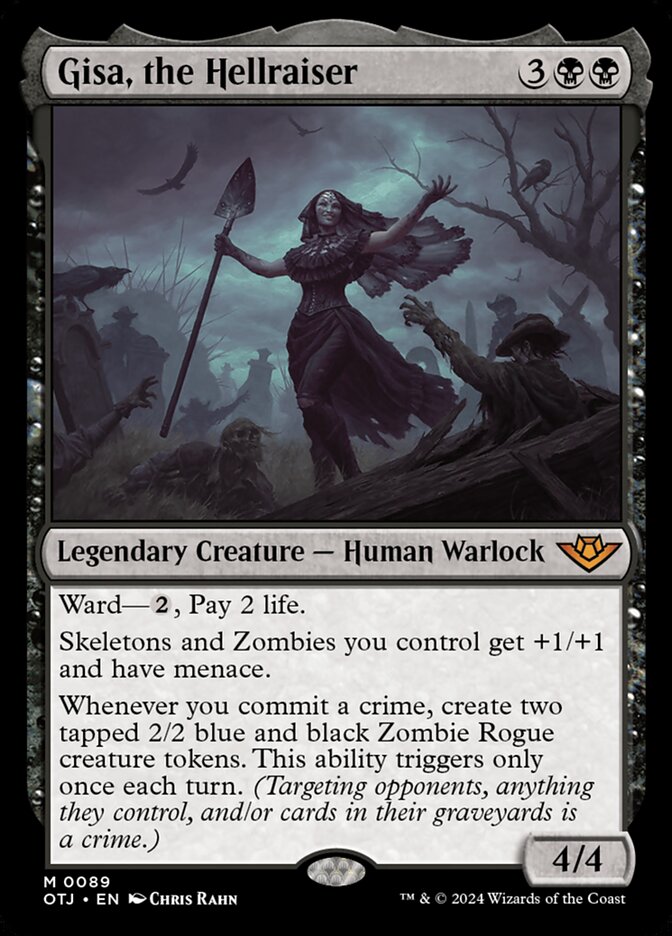
Gisa, the Hellraiser is one of those cards players keep asking about. Here is, in plain words, what its official text says, the rulings published by Wizards of the Coast, and the combos players actually run.
Official card text
Ward—, Pay 2 life. Skeletons and Zombies you control get +1/+1 and have menace. Whenever you commit a crime, create two tapped 2/2 blue and black Zombie Rogue creature tokens. This ability triggers only once each turn. (Targeting opponents, anything they control, and/or cards in their graveyards is a crime.)
Complete guide
Gisa, the Hellraiser is a powerhouse for undead strategies, rewarding you for your most nefarious actions. Not only does she bolster your army, but she also ensures your ranks grow every time you target your opponent or their resources. By combining protection, tribal synergy, and token generation, Gisa stands as a central threat in any black-aligned deck.
Master of the Undead
Gisa provides a static buff of +1/+1 and menace to all Skeletons and Zombies you control. This includes herself if she gains those types, and notably, the tokens she creates. Her Ward ability makes her difficult to remove, requiring an opponent to pay two mana and two life to even target her.
Committing Crimes Step-by-Step
A crime is committed the moment you cast a spell, activate an ability, or put a triggered ability on the stack that targets an opponent, their permanents, their spells, or cards in their graveyard. Gisa's triggered ability goes on the stack as soon as the crime is committed, meaning her tokens are created before the spell or ability that caused the crime even resolves. Note that targeting multiple things with one spell still only counts as one crime.
Timing and Limits
Gisa's token generation triggers only once each turn. However, this isn't limited to your own turn; you can commit a crime on an opponent's turn to create more Zombies. If you change the targets of a spell after it is cast, it does not count as a new crime or change the fact that a crime was already committed.
When to Play Gisa
Gisa is best played when you have a way to immediately commit a crime, ensuring you get value before your opponents can react. Because her tokens enter the battlefield tapped, she is often better suited for an aggressive mid-game push rather than as a defensive measure.
Interaction examples
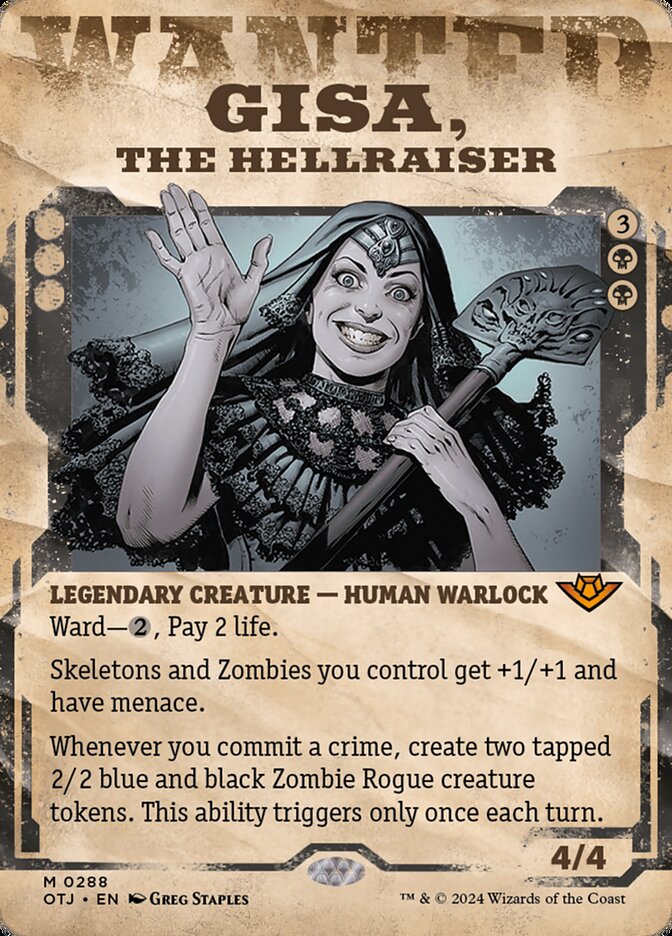 Gisa, the Hellraiser
If Gisa, the Hellraiser is your only creature, you can cast a spell that targets an opponent's creature. This triggers Gisa's ability, creating two 2/2 Zombie Rogues. Because of Gisa's static ability, these tokens immediately become 3/3 creatures with menace as soon as they enter the battlefield.
 Roaming Throne
If Roaming Throne enters the battlefield naming 'Human' or 'Warlock', Gisa's ability will trigger an additional time. When you commit a crime, Gisa will now create four 2/2 Zombie Rogue tokens instead of two. Note that the 'once each turn' restriction applies to the trigger event; Roaming Throne allows that specific event to cause the ability to trigger twice simultaneously.
 Solemn Simulacrum
If you cast Solemn Simulacrum, its entry trigger targets a land in your own library. This is not a crime because it does not target an opponent or their resources. Therefore, Gisa, the Hellraiser will not trigger, and no tokens will be created.
Guide written with AI from the official text and rulings. Official English text prevails.
How it works : Gisa, the Hellraiser
Original English text — Wizards of the Coast / Scryfall
- #1· Wizards of the Coast
A player commits a crime as they cast a spell, activate an ability, or put a triggered ability on the stack that targets at least one opponent, at least one permanent, spell, or ability an opponent controls, and/or at least one card in an opponent’s graveyard.
No other card is named in this ruling.
- #2· Wizards of the Coast
The spell or ability that constituted a crime doesn’t have to have resolved yet or at all. As soon as you’re finished casting the spell, activating the ability, or putting the triggered ability on the stack, you’ve committed a crime.
No other card is named in this ruling.
- #3· Wizards of the Coast
For example, an ability that triggers when you cast a spell that targets an opponent will trigger at the same time as an ability that triggers whenever you commit a crime. Those abilities can be put on the stack in either order (if you control them both), and they’ll both resolve before the spell that caused them to trigger.
No other card is named in this ruling.
- #4· Wizards of the Coast
A player can commit only one crime per spell or ability they control. Targeting multiple opponents, permanents, spells, abilities, and/or cards with the same spell or ability doesn’t constitute committing multiple crimes.
No other card is named in this ruling.
- #5· Wizards of the Coast
Changing the target or targets of a spell or ability won’t affect whether or not the controller of that spell or ability has committed a crime. Only the initial targets chosen for that spell or ability are used to determine whether or not its controller committed a crime.
No other card is named in this ruling.
Related cards and tokens
Legal formats
Commentaires
- Sois le premier à commenter cette carte.
Read next
Meta decks with Gisa, the Hellraiser
