

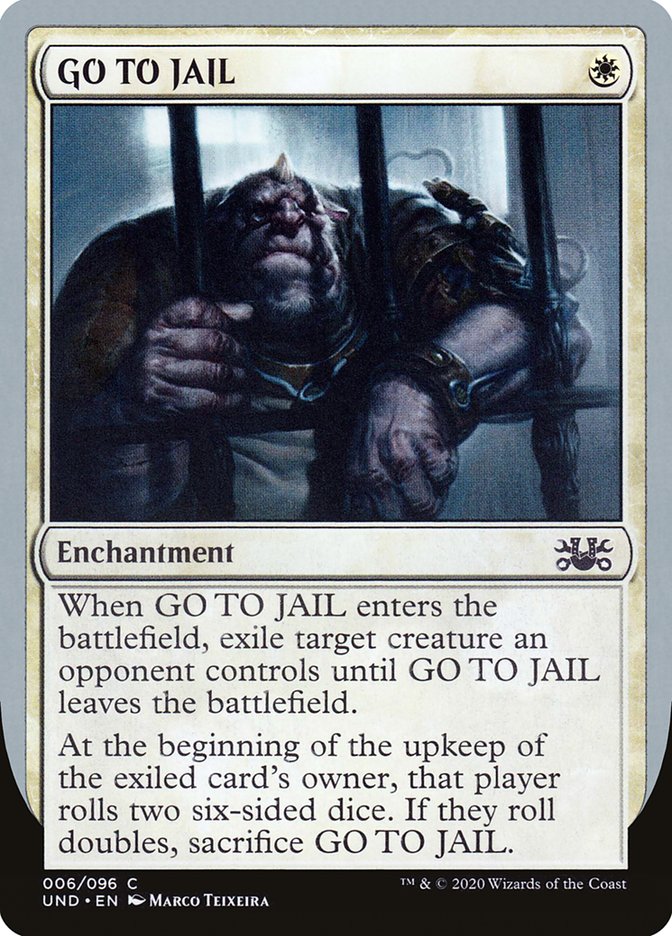
GO TO JAIL is one of those cards players keep asking about. Here is, in plain words, what its official text says, the rulings published by Wizards of the Coast, and the combos players actually run.
Official card text
When this enchantment enters, exile target creature an opponent controls until this enchantment leaves the battlefield. At the beginning of the upkeep of the exiled card's owner, that player rolls two six-sided dice. If they roll doubles, sacrifice this enchantment.
Complete guide
GO TO JAIL is a flavor-packed removal spell from the Unstable set that puts a creature behind bars until the owner can roll their way out. This white enchantment offers an efficient way to temporarily neutralize a threat, provided the dice stay in your favor. It turns the game into a suspenseful prison break where every upkeep brings a chance for freedom.
How the Sentence Works
When GO TO JAIL enters the battlefield, its triggered ability targets a creature an opponent controls and exiles it. This is a temporary exile effect; the creature remains gone only as long as GO TO JAIL stays on the battlefield. Unlike older cards like Oblivion Ring, this is a single ability that creates a one-shot effect that exiles the object, and a second effect that returns it when the enchantment leaves.
The Upkeep Roll
The 'trial' begins during the upkeep of the player who owns the exiled creature. That player rolls two six-sided dice. If the results are the same (doubles), the enchantment is sacrificed, and the creature immediately returns to the battlefield. Remember, if the player has any ways to modify die rolls, those modifications happen before determining if doubles were achieved.
Common Mistakes
A common error is forgetting who rolls the dice. It is always the owner of the exiled card, not necessarily the person who controlled it when it was exiled. Additionally, because the sacrifice happens during the upkeep, the creature will return to the battlefield before the owner moves to their draw step, meaning it won't have summoning sickness by the time they reach their next turn if it was their turn when it returned.
When to Play It
GO TO JAIL is best utilized in the early game to stall aggressive strategies. Since there is a roughly 16.6% chance (1 in 6) to roll doubles on two six-sided dice, it is statistically likely to hold a creature for several turns, giving you time to find a more permanent solution or win the game before the prisoner escapes.
Interaction examples
 Urza's Saga
If your opponent uses Urza's Saga to create a powerful Construct token, you can cast GO TO JAIL targeting that token. The token is exiled. Note that while the token owner will still roll dice during their upkeep, if the enchantment is sacrificed, the token will not return to the battlefield because tokens cease to exist once they leave the battlefield.
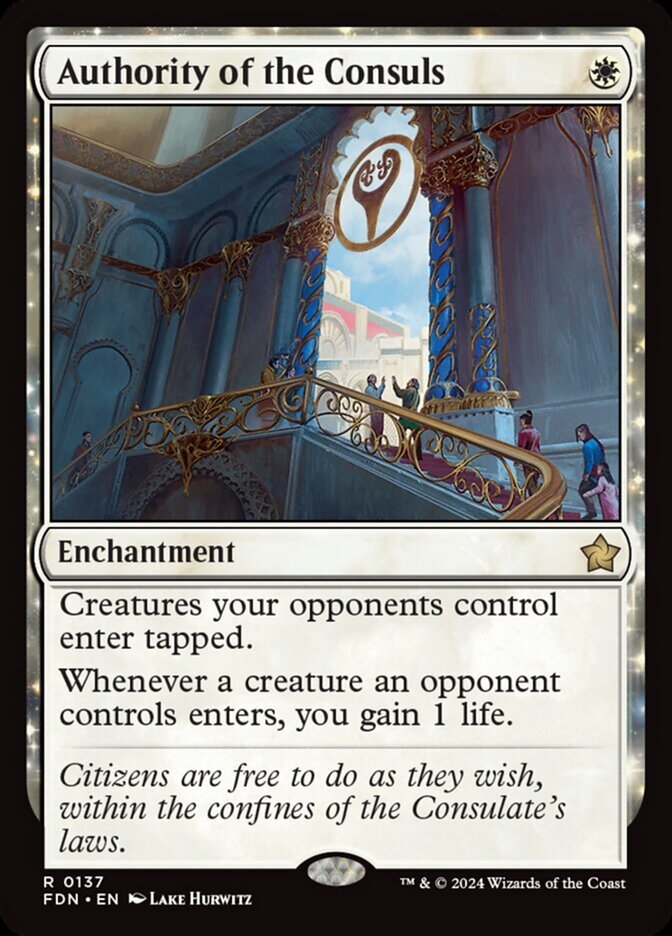 Authority of the Consuls
Suppose you have Authority of the Consuls on the battlefield and your opponent rolls doubles to break out of GO TO JAIL. The creature returns to the battlefield immediately. Because it is an opponent's creature entering the battlefield, Authority of the Consuls will trigger, causing the creature to enter tapped and gaining you 1 life.
Guide written with AI from the official text and rulings. Official English text prevails.
How it works : GO TO JAIL
Original English text — Wizards of the Coast / Scryfall
- #1· Wizards of the Coast
“Doubles” means the results of each of the two rolls is identical, after applying any effects that may alter or affect the roll. For example, if you roll a 5 and a 6, and then use Snickering Squirrel to change the 5 into a 6, you’ve rolled doubles.
No other card is named in this ruling.
Commentaires
- Sois le premier à commenter cette carte.
Read next
Meta decks with GO TO JAIL
No archived Top 8 deck with this card yet.