

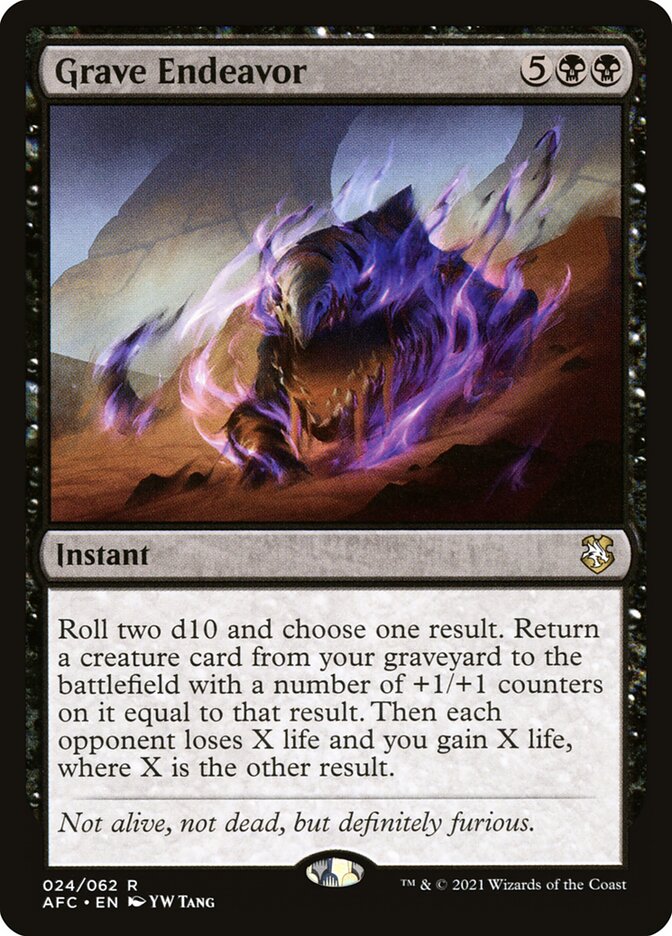
Grave Endeavor is one of those cards players keep asking about. Here is, in plain words, what its official text says, the rulings published by Wizards of the Coast, and the combos players actually run.
Official card text
Roll two d10 and choose one result. Return a creature card from your graveyard to the battlefield with a number of +1/+1 counters on it equal to that result. Then each opponent loses X life and you gain X life, where X is the other result.
Complete guide
Grave Endeavor is a high-stakes instant that combines reanimation with a powerful life swing. By rolling two ten-sided dice, you gain the flexibility to decide whether you need a massive creature or a lethal drain on your opponents' life totals. This card is a versatile finisher for black decks that enjoy leaving their fate to the roll of the dice.
Choosing Your Fate
When Grave Endeavor resolves, you roll two d10s. You must then assign one result to the number of +1/+1 counters the creature enters with, and the other result to the amount of life lost by opponents and gained by you. Since this choice happens during resolution, your opponents cannot wait to see your rolls before deciding whether to counter the spell.
Step-by-Step Resolution
First, you roll two d10s. Second, you choose which die represents the counters and which represents the life drain. Third, you return a creature card from your graveyard to the battlefield. It enters with the chosen number of +1/+1 counters already on it. Finally, each opponent loses life equal to the other result, and you gain life equal to that same amount.
Common Mistakes
A common error is forgetting that Grave Endeavor does not target the creature card in your graveyard. You choose the creature only as the spell resolves. This means if an opponent removes a specific creature from your graveyard in response to the spell, you can simply choose a different one when the spell actually resolves. Also, remember that the life gain is not 'total life lost'; if you have three opponents and the result is 5, they each lose 5 life and you gain exactly 5 life, not 15.
When to Play It
Because it is an instant, Grave Endeavor is best used at the end of an opponent's turn or as a combat trick. Bringing back a creature with up to 10 additional +1/+1 counters can suddenly turn a disadvantageous board state into a winning one, while the life swing can stabilize your total against aggressive strategies.
Interaction examples
You cast Grave Endeavor and roll a 9 and a 2. You choose the 9 for the +1/+1 counters. You return a creature from your graveyard to the battlefield; it enters with nine +1/+1 counters. Then, each opponent loses 2 life and you gain 2 life.
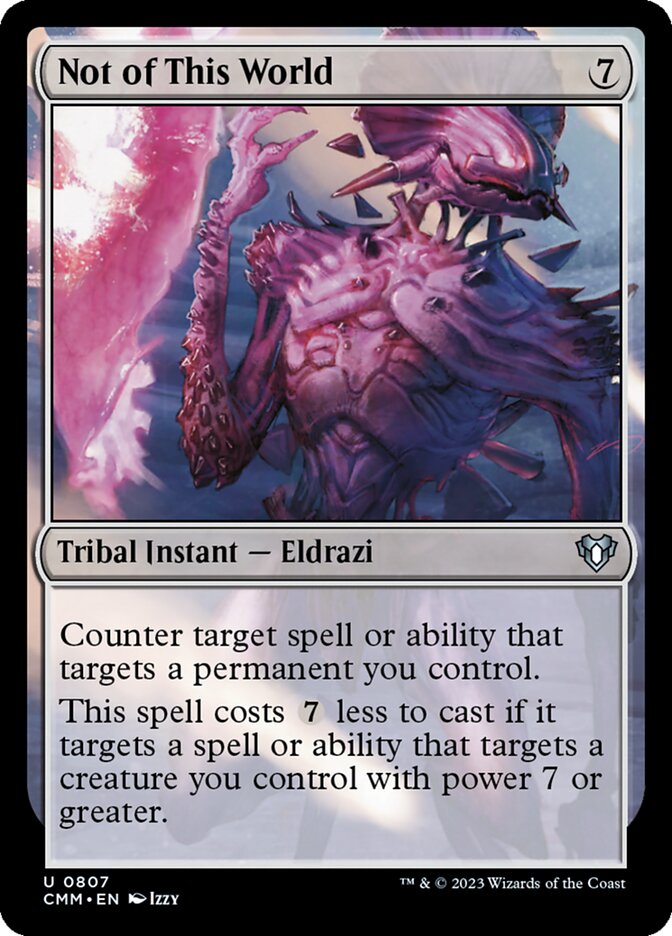 Not of This World
You use Grave Endeavor to return a creature, choosing a roll of 7 for the counters. The creature now has power 7 or greater. If an opponent tries to target that creature later with a removal spell, you can cast Not of This World for zero mana to counter it.
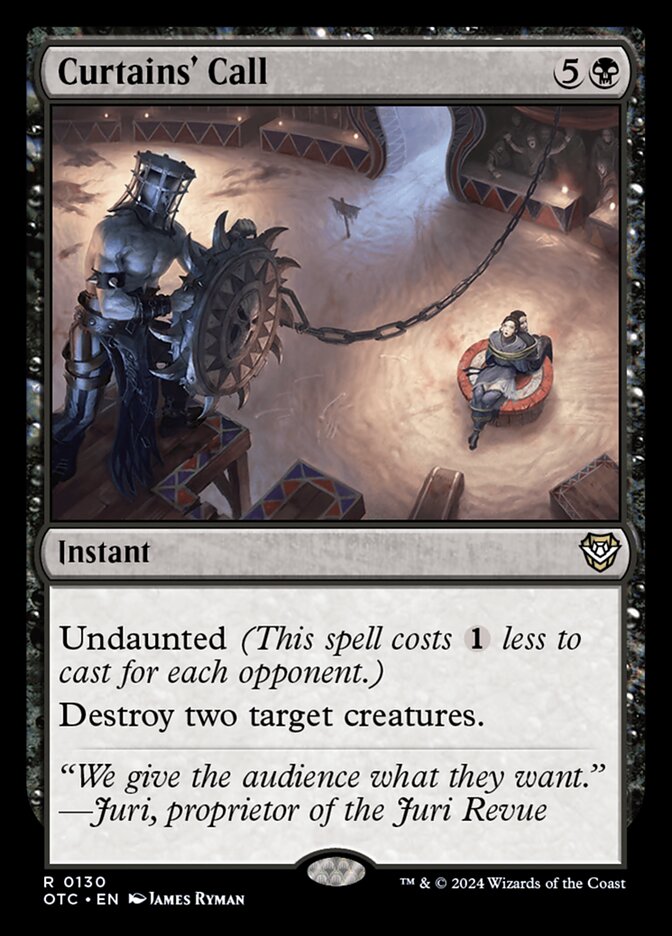 Curtains' Call
In a multiplayer game, you cast Curtains' Call to destroy two threats. After they are in the graveyard, you cast Grave Endeavor. Even if your opponents try to exile your graveyard in response to the spell, Grave Endeavor will still allow you to pick any creature remaining in the graveyard upon resolution to receive the dice-roll bonuses.
Guide written with AI from the official text and rulings. Official English text prevails.
How it works : Grave Endeavor
Original English text — Wizards of the Coast / Scryfall
- #1· Wizards of the Coast
Dice are identified by the number of faces each one has. For example, a d20 is a twenty-sided die.
No other card is named in this ruling.
- #2· Wizards of the Coast
Dice used must have equally likely outcomes and the roll must be fair. Although physical dice are recommended, digital substitutes are allowed, provided they have the same number of equally likely outcomes as specified in the original roll instruction.
No other card is named in this ruling.
- #3· Wizards of the Coast
An ability that tells you to roll a die will also specify what to do with the result of that roll. Most often, this is in the form of a “results table” in the card text.
No other card is named in this ruling.
- #4· Wizards of the Coast
The instruction to roll a die and the effect that occurs because of the result are all part of the same ability. Players do not get the chance to respond to the ability after knowing the result of the roll.
No other card is named in this ruling.
- #5· Wizards of the Coast
An effect that says “choose a target, then roll a d20” or similar still uses the normal process of putting an ability on the stack and resolving it. Choosing targets is part of putting the ability on the stack and rolling the d20 happens later, as the ability resolves.
No other card is named in this ruling.
- #6· Wizards of the Coast
Some effects may modify the result of a die roll. This may be part of the instruction to roll a die or it may come from other cards. Anything that references the “result” of a die roll is looking for the result after these modifications. Anything that is looking for the “natural result” is looking for the number shown on the face of the die before these modifications.
No other card is named in this ruling.
- #7· Wizards of the Coast
Some abilities, like that of Pixie Guide and Barbarian Class, replace rolling a die with rolling extra dice and ignoring the lowest roll. The ignored rolls are not considered for the effect that instructed you to roll a die, and do not cause abilities to trigger. For all intents and purposes, once you determine which dice count, any extra dice were never rolled.
No other card is named in this ruling.
- #8· Wizards of the Coast
Some effects instruct you to roll again. This uses the same number and type of dice as the original roll, and that roll will use the same set of possible outcomes.
No other card is named in this ruling.
- #9· Wizards of the Coast
While playing Planechase, rolling the planar die will cause any ability that triggers whenever a player rolls one or more dice to trigger. However, any effect that refers to a numerical result will ignore the rolling of the planar die.
No other card is named in this ruling.
- #10· Wizards of the Coast
Tournament events have more specific rules regarding dice and die-rolling. For more information, please see the most recent version of the Magic Tournament Rules at https://wpn.wizards.com/en/document/magic-gathering-tournament-rules.
No other card is named in this ruling.
Legal formats
Commentaires
- Sois le premier à commenter cette carte.
Read next
Meta decks with Grave Endeavor
No archived Top 8 deck with this card yet.