

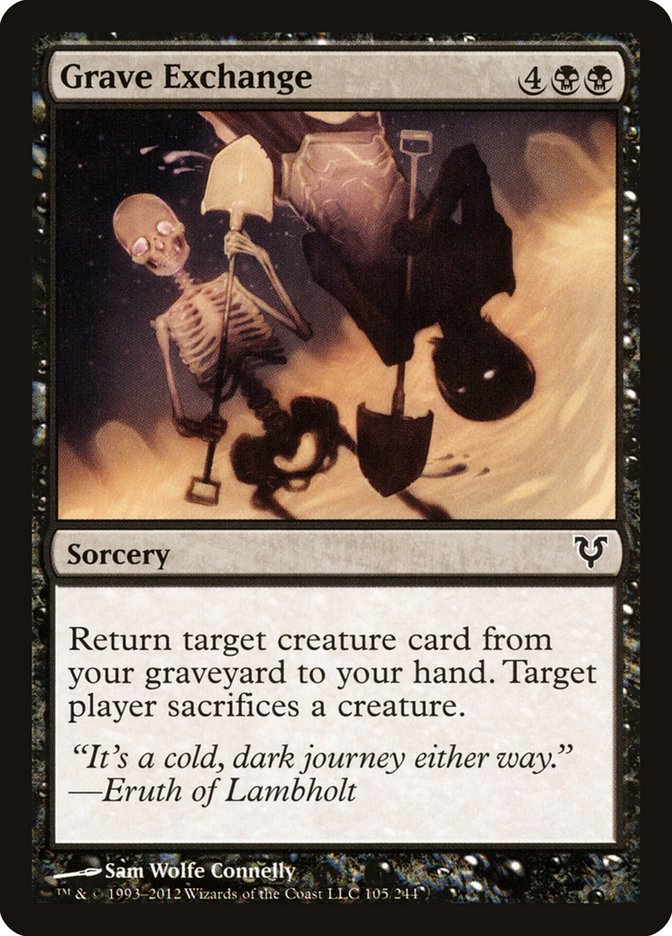
Grave Exchange is one of those cards players keep asking about. Here is, in plain words, what its official text says, the rulings published by Wizards of the Coast, and the combos players actually run.
Official card text
Return target creature card from your graveyard to your hand. Target player sacrifices a creature of their choice.
Complete guide
Grave Exchange is a powerful black sorcery that provides both recursion and removal in a single package. By returning a fallen ally to your hand and forcing an opponent to give up one of their own, you can swing the momentum of a match back in your favor. This card is a classic example of a two-for-one exchange that punishes opponents who rely on a single large threat.
Dual Targeting Requirements
To cast Grave Exchange, you must be able to choose two legal targets: a creature card in your graveyard and a player. You cannot cast this spell if your graveyard is empty of creatures, even if you just want to force an opponent to sacrifice something. However, you can target a player who currently controls no creatures; in that case, the sacrifice part of the spell simply does nothing.
Resolving the Spell
Grave Exchange resolves in the order written on the card. First, you return the targeted creature card from your graveyard to your hand. Second, the targeted player chooses one creature they control and sacrifices it. If one of the targets becomes illegal before resolution—for example, if the creature card is exiled from your graveyard in response—the spell will still try to resolve for the remaining legal target.
Choosing the Sacrifice
It is important to note that the targeted player, not you, chooses which creature they sacrifice. This means Grave Exchange is less effective against boards filled with small tokens. Unlike targeted destruction, the sacrifice effect does not target the creature itself, meaning it can bypass keywords like Hexproof or Indestructible.
Strategic Timing
Because this spell costs six mana, it is often best used during the mid-to-late game when you have high-impact creatures to recover. It serves as a great follow-up to a board wipe, allowing you to get your best creature back while ensuring your opponent cannot easily rebuild their presence.
Interaction examples
 Blasphemous Edict
After casting Blasphemous Edict to clear a crowded battlefield, you can use Grave Exchange to return your strongest creature from your graveyard to your hand. Since your opponent also lost their creatures to the Edict, the sacrifice effect of Grave Exchange will ensure they remain behind on tempo if they managed to play a new creature immediately after the wipe.
 Living Death
If you cast Living Death and later find your best creature back in the graveyard due to combat, Grave Exchange allows you to pick that creature back up. Meanwhile, the sacrifice effect helps whittle down the board that Living Death helped your opponent build, forcing them to discard one of the creatures they just reanimated.
Guide written with AI from the official text and rulings. Official English text prevails.
How it works : Grave Exchange
Original English text — Wizards of the Coast / Scryfall
- #1· Wizards of the Coast
Grave Exchange targets both a creature card in your graveyard and a player. You can’t cast it unless there is a legal target to choose for both. You can target a player who controls no creatures.
No other card is named in this ruling.
- #2· Wizards of the Coast
If both targets are illegal when Grave Exchange tries to resolve, it won’t resolve and none of its effects will happen. If only one target is legal, the effect relevant to that target will happen and the other will not.
No other card is named in this ruling.
Legal formats
Commentaires
- Sois le premier à commenter cette carte.
Read next
Meta decks with Grave Exchange
No archived Top 8 deck with this card yet.