

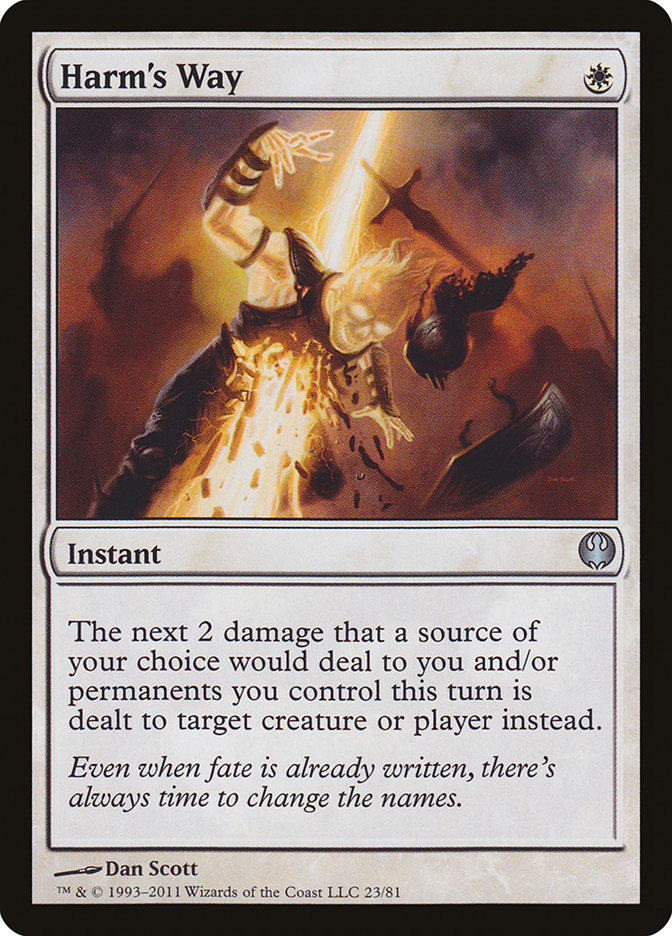
Harm's Way is one of those cards players keep asking about. Here is, in plain words, what its official text says, the rulings published by Wizards of the Coast, and the combos players actually run.
Official card text
The next 2 damage that a source of your choice would deal to you and/or permanents you control this turn is dealt to any target instead.
Complete guide
Harm's Way is a versatile defensive instant that turns an opponent's aggression into your own advantage. By redirecting damage, you can protect your life total or creatures while simultaneously removing a threat or pressuring your opponent. It is a unique 'shield' effect that requires careful timing and source selection.
What it Does
Harm's Way creates a replacement effect that lasts for the remainder of the turn. When you cast it, you choose a target to receive the redirected damage. As the spell resolves, you choose a specific source—such as a creature or a spell—that you expect will deal damage to you or your permanents. The next 2 damage that source would deal to you or your team is instead dealt to your chosen target.
Resolving the Redirection
The resolution process is split into two parts. First, upon casting, you choose a legal target for the damage to be sent to. Second, as the spell resolves, you choose the source of the potential damage. Unlike many protection spells, you do not choose the original recipient; the 'shield' simply waits for the chosen source to attempt to damage you or any permanent you control. If the source deals 1 damage twice, Harm's Way covers both instances until the 2-damage limit is reached.
Common Mistakes
A frequent error is assuming Harm's Way can redirect damage that has already occurred; it only applies to future damage within the same turn. Additionally, if the source deals damage to multiple creatures you control simultaneously (like a board wipe), you only redirect a total of 2 damage across all those recipients, not 2 damage per creature. Finally, if the target you chose to receive the damage is no longer a legal target when the damage would be dealt, the redirection fails and the original recipients take the damage.
When to Play It
Harm's Way is most effective during combat or in response to burn spells. It is particularly potent when an opponent attempts to trade creatures; you can prevent the damage to your creature and use that same damage to destroy the opponent's creature instead. It can also be used to finish off an opponent by redirecting their own spell's damage back at them.
Interaction examples
 Path to Exile
If your opponent targets your creature with a damage-based spell, you can cast Harm's Way. While Path to Exile does not deal damage, if they were instead using a spell like Lightning Bolt, you would choose that spell as the source. Note that Path to Exile interacts differently: if your creature is exiled by Path to Exile before the chosen source deals damage, Harm's Way will still exist, but it will only apply if that source tries to damage you or other permanents you still control.
 Swords to Plowshares
Imagine a 2/2 creature is attacking you. You cast Harm's Way targeting the attacking creature itself and choose that creature as the source. When damage is dealt, the 2 damage it would deal to you is instead dealt to the creature itself, destroying it. If you then used Swords to Plowshares on a different creature, you would still gain life based on that creature's power, as Harm's Way only managed the damage flow, not the exile effect.
Guide written with AI from the official text and rulings. Official English text prevails.
How it works : Harm's Way
Original English text — Wizards of the Coast / Scryfall
- #1· Wizards of the Coast
As you cast Harm’s Way, you target that the redirected damage will be dealt to. As Harm’s Way resolves, you choose a source of damage. You never choose the original recipient of the damage; Harm’s Way will apply to whatever the chosen source tries to deal damage to, as long as it’s you or a permanent you control.
No other card is named in this ruling.
- #2· Wizards of the Coast
If the chosen source would deal just 1 damage to you or a permanent you control, Harm’s Way’s effect will redirect that damage and still have a “shield” left for another 1 damage from that source later in the turn.
No other card is named in this ruling.
- #3· Wizards of the Coast
If the chosen source would simultaneously deal damage to multiple permanents you control (like Pyroclasm could) or to you and at least one permanent you control (like Earthquake could), Harm’s Way will redirect just 2 of that damage. It won’t redirect the next 2 damage that would be dealt to each recipient. You choose which 2 damage is redirected. If you like, you can choose to redirect 1 damage that would be dealt by the chosen source to each of two different recipients.
No other card is named in this ruling.
- #4· Wizards of the Coast
After Harm’s Way resolves, it no longer checks to see if the target is a legal target. However, if that permanent or player can’t be dealt damage at the time the chosen source would deal damage (perhaps because the creature is no longer on the battlefield or is no longer a creature, or because the player is no longer in the game), the damage can’t be redirected. It’s dealt to the original recipient.
No other card is named in this ruling.
- #5· Wizards of the Coast
Harm’s Way has no effect on damage that’s already been dealt.
No other card is named in this ruling.
Legal formats
Commentaires
- Sois le premier à commenter cette carte.
Read next
Meta decks with Harm's Way
No archived Top 8 deck with this card yet.