

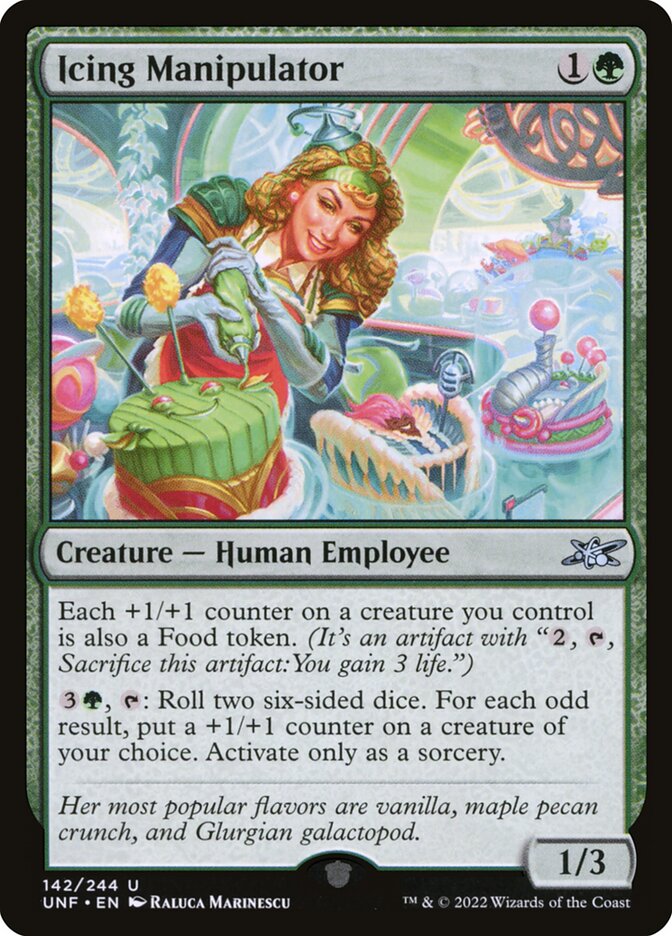
Icing Manipulator is one of those cards players keep asking about. Here is, in plain words, what its official text says, the rulings published by Wizards of the Coast, and the combos players actually run.
Official card text
Each +1/+1 counter on a creature you control is also a Food token. (It's an artifact with ",
, Sacrifice this token: You gain 3 life.")
,

How it works : Icing Manipulator
Original English text — Wizards of the Coast / Scryfall
- #1· Wizards of the Coast
The +1/+1 counters that are also Food tokens are still +1/+1 counters. They should stay on whatever permanent they were on, even though they become permanents themselves. That acorn symbol at the bottom of the card isn't messing around here.
No other card is named in this ruling.
- #2· Wizards of the Coast
The +1/+1 counters/Food tokens are artifacts, so anything that counts artifacts will count them. They can be tapped, untapped, sacrificed, and so on. They can even attack and block if you find a way to make them creatures.
No other card is named in this ruling.
- #3· Wizards of the Coast
+1/+1 counters aren't "attached" to the creatures they're on like an Aura or Equipment is, so a +1/+1 counter/Food token that becomes a creature stays on the creature its on. It still gives that creature a +1/+1 bonus. It doesn't give itself a +1/+1 bonus. Note that +1/+1 counters/Food tokens don't have a mana cost, so their mana value is 0. Many ways of turning them into creatures will turn them into 0/0 creatures, so unless something else is raising their toughness, they'll immediately spoil . . . er, die.
No other card is named in this ruling.
- #4· Wizards of the Coast
The activated ability doesn't target any creature. You choose which creatures get counters after you roll the dice. If you roll two odd numbers, you may put both +1/+1 counters on the same creature.
No other card is named in this ruling.
- #5· Wizards of the Coast
Each die is identified by the number of faces it has. A six-sided die is a die with six equally likely outcomes: 1, 2, 3, 4, 5, and 6. The roll must be fair. Although physical dice are recommended, digital substitutes are allowed except in cases where the physical die is required for the effect.
No other card is named in this ruling.
- #6· Wizards of the Coast
If an ability triggers "whenever you roll a die," it will trigger whenever you roll any die, including the planar die. This is a change from previous Un- rules. Some abilities use the result to determine part of the effect. If you get a non-numerical result (currently just the planar die, but the future is long), that part of the effect won't do anything.
No other card is named in this ruling.
- #7· Wizards of the Coast
Something in the game must tell you to roll a die. If you roll a die for any other reason (to simulate a coin flip, to choose pizza toppings, to create alternate timelines), that roll doesn't count.
No other card is named in this ruling.
- #8· Wizards of the Coast
Some effects may modify the result of a die roll. This may be part of the instruction to roll a die, or it may come from other cards. Anything that references the "result" of a die roll is looking for the result after these modifications.
No other card is named in this ruling.
- #9· Wizards of the Coast
If a die is rerolled, the original roll essentially never happened: it doesn't cause any abilities to trigger, and no effect that cares about die rolls will consider it.
No other card is named in this ruling.
- #10· Wizards of the Coast
Results can be numbers not ordinarily possible on a six-sided die. Spells like Scooch can change the result to 0 or 7, for example.
No other card is named in this ruling.
Commentaires
- Sois le premier à commenter cette carte.
Read next

Meta decks with Icing Manipulator
No archived Top 8 deck with this card yet.