

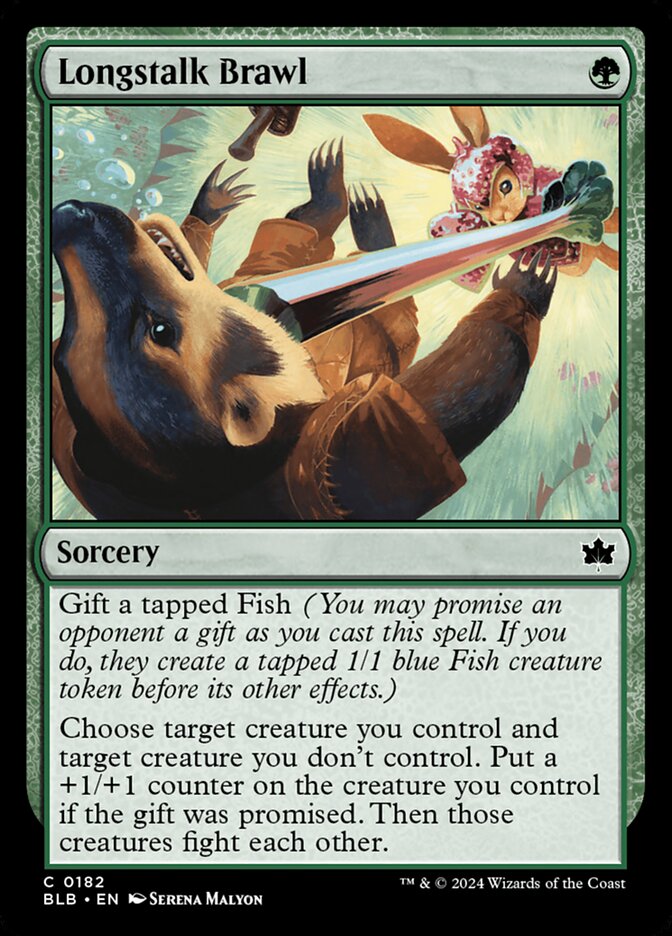
Longstalk Brawl is one of those cards players keep asking about. Here is, in plain words, what its official text says, the rulings published by Wizards of the Coast, and the combos players actually run.
Official card text
Gift a tapped Fish (You may promise an opponent a gift as you cast this spell. If you do, they create a tapped 1/1 blue Fish creature token before its other effects.) Choose target creature you control and target creature you don't control. Put a +1/+1 counter on the creature you control if the gift was promised. Then those creatures fight each other.
Complete guide
Longstalk Brawl is a versatile sorcery that introduces the 'gift' mechanic, allowing you to empower your own forces by being a bit generous to your foes. This green spell provides a cheap way to remove problematic creatures while potentially growing your own threats permanently. By understanding the timing of the gift and the mechanics of fighting, you can turn a small fish into a big victory.
The Gift of a Fish
Longstalk Brawl features the 'Gift' mechanic. As you cast this spell, you can choose to promise a gift to an opponent. In this case, you are promising them a 1/1 blue Fish creature token that enters the battlefield tapped. This promise is made during the casting process, but the Fish is only created during the resolution of the spell, right before any other effects occur. Note that if the spell is countered or fails to resolve, your opponent never receives the Fish.
Step-by-Step Resolution
First, the spell checks if its targets are still legal. If at least one target is legal, resolution begins. If you promised the gift, your chosen opponent creates a tapped 1/1 blue Fish token first. Second, if your creature is still a legal target and the gift was promised, you put a +1/+1 counter on it. Finally, if both the creature you control and the creature you don't control are still on the battlefield and legal targets, they fight each other, each dealing damage equal to its power to the other.
Common Mistakes
One common error is forgetting that if your own creature is removed from the battlefield in response to this spell, no +1/+1 counter is placed and no fighting occurs, even if the gift was promised. However, if only your opponent's creature is removed, you still give the gift and still get the +1/+1 counter on your creature. Additionally, remember that you cannot promise the gift more than once to get multiple counters; it is a binary choice made as you cast the spell.
When to Play It
Longstalk Brawl is most effective when the +1/+1 counter changes the outcome of the fight, allowing your creature to survive or to take down a larger threat. Since the Fish enters the battlefield tapped, your opponent cannot immediately use it to block your other attackers on that same turn. It is best used when you have a creature with high toughness or keywords like Lifelink or Deathtouch, maximizing the value of the damage exchange.
Interaction examples
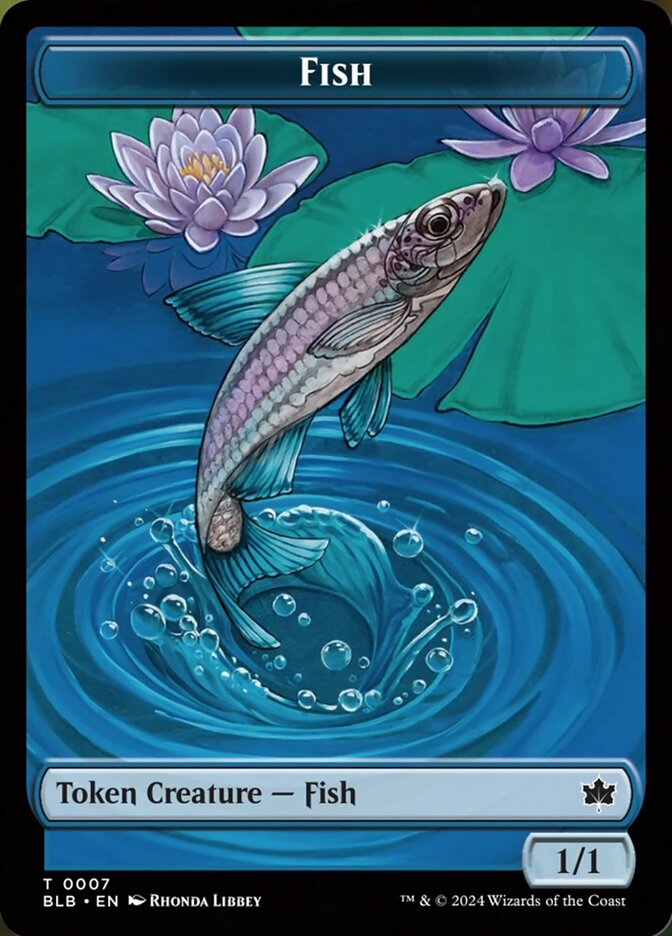 Fish
You cast Longstalk Brawl targeting your 2/2 creature and an opponent's 3/3 creature. You promise the gift. Upon resolution, your opponent creates a tapped 1/1 Fish token. Your creature receives a +1/+1 counter, becoming a 3/3. The two 3/3 creatures then fight, and both are destroyed. Without the gift, your creature would have died while the opponent's creature survived with damage marked on it.
 Farseek
Suppose you cast Longstalk Brawl promising a gift, but your opponent uses a spell to remove your creature in response. When Longstalk Brawl tries to resolve, it sees its first target is gone. Because the spell has no legal targets left, it is removed from the stack and does nothing. Your opponent does not get the Fish token, and no counters are placed.
 Nature's Lore
You cast Longstalk Brawl and promise the gift to an opponent who has no creatures. You target your 1/1 creature and the newly created Fish token. Upon resolution, the Fish is created tapped. Your creature gets a +1/+1 counter (becoming a 2/2) and then fights the Fish. Your creature survives, the Fish dies, and you have successfully converted one green mana into a permanent +1/+1 counter for your board.
Guide written with AI from the official text and rulings. Official English text prevails.
How it works : Longstalk Brawl
Original English text — Wizards of the Coast / Scryfall
- #1· Wizards of the Coast
If the creature you control is an illegal target as Longstalk Brawl tries to resolve, you won’t put a +1/+1 counter on it even if the gift was promised. If that creature is a legal target but the creature you don’t control isn’t, you’ll still put a +1/+1 counter on the creature you control if the gift was promised.
No other card is named in this ruling.
- #2· Wizards of the Coast
As an additional cost to cast a spell with gift, you can promise the listed gift to an opponent. That opponent is chosen as part of that additional cost. The gift isn’t given at this time; rather, it’s given at a later time based on whether or not the spell is a permanent spell.
No other card is named in this ruling.
- #3· Wizards of the Coast
For permanent spells with gift, an ability triggers when that permanent enters if the gift was promised. When that ability resolves, the gift is given to the appropriate opponent.
No other card is named in this ruling.
- #4· Wizards of the Coast
For instants and sorceries with gift, the gift is given to the appropriate opponent as part of the resolution of the spell. This happens before any of the spell’s other effects would take place.
No other card is named in this ruling.
- #5· Wizards of the Coast
If a spell for which the gift was promised is countered, doesn’t resolve (perhaps because all of its targets are illegal), or is otherwise removed from the stack, the gift won’t be given. None of its other effects will happen either.
No other card is named in this ruling.
- #6· Wizards of the Coast
You can’t pay a gift cost more than once.
No other card is named in this ruling.
- #7· Wizards of the Coast
If you copy a spell for which the gift was promised, the gift was also promised to the same opponent for the copy. If a card or token enters as a copy of a permanent that’s already on the battlefield, the gift isn’t promised for that new permanent, even if it was promised for the original.
No other card is named in this ruling.
- #8· Wizards of the Coast
Some instant or sorcery spells require alternative or additional targets if the gift was promised. You ignore these targeting requirements if the gifts aren’t promised for those spells. On the other hand, you can promise a gift for a permanent spell even if you won’t be able to choose targets for an enters ability of that permanent once the spell resolves.
No other card is named in this ruling.
- #9· Wizards of the Coast
In the main set, there are four different kinds of gifts. “Gift a Food” causes the chosen opponent to create a Food token, while “Gift a Treasure” causes the chosen opponent to create a Treasure token. “Gift a card” causes them to draw a card, and “Gift a tapped Fish” causes them to create a tapped 1/1 blue Fish creature token. The Commander decks contain two more kinds of gifts: “Gift an Octopus,” which causes the chosen opponent to create an 8/8 blue Octopus creature token, and “Gift an extra turn,” which causes them to take an extra turn after the current turn ends.
Card named in this ruling
Related cards and tokens
Legal formats
Commentaires
- Sois le premier à commenter cette carte.
Read next
Meta decks with Longstalk Brawl
No archived Top 8 deck with this card yet.