

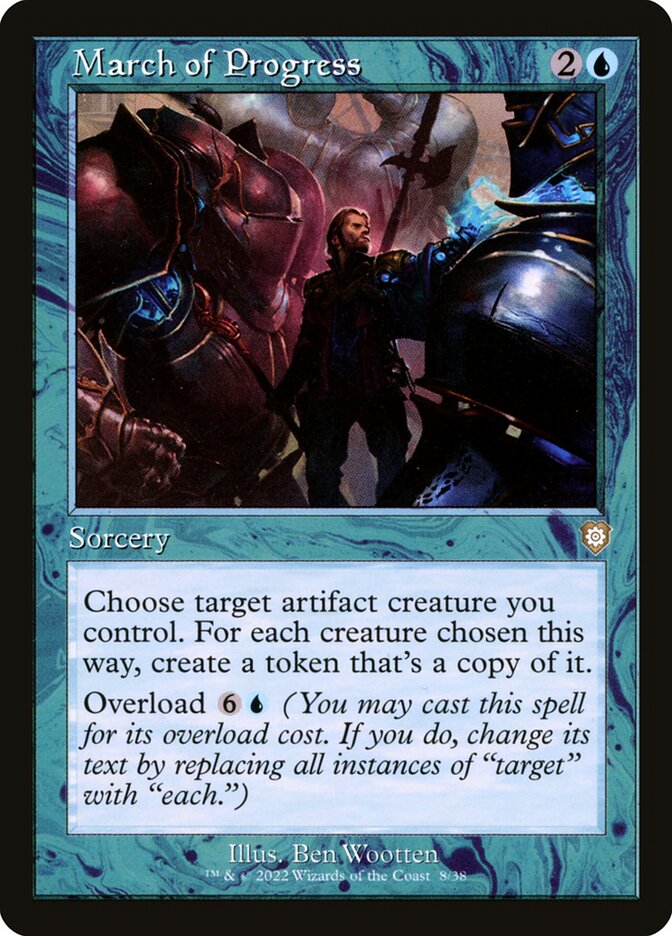
March of Progress is one of those cards players keep asking about. Here is, in plain words, what its official text says, the rulings published by Wizards of the Coast, and the combos players actually run.
Official card text
Choose target artifact creature you control. For each creature chosen this way, create a token that's a copy of it. Overload(You may cast this spell for its overload cost. If you do, change its text by replacing all instances of "target" with "each.")

Complete guide
March of Progress is a powerful blue sorcery that allows you to rapidly expand your board state by duplicating your existing mechanical forces. Whether you are focusing on a single powerful construct or overwhelming your opponent with a whole army, this card scales perfectly into the late game.
What It Does
At its core, March of Progress creates a token copy of an artifact creature you control. While its standard cost is affordable at three mana, its Overload ability allows you to replace the word "target" with "each." This shift means that for seven mana, you can create a token copy of every single artifact creature on your battlefield simultaneously.
How It Resolves Step by Step
When you cast March of Progress, you first decide if you are paying the standard cost or the Overload cost. If targeting a single creature, you choose the target as you cast the spell. Upon resolution, the game checks which creatures were 'chosen'—either the single target or all artifact creatures if overloaded—and creates a token copy for each. These tokens enter the battlefield with all the printed characteristics of the originals, including any enters-the-battlefield abilities they may possess.
Common Mistakes
A frequent misconception involves what exactly gets copied. The tokens copy the base card as printed; they do not copy counters, temporary power boosts, or Auras attached to the original creature. Additionally, if you cast the spell for its Overload cost, it no longer targets. This means it can affect creatures with Hexproof or Protection from Blue, but it also means abilities that trigger when a creature becomes a target will not fire.
When to Play It
Because March of Progress is a sorcery, you should typically cast it during your main phase when you have a high-value artifact creature or a wide board that can benefit from immediate duplication. If you have cards like Fabricate to tutor for specific artifact threats, you can set up a game-ending turn by finding a key creature and then casting March of Progress to double your threat level.
Interaction examples
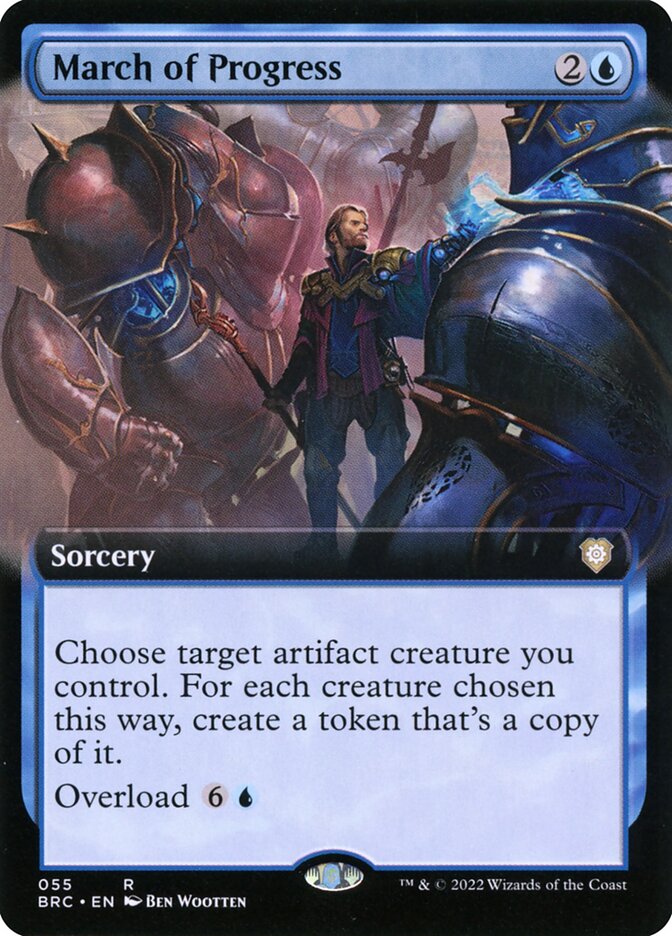 March of Progress
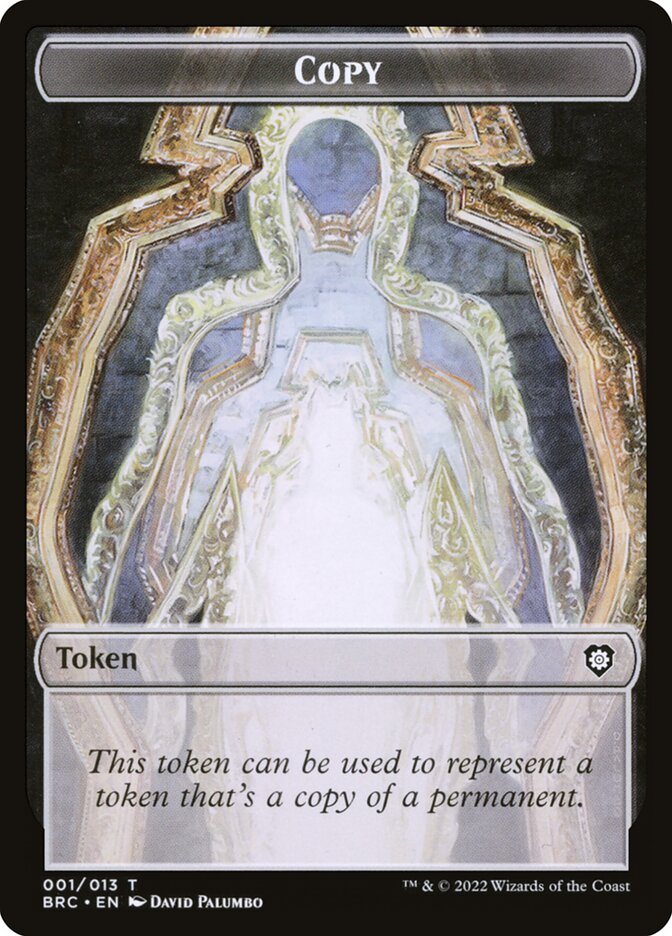 Copy
If you control a single artifact creature and cast March of Progress for its standard cost, you choose that creature as the target. Upon resolution, you create one token (represented by a Copy token) that shares all the original's printed traits. If that creature had a 'When this creature enters the battlefield' ability, that ability will trigger for the new token.
Imagine you control three different artifact creatures. By paying the Overload cost of {6}{U}, the spell's text changes to 'Choose each artifact creature you control.' Instead of one token, you create three new tokens—one for each of the unique artifact creatures you already have on the battlefield. This effectively doubles your artifact creature count in a single action.
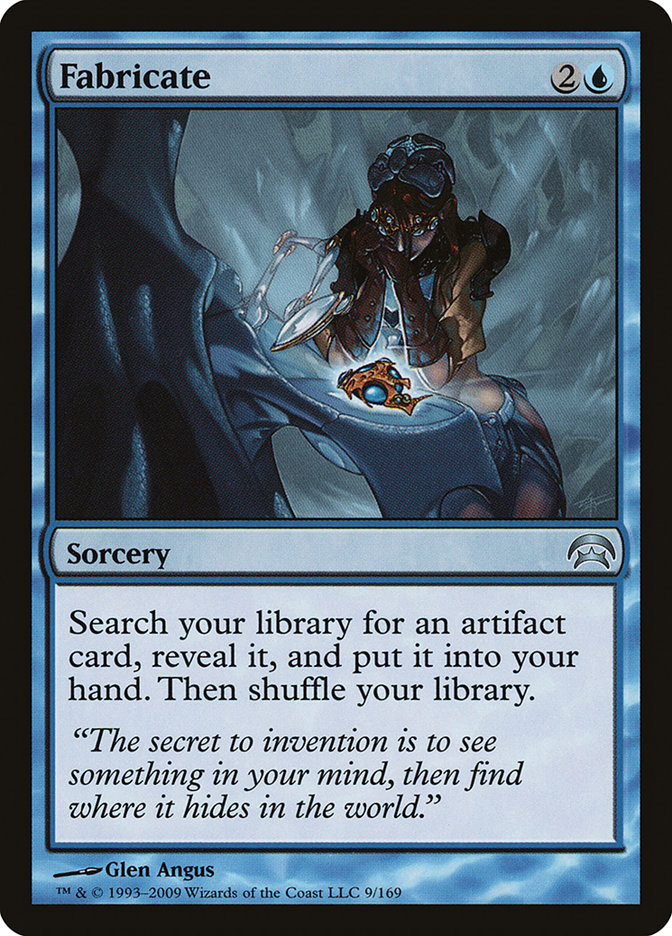 Fabricate
You can use Fabricate to search your library for a specific artifact creature card and put it into your hand. Once you have played that creature, you can follow up with March of Progress to ensure you have multiple copies of your best utility or combat artifact on the field, forcing your opponent to deal with the same threat twice.
Guide written with AI from the official text and rulings. Official English text prevails.
How it works : March of Progress
Original English text — Wizards of the Coast / Scryfall
- #1· Wizards of the Coast
Each token copies exactly what was printed on the original artifact creature and nothing more (unless that creature is copying something else or is a token; see below. It doesn’t copy whether that creature is tapped or untapped, whether it has any counters on it or Auras attached to it, or any non-copy effects that have changed its power, toughness, types, color, and so on.
Card named in this ruling
- #2· Wizards of the Coast
If the copied artifact creature has
 in its mana cost, X is 0.
No other card is named in this ruling.
- #3· Wizards of the Coast
If the chosen artifact creature is copying something else, then the token enters the battlefield as whatever the chosen creature is copying.
Card named in this ruling
- #4· Wizards of the Coast
If the chosen artifact creature is itself a token, the token March of Progress creates copies the original characteristics of that token as stated by the effect that created that token.
No other card is named in this ruling.
- #5· Wizards of the Coast
Any enters-the-battlefield abilities of the copied artifact creature will trigger when the token enters the battlefield. Any “as [this creature] enters the battlefield” or “[this creature] enters the battlefield with” abilities of the chosen creature will also work.
No other card is named in this ruling.
- #6· Wizards of the Coast
If you don’t pay the overload cost of a spell, that spell will have a single target. If you pay the overload cost, the spell won’t have any targets.
No other card is named in this ruling.
- #7· Wizards of the Coast
Because a spell with overload doesn’t target when its overload cost is paid, it may affect permanents with hexproof or with protection from the appropriate color.
No other card is named in this ruling.
- #8· Wizards of the Coast
Overload doesn’t change when you can cast the spell.
No other card is named in this ruling.
- #9· Wizards of the Coast
Casting a spell with overload doesn’t change that spell’s mana cost. You just pay the overload cost instead.
No other card is named in this ruling.
- #10· Wizards of the Coast
Effects that cause you to pay more or less for a spell will cause you to pay that much more or less while casting it for its overload cost, too.
No other card is named in this ruling.
- #11· Wizards of the Coast
If you are instructed to cast a spell with overload “without paying its mana cost,” you can’t choose to pay its overload cost instead.
No other card is named in this ruling.
Related cards and tokens
Legal formats
Commentaires
- Sois le premier à commenter cette carte.
Read next
Meta decks with March of Progress
No archived Top 8 deck with this card yet.