

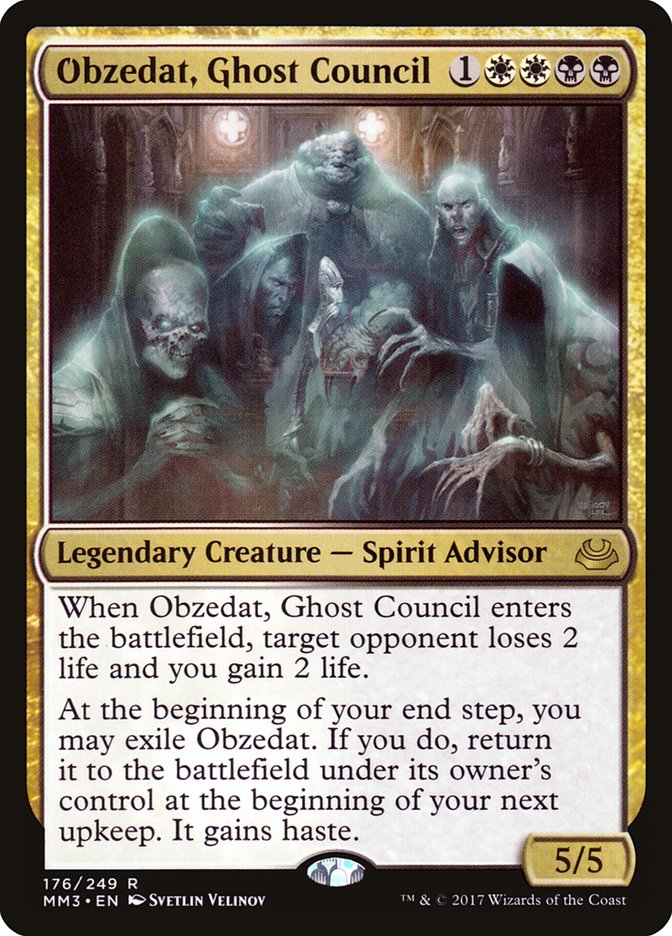
Obzedat, Ghost Council is one of those cards players keep asking about. Here is, in plain words, what its official text says, the rulings published by Wizards of the Coast, and the combos players actually run.
Official card text
When Obzedat enters, target opponent loses 2 life and you gain 2 life. At the beginning of your end step, you may exile Obzedat. If you do, return it to the battlefield under its owner's control at the beginning of your next upkeep. It gains haste.
Complete guide
Obzedat, Ghost Council represents the eternal ruling body of the Orzhov Syndicate, offering a powerful combination of life drain and evasion. This legendary Spirit Advisor is notoriously difficult to remove because it can vanish from the battlefield at the end of every turn. Mastering its timing is key to grinding down your opponents while keeping your board presence secure.
What It Does
Obzedat, Ghost Council has two primary triggered abilities. The first is an 'enters' trigger that drains 2 life from a target opponent and heals you for the same amount. The second is a conditional trigger at the beginning of your end step that allows you to exile Obzedat, only to return it to the battlefield during your next upkeep with haste.
Resolving the Blink Effect
Step 1: During your end step, the trigger goes on the stack. Step 2: Upon resolution, you decide whether to exile it. If you do, it leaves the battlefield immediately. Step 3: At the start of your next upkeep, a delayed trigger puts Obzedat back onto the battlefield. Step 4: The 'enters' ability triggers again, and Obzedat gains a permanent haste effect that lasts as long as it remains on the battlefield.
Common Mistakes
Players often forget that Obzedat returns under its owner's control, not necessarily its current controller's. If you steal an opponent's Obzedat and exile it with its own ability, it will return to your opponent's side of the field during your next upkeep. Additionally, note that the haste granted upon its return does not wear off at the end of the turn; it remains as long as that specific instance of Obzedat stays on the battlefield.
When to Play It
Cast Obzedat when you need to stabilize your life total or close out a game against a deck reliant on sorcery-speed removal. By exiling it during your end step, you protect it from board wipes and targeted spells cast during your opponent's turn, ensuring you can attack again as soon as your next turn begins.
Interaction examples
 Roaming Throne
If you have Roaming Throne on the battlefield with 'Spirit' or 'Advisor' chosen, Obzedat's abilities trigger twice. When it enters, the opponent loses 4 life and you gain 4. At your end step, you still only exile Obzedat once, but when it returns in your upkeep, the 'enters' ability will trigger twice again due to the Throne.
 Solemn Simulacrum
In a deck utilizing enter-the-battlefield effects, Obzedat provides a reliable clock. While Solemn Simulacrum provides a one-time ramp and draw, Obzedat re-triggers its own drain ability every single turn it returns from exile, creating a repetitive loop of life swings that does not require additional mana investment.
Guide written with AI from the official text and rulings. Official English text prevails.
How it works : Obzedat, Ghost Council
Original English text — Wizards of the Coast / Scryfall
- #1· Wizards of the Coast
Once Obzedat's ability has returned it to the battlefield, it has haste for as long as it remains on the battlefield. If an opponent gains control of it (perhaps with Olivia Voldaren or Soul Ransom), it can attack that turn.
No other card is named in this ruling.
- #2· Wizards of the Coast
If you gain control of Obzedat "until end of turn," you'll control it during your end step and you choose whether to exile it. If you do, it returns to the battlefield under its owner's control at the beginning of your next upkeep, not its owner's next upkeep.
No other card is named in this ruling.
Legal formats
Commentaires
- Sois le premier à commenter cette carte.