

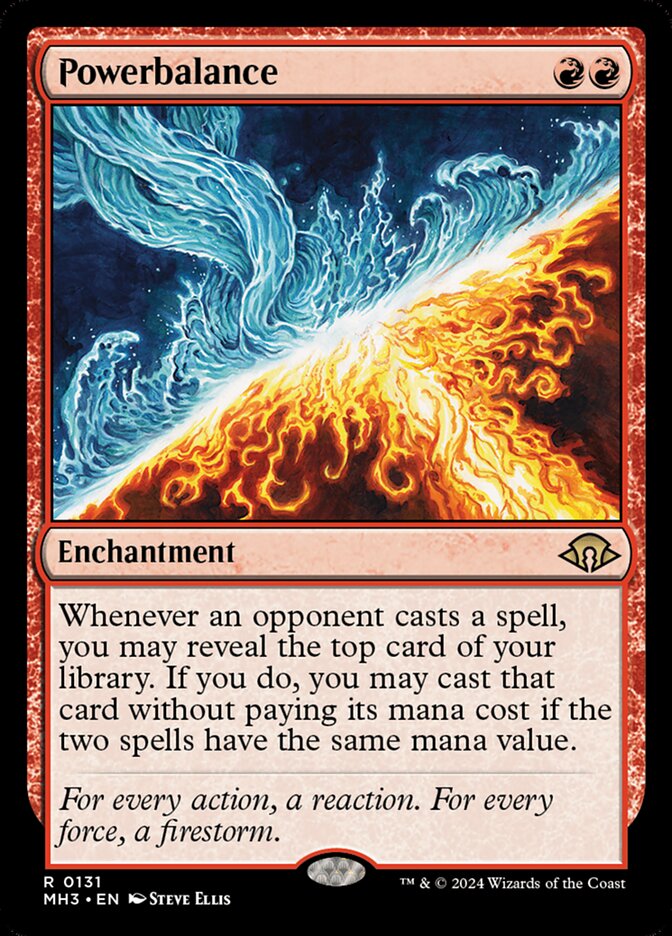
Powerbalance is one of those cards players keep asking about. Here is, in plain words, what its official text says, the rulings published by Wizards of the Coast, and the combos players actually run.
Official card text
Whenever an opponent casts a spell, you may reveal the top card of your library. If you do, you may cast that card without paying its mana cost if the two spells have the same mana value.
Complete guide
Powerbalance is a red enchantment that lets you play your opponent's spells against them by matching their costs. It offers a high-variance reward for players who can manipulate the top of their library or predict their opponent's moves. If the numbers line up, you get to cast a spell for free right then and there.
Understanding Mana Value Matching
Powerbalance triggers whenever an opponent casts any spell. The key is the 'mana value,' which is determined solely by the mana cost printed in the upper right corner of the card. If your opponent casts a spell with X in the cost, like a Fireball where X is 5, the mana value is 6. To cast your revealed card, its mana value must match that specific number exactly.
Resolving the Ability
When the ability triggers, you first decide if you want to reveal the top card of your library. If you do reveal it and the mana values match, you choose whether to cast it immediately. You ignore all timing restrictions, meaning you can cast a creature or sorcery during your opponent's turn. If you cast it, you do so without paying its mana cost, though you must still pay any mandatory additional costs.
Common Mistakes to Avoid
A frequent error is trying to save the revealed card for later; you must cast it during the resolution of the trigger or not at all. Additionally, if the card you reveal has an X in its mana cost, you must choose 0 for X if you cast it for free. Remember that cost reducers or taxes (like Thalia, Guardian of Thraben) do not change a spell's mana value, so ignore those when checking for a match.
When to Play Powerbalance
This enchantment shines in formats where mana values are predictable or low. It is especially potent when combined with cards that allow you to see or reorganize the top of your library. Since it triggers on every opponent's spell, it can generate massive value in multiplayer games if your deck has a diverse range of mana costs.
Interaction examples
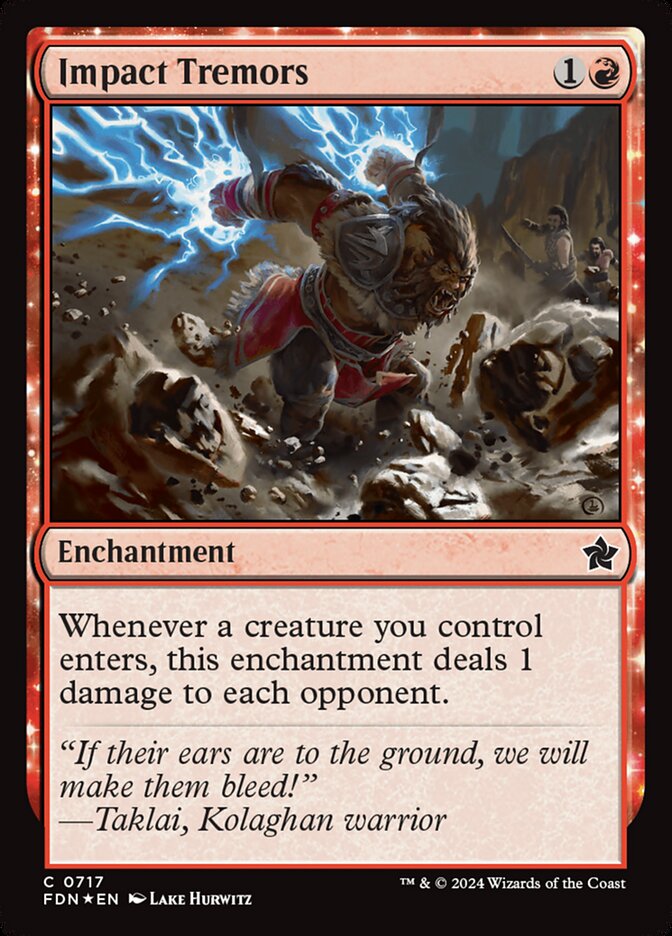 Impact Tremors
If your opponent casts a spell with a mana value of 2, such as a creature or another enchantment, you may reveal the top card of your library. If that card is Impact Tremors, which also has a mana value of 2, you may cast it immediately for free. The Impact Tremors will then resolve before your opponent's original spell.
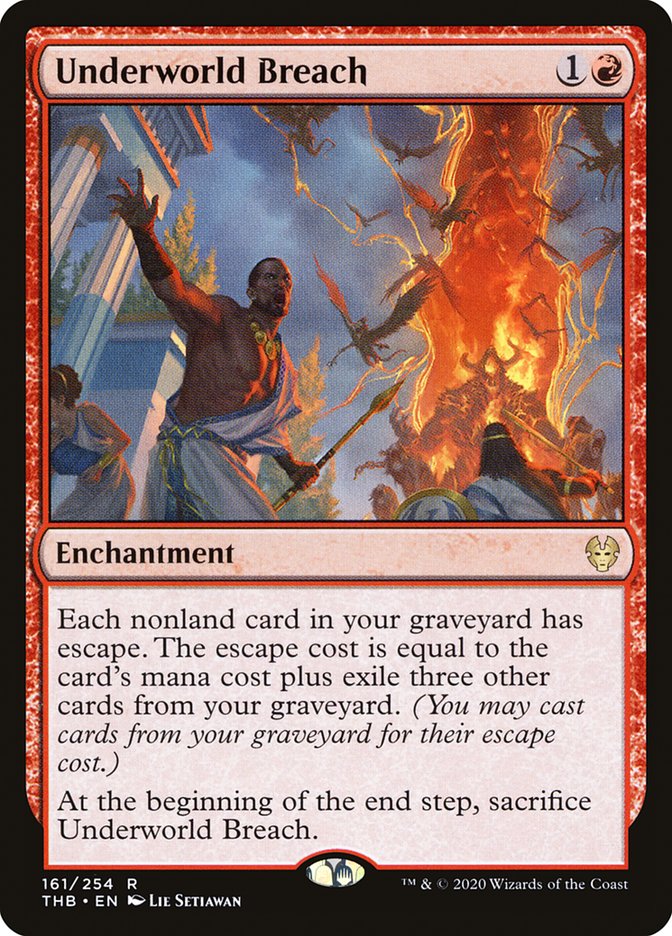 Underworld Breach
Suppose an opponent casts a spell with a mana value of 2. You reveal Underworld Breach from the top of your library. Since Underworld Breach has a mana value of 2, the costs match. Even though Underworld Breach has an Escape ability, you are casting it using the 'without paying its mana cost' alternative cost provided by Powerbalance, not its Escape cost.
Guide written with AI from the official text and rulings. Official English text prevails.
How it works : Powerbalance
Original English text — Wizards of the Coast / Scryfall
- #1· Wizards of the Coast
If an opponent casts a spell with
 in its mana cost, use the value of X that was chosen when it was cast to determine its mana value.
No other card is named in this ruling.
- #2· Wizards of the Coast
A spell's mana value is determined only by its mana cost. Ignore any alternative costs, additional costs, cost increases, or cost reductions.
No other card is named in this ruling.
- #3· Wizards of the Coast
The mana value of a split card not on the stack or a fused split spell on the stack is determined by the combined mana cost of its two halves. Otherwise, while a split card is on the stack, its mana value is determined by the mana cost of the half that was chosen to be cast.
No other card is named in this ruling.
- #4· Wizards of the Coast
You choose whether or not to cast the exiled card as Powerbalance's triggered ability resolves. If you do, you do so as part of the resolution of that ability. You can't wait to cast it later in the turn. Timing restrictions based on the card's type are ignored.
No other card is named in this ruling.
- #5· Wizards of the Coast
If the revealed card has
in its mana cost, you must choose 0 as the value of X when casting it without paying its mana cost.No other card is named in this ruling.
- #6· Wizards of the Coast
If you cast a spell "without paying its mana cost," you can't choose to cast it for any alternative costs. You can, however, pay additional costs, such as kicker costs. If the spell has any mandatory additional costs, those must be paid to cast it.
No other card is named in this ruling.
- #7· Wizards of the Coast
In some unusual cases, the card you reveal from the top of your library may not have the same mana value as the spell your opponent cast, but you can still cast that card because the resulting spell does have the same mana value. For example, if an opponent casts a spell with mana value 4 and you reveal Frogmyr Enforcer (a prototype card with mana cost
 and prototype cost

 ), you can cast Frogmyr Enforcer as a prototyped spell, as that spell will have a mana value of 4.
No other card is named in this ruling.
Legal formats
Commentaires
- Sois le premier à commenter cette carte.
Read next
Meta decks with Powerbalance
No archived Top 8 deck with this card yet.