

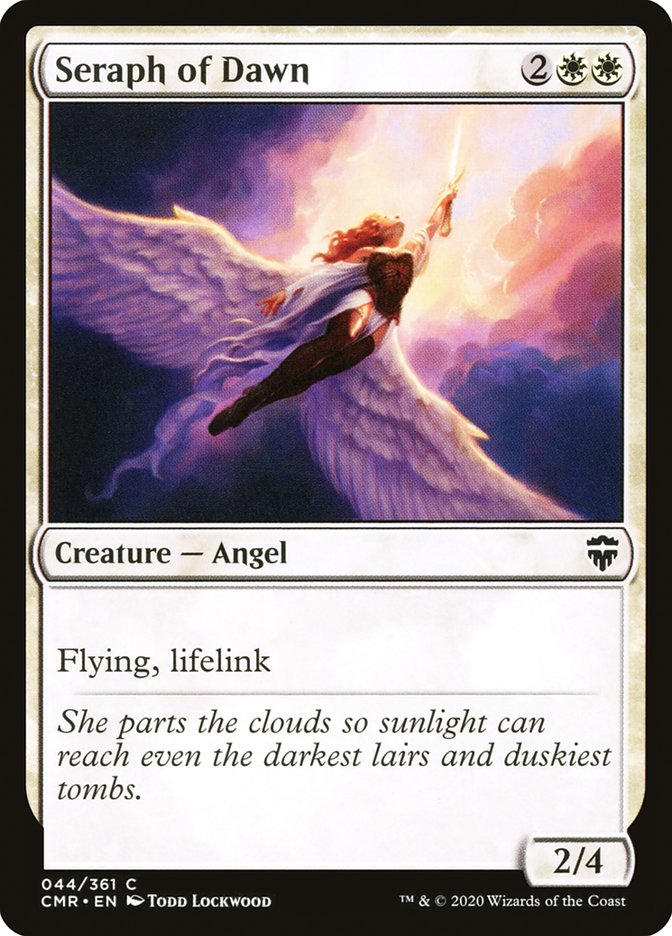
Seraph of Dawn is one of those cards players keep asking about. Here is, in plain words, what its official text says, the rulings published by Wizards of the Coast, and the combos players actually run.
Official card text
Flying, lifelink
Complete guide
Seraph of Dawn is a quintessential white creature that provides both an aerial threat and a way to stabilize your life total. As an Angel with both evasion and a way to buffer your health, it remains a solid pick for any deck focusing on mid-range defense. Understanding how its static abilities function is key to mastering its role on the battlefield.
What It Does
Seraph of Dawn has two keyword abilities: Flying and Lifelink. Flying means this creature can't be blocked except by creatures with flying or reach, allowing you to bypass ground-based defenses. Lifelink is a static ability that causes damage dealt by this creature to also result in you gaining that much life simultaneously.
How It Resolves Step by Step
When Seraph of Dawn attacks or blocks, the process is straightforward. First, declare the Seraph as an attacker; because it has flying, the opponent can only assign legal blockers with flying or reach. Second, if the Seraph deals damage—whether to a player, a planeswalker, or another creature—the life gain from lifelink happens at the exact same time as the damage is dealt. There is no separate triggered ability to put on the stack, meaning you gain the life even if the damage dealt would otherwise reduce your life total to zero in the same combat step.
Common Mistakes
A common misconception is that lifelink is a triggered ability that can be responded to or countered by effects like Stifle. Because lifelink is a static ability, the life gain is instantaneous and does not use the stack. Additionally, remember that Seraph of Dawn does not have a triggered ability when it enters or leaves the battlefield, so cards that care about triggers will not interact with its basic keywords.
When to Play It
This Angel is best deployed when you need to stabilize against aggressive decks. Its 4 toughness makes it a sturdy blocker against many early-game creatures, and its flying ability ensures it can chip away at your opponent's life total or provide a consistent source of lifelink recovery even if the ground board state is stalled.
Interaction examples
If Seraph of Dawn attacks and is not blocked, it deals 2 damage to the opponent. Simultaneously, you gain 2 life. If it blocks a 2/2 creature, both creatures deal 2 damage to each other; the Seraph survives due to its 4 toughness, the 2/2 is destroyed, and you gain 2 life immediately.
 Roaming Throne
If you control Roaming Throne and chose 'Angel', you might expect more life. However, Lifelink and Flying are static abilities, not triggered abilities. Roaming Throne only doubles abilities that use 'when', 'whenever', or 'at'. Therefore, Roaming Throne does not cause you to gain extra life when Seraph of Dawn deals damage.
 Solemn Simulacrum
When you cast Solemn Simulacrum, its 'enters' ability is a trigger that goes on the stack, which players can respond to. In contrast, when Seraph of Dawn deals damage, the lifelink effect happens immediately without a trigger. While Solemn Simulacrum provides card advantage and ramp, Seraph of Dawn provides immediate, non-interactable life swings during the damage step.
Guide written with AI from the official text and rulings. Official English text prevails.
How it works : Seraph of Dawn
Original English text — Wizards of the Coast / Scryfall
No additional ruling has been published for this card.
Legal formats
Commentaires
- Sois le premier à commenter cette carte.
Read next
Meta decks with Seraph of Dawn
No archived Top 8 deck with this card yet.