
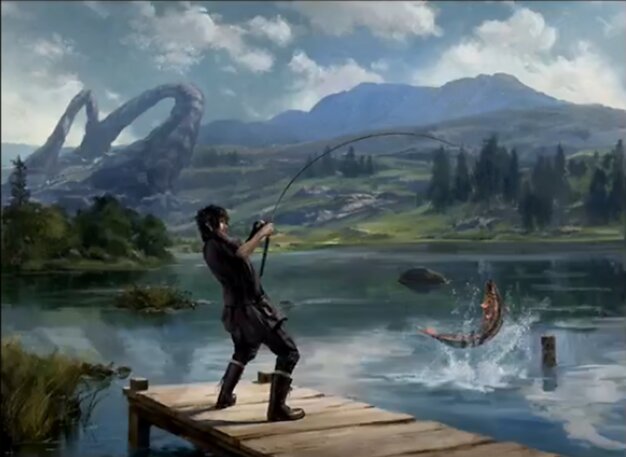
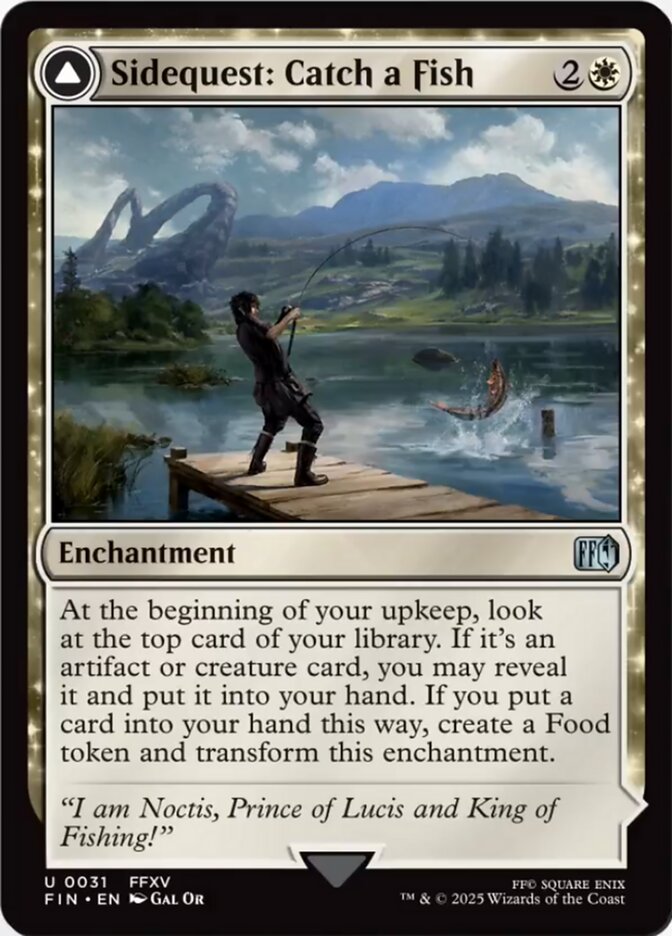
Sidequest: Catch a Fish // Cooking Campsite is one of those cards players keep asking about. Here is, in plain words, what its official text says, the rulings published by Wizards of the Coast, and the combos players actually run.
Official card text
At the beginning of your upkeep, look at the top card of your library. If it's an artifact or creature card, you may reveal it and put it into your hand. If you put a card into your hand this way, create a Food token and transform this enchantment.: Add
.
,
Complete guide
Sidequest: Catch a Fish offers a flavorful journey from a morning fishing trip to a restorative meal at a Cooking Campsite. This nonmodal double-faced enchantment helps you find specific resources and rewards your success with a permanent buff to your board. Understanding how it transforms is key to mastering this White value engine.
Casting and Filtering
You always cast this card as the front face, Sidequest: Catch a Fish, for two generic and one white mana. Once on the battlefield, it triggers at the beginning of your upkeep. You look at the top card of your library; if it is an artifact or a creature, you can choose to reveal it. If you do, the card goes to your hand, you create a Food token, and the enchantment transforms into its back face, Cooking Campsite.
The Transformation Process
Transforming is mandatory only if you choose to reveal and draw the artifact or creature card. If you find a card you want but prefer to keep the enchantment on the battlefield to fish again next turn, you can simply choose not to reveal it. Once it becomes Cooking Campsite, it is a land. It can tap for white mana or use its activated ability to sacrifice an artifact—like the Food token you just created—to put +1/+1 counters on all your creatures.
Characteristics in Other Zones
In your hand, library, or graveyard, only the front face (Sidequest: Catch a Fish) exists. This means the card has a mana value of 3 and is an enchantment. Even when on the battlefield as Cooking Campsite, its mana value remains 3, based on the front face's cost. In Commander, however, the color identity is determined by both faces; since both use white mana symbols, its identity is white.
Strategy: When to Flip
Timing your 'catch' is vital. If you already have a strong board presence, you might want to reveal a creature immediately to get the Food and transform into the Campsite to start buffing your team. If you are struggling for card advantage, you might choose not to reveal cards that aren't essential, hoping to use the enchantment's upkeep trigger over multiple turns to filter your draws.
Interaction examples
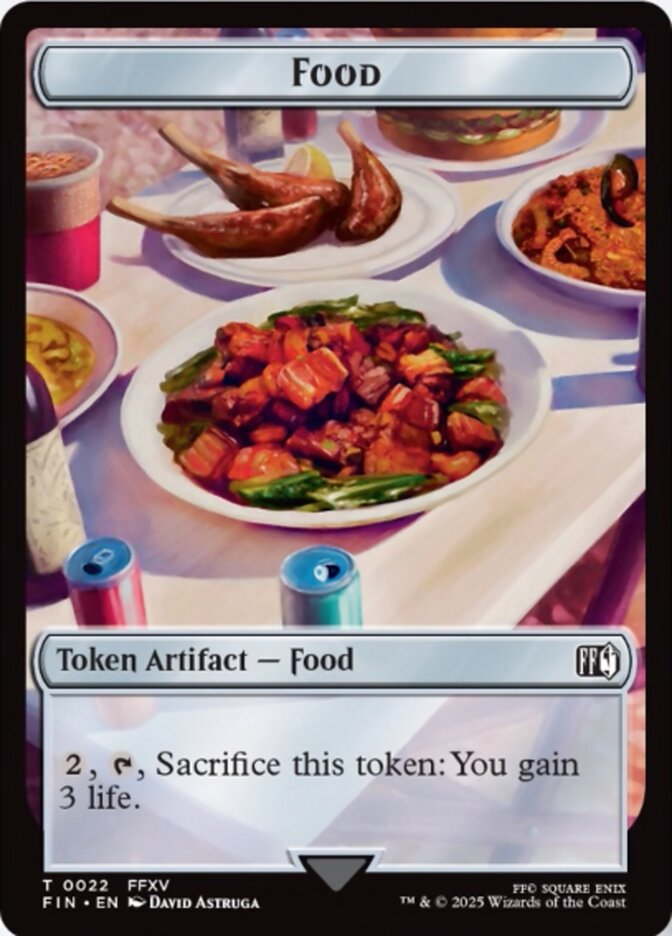 Food
When the upkeep trigger of Sidequest: Catch a Fish resolves and you reveal a creature, you put that creature into your hand and create a Food token. The enchantment then transforms into Cooking Campsite. During your main phase, you can use the mana from the land or other sources to activate the Campsite's second ability. You sacrifice the Food token (rather than spending mana to eat it for life) to put a +1/+1 counter on each of your creatures.
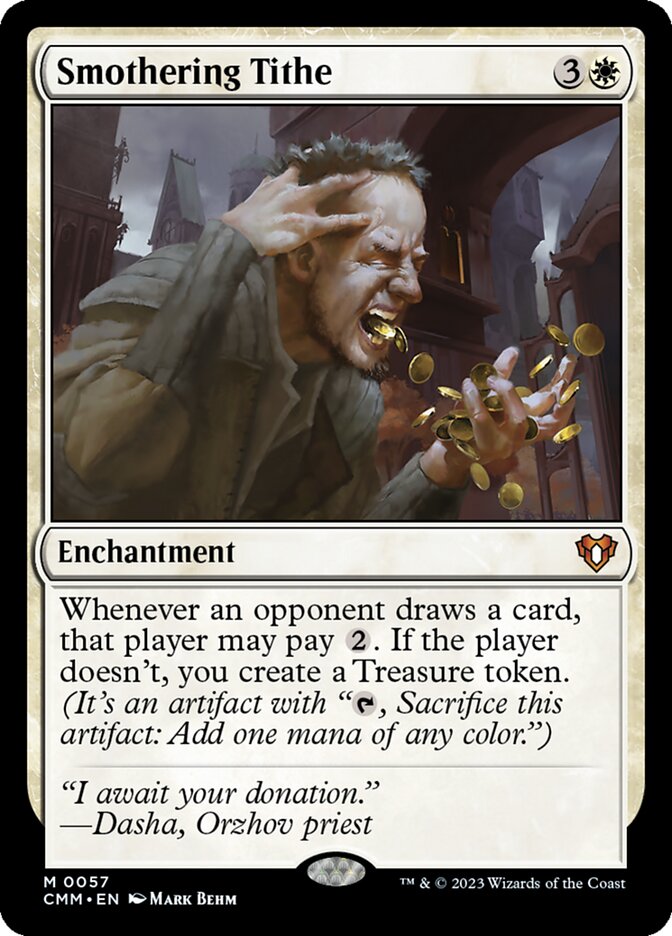 Smothering Tithe
If you have Smothering Tithe on the battlefield, you will likely accumulate Treasure tokens. Cooking Campsite requires you to sacrifice an artifact to buff your creatures. Instead of using the Food token generated by the transformation, you can sacrifice a Treasure token to the Campsite's ability. This allows you to save your Food for life gain later if needed while still boosting your army.
 Ghostly Prison
Suppose you have Ghostly Prison and Sidequest: Catch a Fish on the battlefield. During your upkeep, you look at the top card and see a creature. If you are under heavy pressure, you might choose NOT to reveal it. By keeping the front face active, you ensure you can look at the top card again next turn, potentially finding more defensive artifacts or creatures to help stabilize your board before you finally decide to transform into the Campsite.
Guide written with AI from the official text and rulings. Official English text prevails.
How it works : Sidequest: Catch a Fish // Cooking Campsite
Original English text — Wizards of the Coast / Scryfall
- #1· Wizards of the Coast
You don't have to reveal the card even if it's an artifact or creature card. You may choose not to reveal it and instead leave it on top of your library.
No other card is named in this ruling.
- #2· Wizards of the Coast
The mana value of a nonmodal double-faced card is the mana value of its front face, no matter which face is up.
No other card is named in this ruling.
- #3· Wizards of the Coast
Each face of a nonmodal double-faced card has its own set of characteristics: name, types, subtypes, abilities, and so on. While a nonmodal double-faced permanent is on the battlefield, consider only the characteristics of the face that's currently up. The other set of characteristics is ignored.
No other card is named in this ruling.
- #4· Wizards of the Coast
If you are instructed to put a card that isn't a double-faced card onto the battlefield transformed, it will not enter at all. In that case, it stays in the zone it was previously in. For example, if a single-faced card is a copy of Crystal Fragments, it will be exiled during the resolution of its second ability and remain in exile.
No other card is named in this ruling.
- #5· Wizards of the Coast
A token that is created as a copy of a double-faced permanent or a double-faced card in another zone is a double-faced token. It will have both the front face and back face of whatever object it's copying. If it's copying a double-faced permanent whose back face is up, the token will enter with its back face up. It can transform if instructed to do so.
No other card is named in this ruling.
- #6· Wizards of the Coast
In the Commander variant, a double-faced card's color identity is determined by the mana costs and mana symbols in the rules text of both faces combined. If either face has a color indicator or basic land type, those are also considered. For example, Cecil, Dark Knight's color identity is black and white, since its front face is black and its back face has a white color indicator.
No other card is named in this ruling.
- #7· Wizards of the Coast
The back face of a nonmodal double-faced card usually has a color indicator that defines its color.
No other card is named in this ruling.
- #8· Wizards of the Coast
A nonmodal double-faced card enters with its front face up by default, unless a spell or ability instructs you to put it onto the battlefield transformed or allows you to cast it transformed, in which case it enters with its back face up.
No other card is named in this ruling.
- #9· Wizards of the Coast
Each nonmodal double-faced card in this release is cast face up. In every zone other than the battlefield, consider only the characteristics of its front face. If it is on the battlefield, consider only the characteristics of the face that's up; the other face's characteristics are ignored.
No other card is named in this ruling.
Related cards and tokens
Legal formats
Commentaires
- Sois le premier à commenter cette carte.
Read next
Meta decks with Sidequest: Catch a Fish // Cooking Campsite
No archived Top 8 deck with this card yet.