


Silundi Vision // Silundi Isle is one of those cards players keep asking about. Here is, in plain words, what its official text says, the rulings published by Wizards of the Coast, and the combos players actually run.
Official card text
Look at the top six cards of your library. You may reveal an instant or sorcery card from among them and put it into your hand. Put the rest on the bottom of your library in a random order. This land enters tapped.: Add
.
Complete guide
Silundi Vision // Silundi Isle is a versatile blue modal double-faced card from the Zendikar Rising set. It offers the flexibility of a mid-game card selection spell or an early-game land drop, ensuring you never miss a beat in control or combo decks. Understanding how the game views each face is the key to mastering this card.
One Card, Two Faces
As a modal double-faced card (MDFC), you choose which side to play as you take the action. The front face, Silundi Vision, is a three-mana instant spell, while the back face, Silundi Isle, is a land that enters the battlefield tapped and produces blue mana. In your hand, library, or graveyard, the game only sees the front face's characteristics, meaning it has a mana value of 3 and is an instant card.
Resolving the Vision
When you cast Silundi Vision, you look at the top six cards of your library. You may reveal one instant or sorcery card from among them to put into your hand. The remaining cards, including any instant or sorcery cards you chose not to take, are placed on the bottom of your library in a random order. Note that if you look at six cards and find no instants or sorceries, all six simply go to the bottom of the library.
Common Pitfalls
A common mistake involves effects that put cards directly onto the battlefield. If an effect tells you to put a card onto the battlefield, it always enters with the front face up. Since Silundi Vision is an instant, it cannot enter the battlefield; therefore, it would remain in its current zone. Additionally, if an effect allows you to 'cast' a card from your graveyard, you can only cast the Silundi Vision side, not play the Silundi Isle land side.
When to Play Each Side
Play Silundi Isle early if you are short on mana, keeping in mind it enters tapped and won't be available for use until the following turn. Save Silundi Vision for the mid-to-late game when you need to dig for a specific answer or a finisher. Because it looks six cards deep, it is highly effective at finding high-impact spells in high-density instant/sorcery decks.
Interaction examples
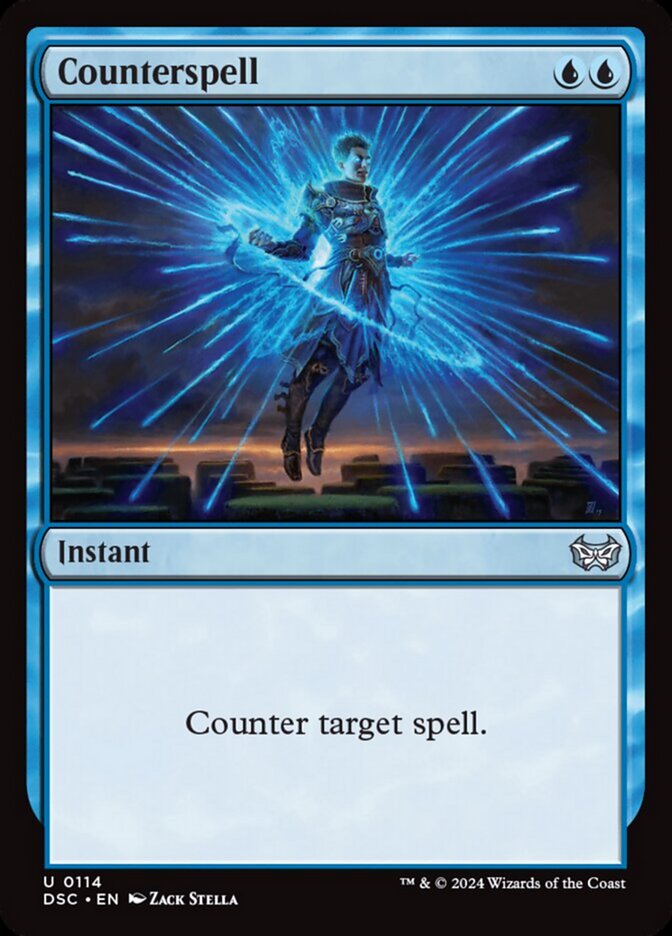 Counterspell
You are facing a lethal spell from your opponent. You cast Silundi Vision during their end step. You look at your top six cards and see a Counterspell. You reveal it, put it into your hand, and randomize the other five cards on the bottom of your library. You now have the protection you need for your next turn.
 Arcane Denial
During a stalled game state, you cast Silundi Vision to find more utility. You find Arcane Denial among the top six cards. Even if you don't need to counter a spell immediately, adding the Arcane Denial to your hand provides both a defensive tool and a way to cycle cards later.
You cast Silundi Vision but the top six cards of your library are all lands and creatures. Because there is no instant or sorcery card to reveal, you simply put all six cards on the bottom of your library in a random order. The spell finishes resolving and is placed in your graveyard.
Guide written with AI from the official text and rulings. Official English text prevails.
How it works : Silundi Vision // Silundi Isle
Original English text — Wizards of the Coast / Scryfall
- #1· Wizards of the Coast
To determine whether it is legal to play a modal double-faced card, consider only the characteristics of the face you're playing and ignore the other face's characteristics.
No other card is named in this ruling.
- #2· Wizards of the Coast
There is a single triangle icon in the top left corner of the front face. There is a double triangle icon in the top left corner of the back face.
No other card is named in this ruling.
- #3· Wizards of the Coast
If an effect allows you to play a specific modal double-faced card, you may cast it as a spell or play it as a land, as determined by which face you choose to play. If an effect allows you to cast (rather than "play") a specific modal double-faced card, you can't play it as a land.
No other card is named in this ruling.
- #4· Wizards of the Coast
If an effect allows you to play a land or cast a spell from among a group of cards, you may play or cast a modal double-faced card with any face that fits the criteria of that effect.
No other card is named in this ruling.
- #5· Wizards of the Coast
The mana value of a modal double-faced card is based on the characteristics of the face that's being considered. On the stack and battlefield, consider whichever face is up. In all other zones, consider only the front face. This is different than how the mana value of a transforming double-faced card is determined.
No other card is named in this ruling.
- #6· Wizards of the Coast
A modal double-faced card can't be transformed or be put onto the battlefield transformed. Ignore any instruction to transform a modal double-faced card or to put one onto the battlefield transformed.
No other card is named in this ruling.
- #7· Wizards of the Coast
If an effect puts a double-faced card onto the battlefield, it enters with its front face up. If that front face can't be put onto the battlefield, it doesn't enter the battlefield.
No other card is named in this ruling.
- #8· Wizards of the Coast
If an effect instructs a player to choose a card name, the name of either face may be chosen. If that effect or a linked ability refers to a spell with the chosen name being cast and/or a land with the chosen name being played, it considers only the chosen name, not the other face's name.
No other card is named in this ruling.
- #9· Wizards of the Coast
In the Commander variant, a double-faced card's color identity is determined by the mana costs and mana symbols in the rules text of both faces combined. If either face has a color indicator or basic land type, those are also considered.
No other card is named in this ruling.
Legal formats
Commentaires
- Sois le premier à commenter cette carte.
Read next
Meta decks with Silundi Vision // Silundi Isle
No archived Top 8 deck with this card yet.