

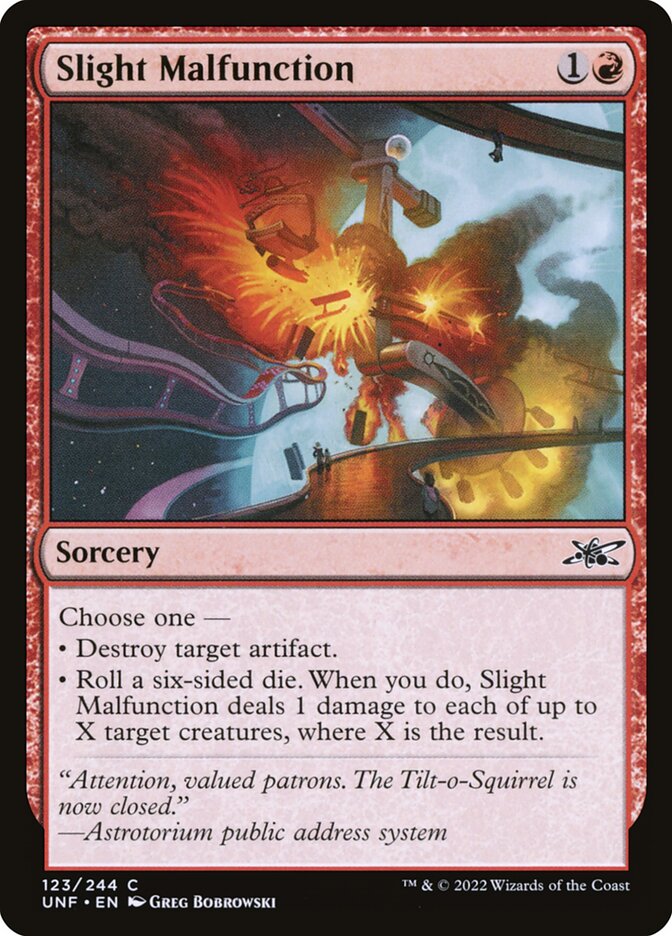
Slight Malfunction is one of those cards players keep asking about. Here is, in plain words, what its official text says, the rulings published by Wizards of the Coast, and the combos players actually run.
Official card text
Choose one — • Destroy target artifact. • Roll a six-sided die. When you do, Slight Malfunction deals 1 damage to each of up to X target creatures, where X is the result.
Complete guide
Slight Malfunction is a versatile red sorcery from the Unfinity set that offers both utility and potential board control. Whether you need to dismantle a problematic machine or scatter a group of small creatures, this card provides options for a low mana investment. Its unique use of a reflexive triggered ability makes it a fascinating card for players who enjoy a bit of randomness with their strategy.
Choosing Your Mode
When you cast Slight Malfunction, you must choose one of two modes. The first mode is a straightforward artifact destruction spell, requiring a single target artifact to be selected as you cast it. The second mode is more complex: it involves rolling a six-sided die (d6) to determine how many creatures you can damage. Notably, if you choose the second mode, you do not choose any targets when you initially cast the spell.
The Reflexive Trigger
The second mode of Slight Malfunction uses what is called a reflexive triggered ability. First, the spell resolves and you roll a six-sided die. Once the result is determined, a new ability goes on the stack: 'When you do, Slight Malfunction deals 1 damage to each of up to X target creatures.' It is at this moment—after the roll—that you choose your targets. This means you know exactly how many targets you can hit before you have to pick them, preventing the spell from 'fizzling' if you rolled lower than expected.
Common Pitfalls
A frequent mistake is attempting to target creatures while casting Slight Malfunction in its second mode. Remember, the targets are only chosen after the die is rolled and the reflexive trigger is placed on the stack. Additionally, keep in mind that the damage is dealt by the spell itself; if the spell is countered before it resolves, you never roll the die. If the reflexive trigger is countered, the die was still rolled, but no damage is dealt.
Strategic Timing
Because Slight Malfunction is a sorcery, you generally want to use it during your main phase to clear away blockers or pesky utility artifacts. In the early game, it can serve as a cheap answer to artifacts. In the late game, if you have ways to modify die rolls, the second mode becomes a mini-board wipe that can pick off multiple tokens or weakened creatures with precision.
Interaction examples
 Vandalblast
If you are facing a single artifact, Slight Malfunction and Vandalblast serve similar roles for two mana. However, Slight Malfunction provides an alternative against creature decks. If your opponent has three 1/1 tokens, you can choose the second mode. Upon resolution, you roll a die; if you roll a 3 or higher, you can then target all three tokens with the reflexive trigger to clear their board, whereas Vandalblast would be a dead card in that scenario.
 Faithless Looting
In a deck using Faithless Looting, you are often looking for specific answers. If you draw into Slight Malfunction, you can evaluate the board state to see if you need artifact removal or creature pings. If neither mode is useful, you can use Faithless Looting to discard Slight Malfunction and dig deeper into your library for more impactful cards, knowing that Slight Malfunction's flexibility makes it a safe card to hold until you are certain of your opponent's threats.
Guide written with AI from the official text and rulings. Official English text prevails.
How it works : Slight Malfunction
Original English text — Wizards of the Coast / Scryfall
- #1· Wizards of the Coast
If you choose the second mode, Slight Malfunction goes on the stack without any targets. As it resolves, you roll a six-sided die. This causes the reflexive triggered ability trigger. You choose the targets for that ability as it goes on the stack.
No other card is named in this ruling.
- #2· Wizards of the Coast
Each die is identified by the number of faces it has. A six-sided die is a die with six equally likely outcomes: 1, 2, 3, 4, 5, and 6. The roll must be fair. Although physical dice are recommended, digital substitutes are allowed except in cases where the physical die is required for the effect.
No other card is named in this ruling.
- #3· Wizards of the Coast
If an ability triggers "whenever you roll a die," it will trigger whenever you roll any die, including the planar die. This is a change from previous Un- rules. Some abilities use the result to determine part of the effect. If you get a non-numerical result (currently just the planar die, but the future is long), that part of the effect won't do anything.
No other card is named in this ruling.
- #4· Wizards of the Coast
Something in the game must tell you to roll a die. If you roll a die for any other reason (to simulate a coin flip, to choose pizza toppings, to create alternate timelines), that roll doesn't count.
No other card is named in this ruling.
- #5· Wizards of the Coast
Some effects may modify the result of a die roll. This may be part of the instruction to roll a die, or it may come from other cards. Anything that references the "result" of a die roll is looking for the result after these modifications.
No other card is named in this ruling.
- #6· Wizards of the Coast
If a die is rerolled, the original roll essentially never happened: it doesn't cause any abilities to trigger, and no effect that cares about die rolls will consider it.
No other card is named in this ruling.
- #7· Wizards of the Coast
Results can be numbers not ordinarily possible on a six-sided die. Spells like Scooch can change the result to 0 or 7, for example.
No other card is named in this ruling.
Legal formats
Commentaires
- Sois le premier à commenter cette carte.
Read next
Meta decks with Slight Malfunction
No archived Top 8 deck with this card yet.