

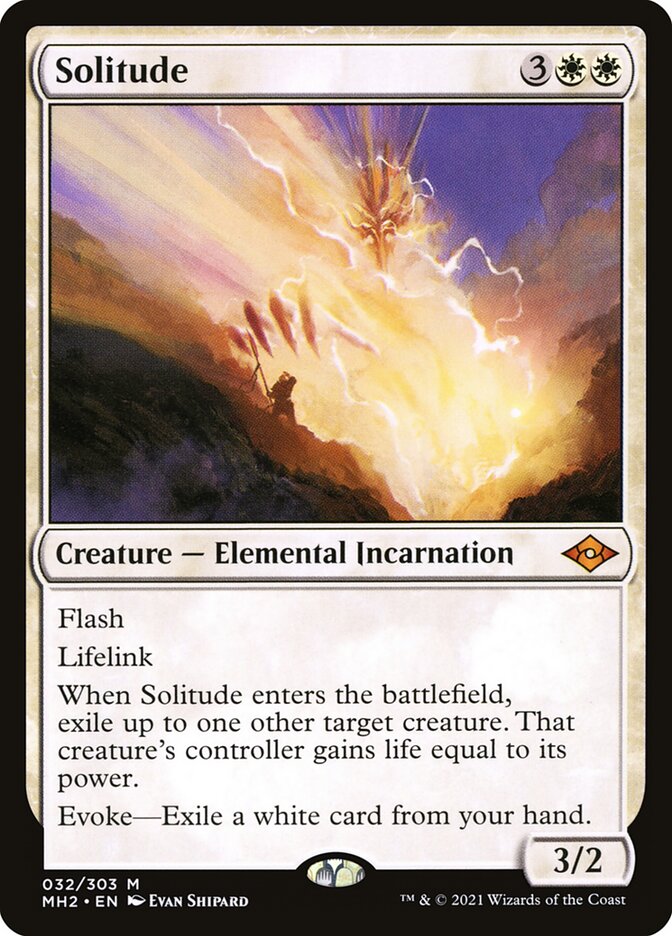
Solitude is one of those cards players keep asking about. Here is, in plain words, what its official text says, the rulings published by Wizards of the Coast, and the combos players actually run.
Official card text
Flash Lifelink When this creature enters, exile up to one other target creature. That creature's controller gains life equal to its power. Evoke—Exile a white card from your hand.
Complete guide
Solitude is a powerful Elemental Incarnation that provides instant-speed interaction while doubling as a lifelink threat. It is a staple in Modern and other formats because it can be cast for free or as a high-impact late-game creature. Understanding how its enter-the-battlefield ability interacts with its Evoke cost is key to mastering white control strategies.
Free Removal or Flash Threat
Solitude has Flash, allowing you to cast it at any time you could cast an Instant. You have two ways to pay for it: its mana cost of 3WW, or its Evoke cost by exiling a white card from your hand. If you Evoke it, you must sacrifice Solitude when it enters the battlefield, but you still get to use its powerful exile ability before it leaves.
Resolution Step-by-Step
When Solitude enters the battlefield, two things happen if you paid the Evoke cost: the exile ability triggers and the Evoke sacrifice ability triggers. You choose the order they are put on the stack. Typically, you will target a creature to exile. Once that ability resolves, the target's controller gains life equal to that creature's power, and Solitude remains on the field until the Evoke sacrifice trigger resolves.
Strategic Timing
Because Solitude has Lifelink, it is an excellent blocker. If you pay the full mana cost, it can stabilize your health while removing a threat. Even when Evoked, it acts as a 'free' spell that can stop an opponent's combo or aggressive start. Remember that the lifegain for your opponent is based on the creature's power at the moment it was exiled.
Common Mistakes
A common error is thinking that the mana value changes when you Evoke. The mana value of Solitude is always 5, regardless of whether you cast it for free. Additionally, you cannot choose to sacrifice a different creature to the Evoke trigger; you must sacrifice Solitude itself.
Interaction examples
 Solemn Simulacrum
You cast Solitude, targeting your opponent's Solemn Simulacrum. Upon resolution, Solemn Simulacrum is exiled and your opponent gains 2 life. Because it was exiled and did not die, the 'dies' ability of Solemn Simulacrum will not trigger, preventing your opponent from drawing a card.
 Roaming Throne
With Roaming Throne on the battlefield (choosing 'Elemental'), you cast Solitude. The enter-the-battlefield ability triggers an additional time. You can target and exile two different creatures, or the same creature twice (though the second one will fizzle). If you Evoked Solitude, you still sacrifice it only once, but you effectively doubled your removal for the same cost.
Guide written with AI from the official text and rulings. Official English text prevails.
How it works : Solitude
Original English text — Wizards of the Coast / Scryfall
- #1· Wizards of the Coast
To determine the total cost of a spell, start with the mana cost or alternative cost you're paying (such as an evoke cost), add any cost increases, then apply any cost reductions. The mana value of the spell is determined by only its mana cost, no matter what the total cost to cast that spell was.
No other card is named in this ruling.
- #2· Wizards of the Coast
If you pay the evoke cost, you can have the creature's own triggered ability resolve before the evoke triggered ability. You can cast spells after that ability resolves but before you have to sacrifice the creature.
No other card is named in this ruling.
Legal formats
Commentaires
- Sois le premier à commenter cette carte.
Read next
Meta decks with Solitude
No archived Top 8 deck with this card yet.