
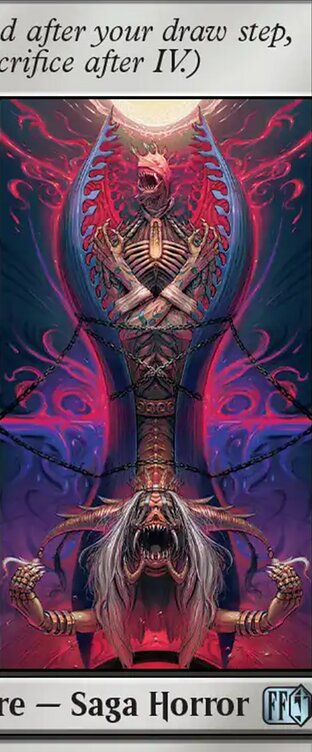

Summon: Anima is one of those cards players keep asking about. Here is, in plain words, what its official text says, the rulings published by Wizards of the Coast, and the combos players actually run.
Official card text
(As this Saga enters and after your draw step, add a lore counter. Sacrifice after IV.) I, II, III — Pain — You draw a card and you lose 1 life. IV — Oblivion — Each opponent sacrifices a creature of their choice and loses 3 life. Menace
Complete guide
Summon: Anima is a unique enchantment creature that bridges the gap between a terrifying threat and a powerful resource generator. As a Saga Horror with Menace, it forces your opponents to face both inevitable card advantage and a looming board wipe. This guide explores how to maximize its chapter abilities while utilizing its creature status on the battlefield.
Understanding the Saga Horror
Summon: Anima follows the standard Saga rules: it enters with one lore counter and gains one after each of your draw steps. However, because it is also a creature, it can attack and block as soon as it loses summoning sickness. The first three chapters, titled Pain, provide consistent card draw at the cost of life, while the final chapter, Oblivion, forces a sacrifice and direct life loss for your opponents. Remember that because it has Menace, it requires at least two creatures to be blocked, making it a persistent nuisance throughout its four-turn lifespan.
The Lifecycle of the Anima
When the first lore counter is placed, the 'Pain' ability triggers, goes on the stack, and resolves to let you draw a card. This repeats for chapters II and III. When the fourth counter is added, 'Oblivion' triggers. Once that final ability resolves or leaves the stack, you must sacrifice Summon: Anima as a state-based action. Crucially, the Menace ability is static and active the entire time the permanent is on the battlefield, regardless of which chapter is currently resolving.
Strategic Timing and Synergy
Because this card is an Enchantment Creature, it contributes two pips toward your devotion to black. This makes it an excellent setup piece for finishers. Common mistakes include forgetting that the sacrifice at chapter IV is mandatory once the ability leaves the stack. You cannot respond to the sacrifice itself; you must perform any 'sacrifice for value' actions while the chapter IV ability is still waiting on the stack if you wish to use it as a cost for something else.
Interaction examples
 Gray Merchant of Asphodel
With Summon: Anima on the battlefield, your devotion to black is increased by two from its mana cost ({4}{B}{B}). If you play Gray Merchant of Asphodel while Summon: Anima is on chapter I, II, or III, the Merchant's enter-the-battlefield ability will count the Anima, resulting in at least 4 life drained from each opponent (2 from Anima, 2 from the Merchant itself).
 Syr Konrad, the Grim
When Summon: Anima reaches Chapter IV (Oblivion), each opponent must sacrifice a creature. If Syr Konrad, the Grim is on the battlefield, his triggered ability will see each of those creatures hitting the graveyard, dealing 1 damage to each opponent for every creature sacrificed. Furthermore, when the Oblivion ability finishes resolving, Summon: Anima is sacrificed by state-based actions; Syr Konrad will trigger one additional time because a creature (Anima) died.
Guide written with AI from the official text and rulings. Official English text prevails.
How it works : Summon: Anima
Original English text — Wizards of the Coast / Scryfall
- #1· Wizards of the Coast
Once the number of lore counters on a Saga is greater than or equal to the greatest number among its chapter abilities, the Saga's controller sacrifices it as soon as its chapter ability has left the stack, most likely by resolving or being countered. This state-based action doesn't use the stack.
No other card is named in this ruling.
- #2· Wizards of the Coast
If multiple chapter abilities trigger at the same time, their controller puts them on the stack in any order. If any of them require targets, those targets are chosen as you put the abilities on the stack, before any of those abilities resolve.
No other card is named in this ruling.
- #3· Wizards of the Coast
As a Saga enters, its controller puts a lore counter on it. As your first main phase begins (immediately after your draw step), you put another lore counter on each Saga you control. Putting a lore counter on a Saga in either of these ways doesn't use the stack.
No other card is named in this ruling.
- #4· Wizards of the Coast
Due to a rules change that takes effect with this release (see below for details), a Saga that somehow loses all of its chapter abilities will not be sacrificed as a state-based action. It will also not gain a lore counter at the beginning of each of its controller's first main phases.
No other card is named in this ruling.
- #5· Wizards of the Coast
Each symbol on the left of a Saga's text box represents a chapter ability. A chapter ability is a triggered ability that triggers when a lore counter that is put on the Saga causes the number of lore counters on the Saga to become equal to or greater than the ability's chapter number. Chapter abilities are put onto the stack and may be responded to.
No other card is named in this ruling.
- #6· Wizards of the Coast
Once a chapter ability has triggered, the ability on the stack won't be affected if the Saga gains or loses counters, or if it leaves the battlefield.
No other card is named in this ruling.
- #7· Wizards of the Coast
Saga creatures have two sections to their text boxes. The first section, above the type line, contains their chapter abilities, and the second section, below the type line, contains any other abilities (or italicized flavor text). Any abilities in the latter section aren't chapter abilities and apply no matter how many lore counters are on the creature.
No other card is named in this ruling.
- #8· Wizards of the Coast
A chapter ability doesn't trigger if a lore counter is put on a Saga that already had a number of lore counters greater than or equal to that chapter's number. For example, the third lore counter put on a Saga causes the chapter III ability to trigger, but chapters I and II won't trigger again.
No other card is named in this ruling.
- #9· Wizards of the Coast
Removing lore counters won't cause a previous chapter ability to trigger. If lore counters are removed from a Saga, the appropriate chapter abilities will trigger again when the Saga receives more lore counters.
No other card is named in this ruling.
Legal formats
Commentaires
- Sois le premier à commenter cette carte.
Read next
Meta decks with Summon: Anima
No archived Top 8 deck with this card yet.