
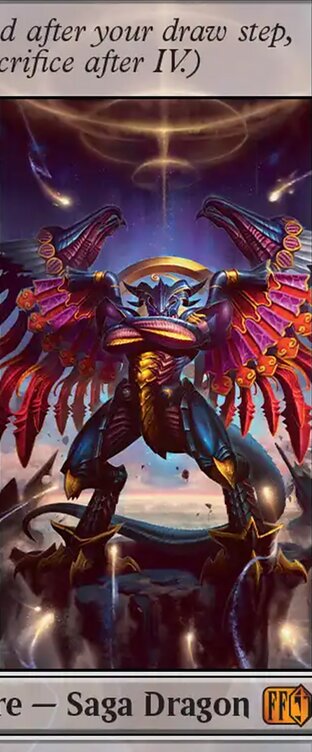
Summon: Bahamut is one of those cards players keep asking about. Here is, in plain words, what its official text says, the rulings published by Wizards of the Coast, and the combos players actually run.
Official card text
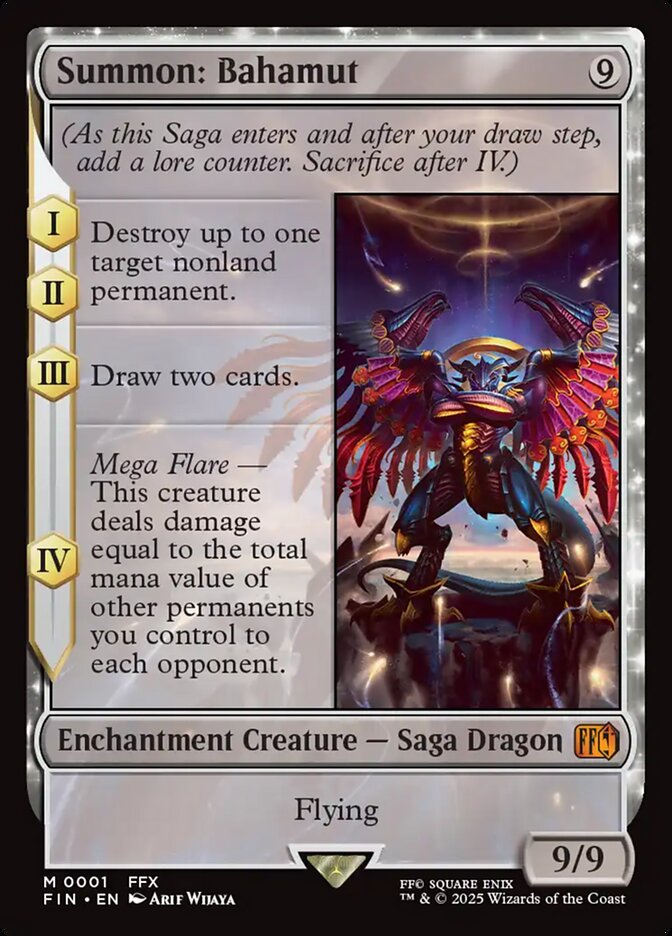
(As this Saga enters and after your draw step, add a lore counter. Sacrifice after IV.) I, II — Destroy up to one target nonland permanent. III — Draw two cards. IV — Mega Flare — This creature deals damage equal to the total mana value of other permanents you control to each opponent. Flying
Complete guide
Prepare for the arrival of the king of dragons with Summon: Bahamut, a massive nine-mana Enchantment Creature that functions as a devastating Saga. This unique card commands the battlefield with targeted destruction and card draw, culminating in its iconic Mega Flare ability. As a creature with Flying, it provides a persistent threat while its story unfolds across four powerful chapters.
Understanding the Saga Creature
Summon: Bahamut follows the standard rules for Sagas: it enters with a lore counter and gains one after each of your draw steps. Unlike traditional Sagas, this is also a creature with Flying. The Flying ability is separate from the chapters and remains active as long as the permanent is on the battlefield. Because it is a creature, it is subject to summoning sickness and can be blocked or targeted by creature removal.
The Path to Mega Flare
Chapters I and II allow you to target and destroy a nonland permanent twice, providing significant board control. Chapter III refills your hand by drawing two cards. The final chapter, IV, triggers Mega Flare. When this ability resolves, the game checks the total mana value of every other permanent you control. It then deals that much damage to each of your opponents. Note that 'other permanents' does not include Bahamut itself.
Sacrifice and Timing
A Saga is sacrificed as a state-based action only after its final chapter ability (Chapter IV) has left the stack. This happens whether the ability resolves normally, is countered, or fails because of a lack of targets. If you manage to remove lore counters from Bahamut before the fourth counter is added, you can delay the sacrifice and repeat previous chapters as you add counters back.
Common Mistakes
A frequent error is miscalculating the damage for Chapter IV. Tokens usually have a mana value of 0 unless they are copies of another permanent, and for permanents with {X} in their mana cost, X is always treated as 0. Additionally, remember that Chapter IV targets your opponents, not their creatures; however, the ability itself does not use the word 'target,' meaning it can bypass Hexproof or Shroud on players.
Interaction examples
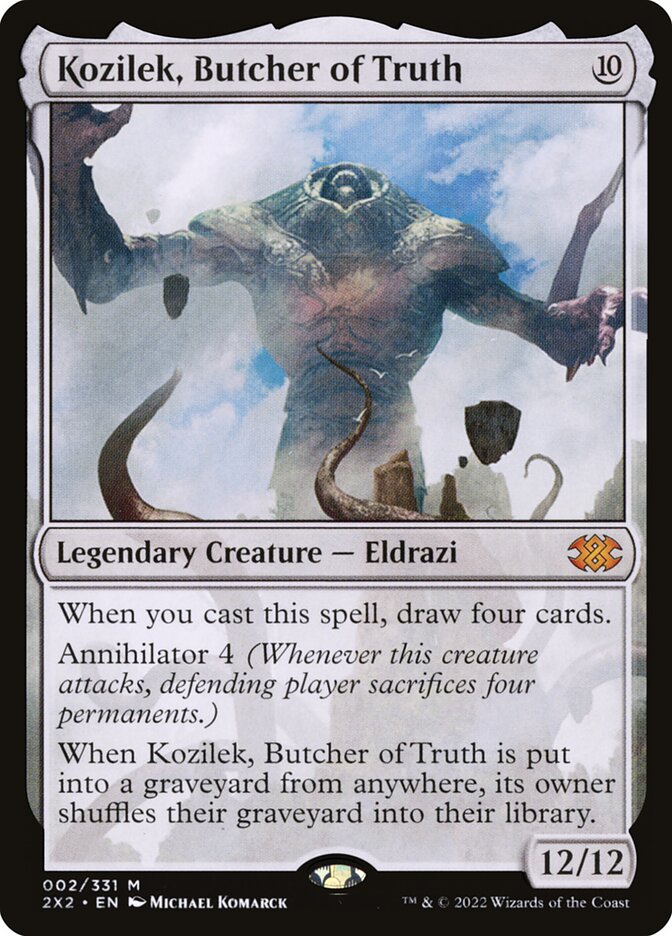 Kozilek, Butcher of Truth
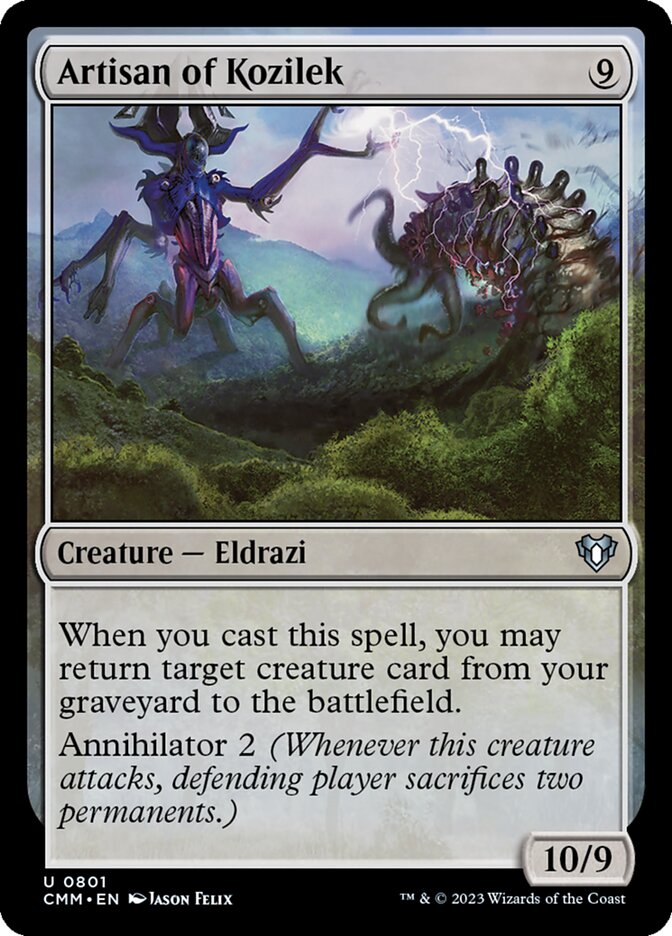 Artisan of Kozilek
If you control Kozilek, Butcher of Truth (mana value 10) and Artisan of Kozilek (mana value 9) when Summon: Bahamut's IV chapter resolves, Mega Flare will check your board. Excluding Bahamut, the total mana value is 19. Each opponent will be dealt 19 damage, likely ending the game on the spot.
Upon entering the battlefield, Summon: Bahamut triggers Chapter I. You target a troublesome permanent, such as an Ensnaring Bridge, to destroy it. This ensures that on future turns, your heavy hitters like Kozilek, Butcher of Truth are free to attack without restriction while the Saga continues to build toward its final chapter.
Guide written with AI from the official text and rulings. Official English text prevails.
How it works : Summon: Bahamut
Original English text — Wizards of the Coast / Scryfall
- #1· Wizards of the Coast
Use the total mana value of other permanents you control as Summon: Bahamut's fourth chapter ability resolves to determine how much damage is dealt.
No other card is named in this ruling.
- #2· Wizards of the Coast
A chapter ability doesn't trigger if a lore counter is put on a Saga that already had a number of lore counters greater than or equal to that chapter's number. For example, the third lore counter put on a Saga causes the chapter III ability to trigger, but chapters I and II won't trigger again.
No other card is named in this ruling.
- #3· Wizards of the Coast
If multiple chapter abilities trigger at the same time, their controller puts them on the stack in any order. If any of them require targets, those targets are chosen as you put the abilities on the stack, before any of those abilities resolve.
No other card is named in this ruling.
- #4· Wizards of the Coast
As a Saga enters, its controller puts a lore counter on it. As your first main phase begins (immediately after your draw step), you put another lore counter on each Saga you control. Putting a lore counter on a Saga in either of these ways doesn't use the stack.
No other card is named in this ruling.
- #5· Wizards of the Coast
If a permanent you control has
 in its mana cost, X is 0 for the purpose of determining its mana value.
No other card is named in this ruling.
- #6· Wizards of the Coast
Due to a rules change that takes effect with this release (see below for details), a Saga that somehow loses all of its chapter abilities will not be sacrificed as a state-based action. It will also not gain a lore counter at the beginning of each of its controller's first main phases.
No other card is named in this ruling.
- #7· Wizards of the Coast
Once a chapter ability has triggered, the ability on the stack won't be affected if the Saga gains or loses counters, or if it leaves the battlefield.
No other card is named in this ruling.
- #8· Wizards of the Coast
The mana value of a nonmodal double-faced permanent is the mana value of its front face, no matter which face is up.
No other card is named in this ruling.
- #9· Wizards of the Coast
Saga creatures have two sections to their text boxes. The first section, above the type line, contains their chapter abilities, and the second section, below the type line, contains any other abilities (or italicized flavor text). Any abilities in the latter section aren't chapter abilities and apply no matter how many lore counters are on the creature.
No other card is named in this ruling.
- #10· Wizards of the Coast
Removing lore counters won't cause a previous chapter ability to trigger. If lore counters are removed from a Saga, the appropriate chapter abilities will trigger again when the Saga receives more lore counters.
No other card is named in this ruling.
- #11· Wizards of the Coast
Each symbol on the left of a Saga's text box represents a chapter ability. A chapter ability is a triggered ability that triggers when a lore counter that is put on the Saga causes the number of lore counters on the Saga to become equal to or greater than the ability's chapter number. Chapter abilities are put onto the stack and may be responded to.
No other card is named in this ruling.
- #12· Wizards of the Coast
Once the number of lore counters on a Saga is greater than or equal to the greatest number among its chapter abilities, the Saga's controller sacrifices it as soon as its chapter ability has left the stack, most likely by resolving or being countered. This state-based action doesn't use the stack.
No other card is named in this ruling.
Popular combos
Real combos played by the community, sorted by popularity.


Summon: Bahamut + Glava, Five-Advents Mage + Gogo, Master of Mimicry
- 1At the beginning of your precombat main phase, Summon: Bahamut triggers, putting a lore counter on it and triggering its fourth chapter ability.
- 2Activate Gogo by paying
 and tapping it, targeting Summon: Bahamut's trigger.
- 3Glava triggers, causing the value of X used for Gogo's ability to become 5 instead.
- 4Resolve Gogo's ability, copying Summon: Bahamut's trigger five times.
- 5Resolve all Summon: Bahamut triggers, dealing damage to each opponent equal to six times the total mana value of permanents you control other than Summon: Bahamut.
Legal formats
Commentaires
- Sois le premier à commenter cette carte.
Read next
Meta decks with Summon: Bahamut
No archived Top 8 deck with this card yet.