

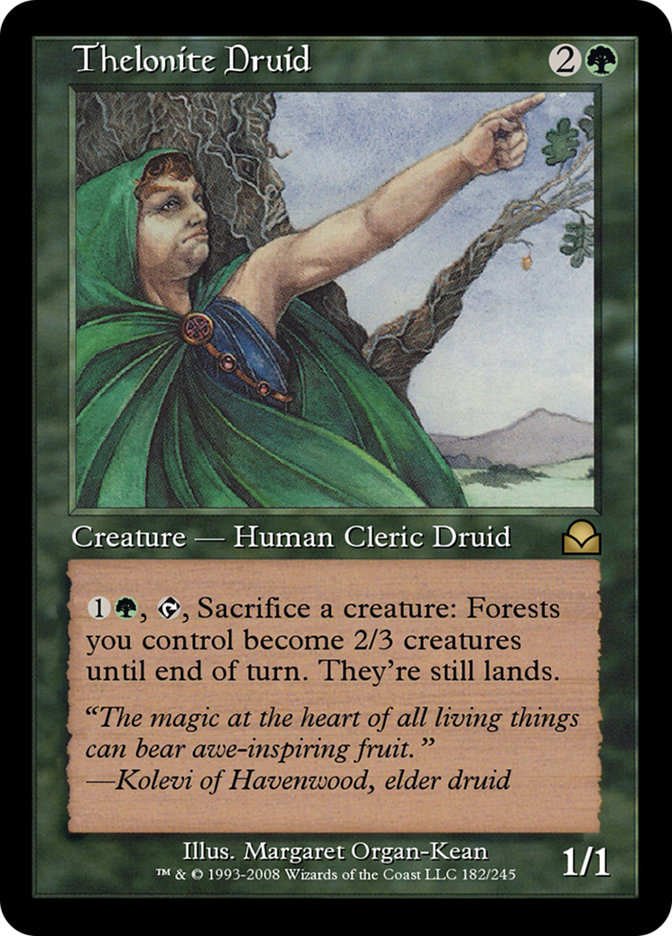
Thelonite Druid is one of those cards players keep asking about. Here is, in plain words, what its official text says, the rulings published by Wizards of the Coast, and the combos players actually run.
Official card text
,
, Sacrifice a creature: Forests you control become 2/3 creatures until end of turn. They're still lands.

Complete guide
Thelonite Druid is a classic green utility creature that turns your peaceful woods into a formidable army. By sacrificing a creature, you can awaken your Forests to defend your life or deliver a finishing blow to your opponent.
What It Does
Thelonite Druid has a mana ability that costs {1}{G}, tapping itself, and sacrificing a creature to turn all Forests you control into 2/3 creatures until the end of the turn. These creatures retain their land type, meaning they can still be tapped for mana, but they are now susceptible to creature removal and combat damage.
Step-by-Step Resolution
First, you activate the ability by paying the mana, tapping the Druid, and sacrificing a creature (you can even sacrifice the Druid itself). Upon resolution, every permanent you control with the 'Forest' subtype becomes a 2/3 creature. Note that this only affects Forests currently on the battlefield; any Forests played later in the turn will remain non-creature lands.
Common Mistakes
A frequent error involves 'Summoning Sickness.' Even though a land has been on the battlefield for several turns, the moment it becomes a creature, it cannot attack or tap for mana unless you have controlled that permanent since the start of your most recent turn. Additionally, if a land loses the 'Forest' subtype after the ability resolves, it remains a 2/3 creature until the end of the turn.
When to Play It
Thelonite Druid is best used during your declare attackers step to create a surprise army, or as a defensive measure to block incoming threats. It excels in decks that generate disposable tokens or have 'leaves the battlefield' triggers, allowing you to turn utility into raw power.
Interaction examples
 Solemn Simulacrum
You activate Thelonite Druid by sacrificing Solemn Simulacrum. The Druid's ability goes on the stack, and the Simulacrum's 'dies' trigger also goes on the stack. You draw a card first, then your Forests become 2/3 creatures.
 Sakura-Tribe Elder
If you want to maximize your army, you should use Sakura-Tribe Elder to find a Forest first. However, if you sacrifice the Elder to pay for the Druid's cost, you get the 2/3 creatures but you do not get the land from the Elder's own ability, as you can only sacrifice a permanent to pay for one cost at a time.
If your opponent targets Thelonite Druid with a removal spell, you can respond by activating its ability and sacrificing the Druid to itself. The ability will still resolve, turning your Forests into 2/3 creatures even though the Druid is no longer on the battlefield.
Guide written with AI from the official text and rulings. Official English text prevails.
How it works : Thelonite Druid
Original English text — Wizards of the Coast / Scryfall
- #1· Wizards of the Coast
A noncreature permanent that turns into a creature can attack, and its
abilities can be activated, only if its controller has continuously controlled that permanent since the beginning of their most recent turn. It doesn’t matter how long the permanent has been a creature.No other card is named in this ruling.
- #2· Wizards of the Coast
The most recent land animating ability takes precedence.
No other card is named in this ruling.
- #3· Wizards of the Coast
Can sacrifice the Druid to itself.
No other card is named in this ruling.
- #4· Wizards of the Coast
Only affects Forests that are on the battlefield when the effect resolves.
No other card is named in this ruling.
- #5· Wizards of the Coast
The land animation ability does not wear off if the land stops being a Forest. It continues until the end of the turn.
No other card is named in this ruling.
Legal formats
Commentaires
- Sois le premier à commenter cette carte.
Read next
Meta decks with Thelonite Druid
No archived Top 8 deck with this card yet.