

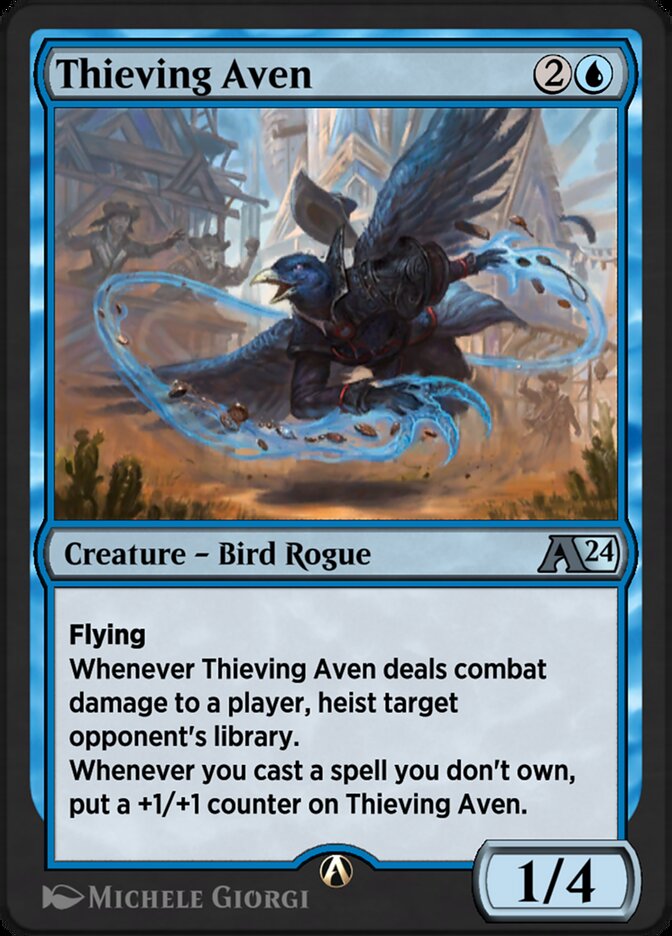
Thieving Aven is one of those cards players keep asking about. Here is, in plain words, what its official text says, the rulings published by Wizards of the Coast, and the combos players actually run.
Official card text
Flying Whenever Thieving Aven deals combat damage to a player, heist target opponent's library. Whenever you cast a spell you don't own, put a +1/+1 counter on Thieving Aven.
Complete guide
Thieving Aven is a versatile Bird Rogue that combines evasion with the powerful heist mechanic to turn your opponent's deck against them. Not only does it steal resources, but it also grows stronger every time you cast a spell that originally belonged to another player. This creature is a must-have for any commander deck looking to benefit from the misfortunes of others.
Understanding Heist and Growth
Thieving Aven has two distinct triggered abilities. The first triggers when it deals combat damage to a player, allowing you to heist their library. The second is a triggered ability that monitors when you cast a spell you don't own. When you heist a library, you look at the top three cards of that player's library, exile one face down, and put the rest on the bottom in a random order. You may cast that exiled card for as long as it remains exiled, using mana of any color to do so. Each time you cast such a spell, Thieving Aven receives a +1/+1 counter.
Resolution Step-by-Step
First, Thieving Aven must deal combat damage to a player. Once damage is dealt, the heist ability goes on the stack. When the ability resolves, you choose an opponent (usually the one damaged) and look at the top three cards of their library. You select one to exile face down and return the others to the bottom. Later, when you decide to cast that exiled card, the Aven's second ability triggers. This growth trigger goes on the stack on top of the stolen spell, meaning Thieving Aven will get its +1/+1 counter before the stolen spell actually resolves.
Common Pitfalls
A common mistake is forgetting that you must still pay the mana cost for the heisted card; heisting does not make the spell free. Additionally, the heist ability only triggers on combat damage, not any damage dealt by the creature. If Thieving Aven leaves the battlefield, you can still cast any cards you previously heisted with it, but the Aven will no longer be there to receive +1/+1 counters from those spells.
When to Play Thieving Aven
Thieving Aven is best played early in the game when opponents lack flying blockers. This ensures you can start heisting cards as soon as possible. It is particularly effective against decks that run high-impact utility cards or powerful creatures that you can use to bolster your own board state while growing your Aven into a lethal threat.
Interaction examples
 Roaming Throne
If you have Roaming Throne on the battlefield with 'Bird' or 'Rogue' chosen as the creature type, Thieving Aven's combat damage trigger will fire twice. You will heist the opponent's library two separate times, exiling two different cards. Furthermore, when you cast those stolen spells, the Roaming Throne will cause the +1/+1 counter trigger to fire twice for each spell, doubling the growth of your Aven.
 Solemn Simulacrum
Suppose you heist your opponent's Solemn Simulacrum. When you cast it, Thieving Aven's second ability triggers, giving it a +1/+1 counter. As the Solemn Simulacrum enters the battlefield under your control, you search your library for a basic land. If the Golem later dies, you (the controller) draw the card, even though your opponent owns the card.
Guide written with AI from the official text and rulings. Official English text prevails.
How it works : Thieving Aven
Original English text — Wizards of the Coast / Scryfall
No additional ruling has been published for this card.
Legal formats
Commentaires
- Sois le premier à commenter cette carte.
Read next
Meta decks with Thieving Aven
No archived Top 8 deck with this card yet.