


Thought Monitor is one of those cards players keep asking about. Here is, in plain words, what its official text says, the rulings published by Wizards of the Coast, and the combos players actually run.
Official card text
Affinity for artifacts (This spell costsless to cast for each artifact you control.) Flying When this creature enters, draw two cards.
Complete guide
Thought Monitor is a powerful artifact creature that rewards players for filling their battlefield with trinkets and treasures. By utilizing the Affinity keyword, you can often deploy this high-flying Construct for a fraction of its mana cost. Once it hits the battlefield, it immediately replenishes your hand, making it a staple for artifact-centric strategies.
Understanding Affinity for Artifacts
The primary mechanic of Thought Monitor is Affinity for artifacts. This ability reduces the total cost to cast the spell by one generic mana for each artifact you control at the time you pay for the spell. It is important to note that Affinity can only reduce the generic mana portion of the cost; you must always pay the single blue mana required regardless of how many artifacts you have.
Resolution Step by Step
First, you announce you are casting Thought Monitor and determine the cost by counting your artifacts. After paying the mana and putting the spell on the stack, players may respond. Once it resolves, Thought Monitor enters the battlefield, and its triggered ability goes on the stack. When that ability resolves, you draw two cards. If the creature is destroyed in response to its entry trigger, you still get to draw your cards.
Common Pitfalls
A common mistake is forgetting that Thought Monitor counts itself if it is already on the battlefield, but not while it is a spell being cast. Additionally, if an opponent destroys one of your artifacts in response to you announcing the spell, it is too late to change the cost you paid. However, if they destroy an artifact before you begin the casting process, the cost will increase.
When to Deploy
Thought Monitor is best played in the mid-to-late game when your board is established with mana rocks or equipment. Because it provides immediate card advantage, it is an excellent way to recover after a board wipe or to dig for specific combo pieces while maintaining a presence in the air.
Interaction examples
 Hullbreaker Horror
With Hullbreaker Horror on the battlefield, you cast Thought Monitor. The Horror's ability triggers immediately. Even if your opponent tries to counter Thought Monitor, you can use the Horror's trigger to return a nonland permanent to its owner's hand. After the trigger resolves, Thought Monitor enters, and you draw two cards, potentially finding more spells to trigger the Horror again.
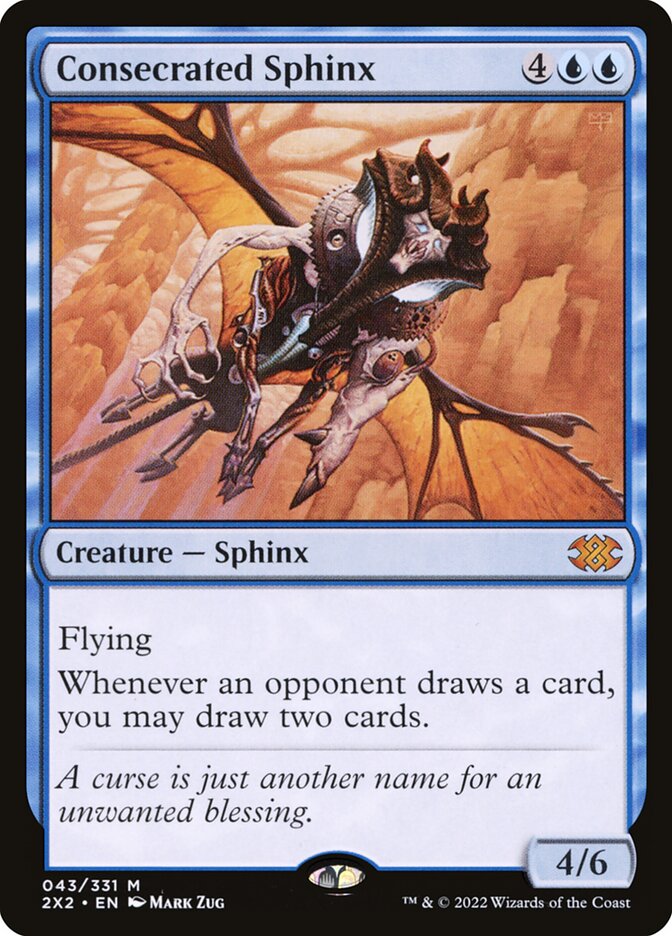 Consecrated Sphinx
If you control Consecrated Sphinx and your opponent casts Thought Monitor, the opponent draws two cards upon its entry. This triggers your Sphinx twice. For each card the opponent drew, you may draw two cards, resulting in you drawing up to four cards total from their single creature entry.
If you control six Treasure tokens, Thought Monitor's cost is reduced by {6}. You only need to pay one blue mana to cast it. Upon resolution, you have a 2/2 flier and two new cards in hand for the price of a single mana.
Guide written with AI from the official text and rulings. Official English text prevails.
How it works : Thought Monitor
Original English text — Wizards of the Coast / Scryfall
No additional ruling has been published for this card.
Legal formats
Commentaires
- Sois le premier à commenter cette carte.
Read next
Meta decks with Thought Monitor
No archived Top 8 deck with this card yet.