

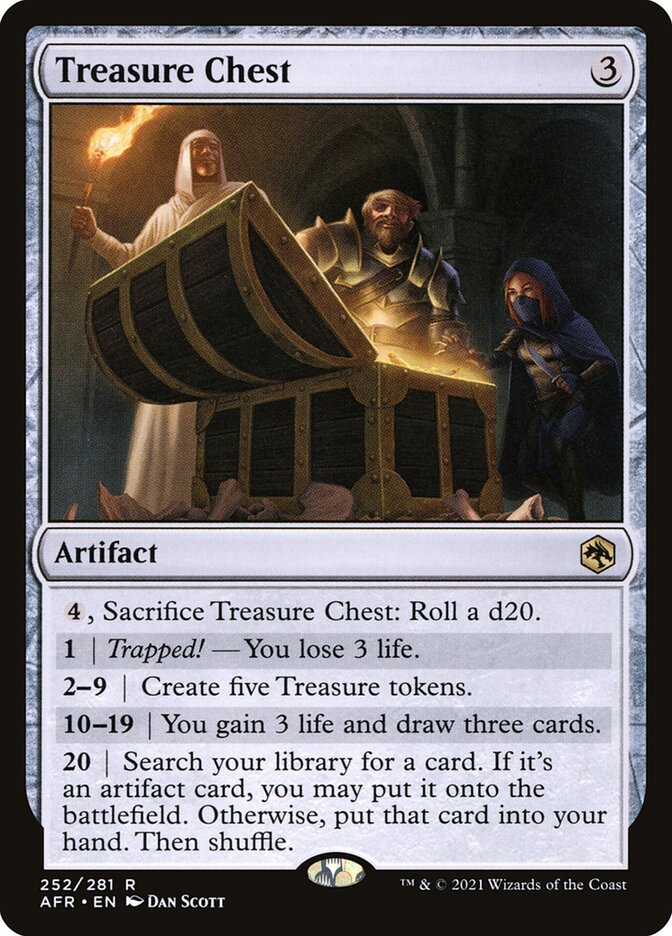
Treasure Chest is one of those cards players keep asking about. Here is, in plain words, what its official text says, the rulings published by Wizards of the Coast, and the combos players actually run.
Official card text
, Sacrifice this artifact: Roll a d20. 1 | Trapped! — You lose 3 life. 2—9 | Create five Treasure tokens. 10—19 | You gain 3 life and draw three cards. 20 | Search your library for a card. If it's an artifact card, you may put it onto the battlefield. Otherwise, put that card into your hand. Then shuffle.
Complete guide
Treasure Chest brings the excitement of a high-stakes dungeon crawl to your Magic game, offering a range of outcomes from a deadly trap to a powerful relic. This artifact challenges players to gamble their mana for the chance of immense card advantage or a free permanent. Knowing how the d20 roll integrates with the stack is key to mastering this card's unpredictable nature.
Unlocking the Chest
Treasure Chest has a single activated ability that costs four mana and requires you to sacrifice the artifact as part of the cost. Once activated, the ability goes on the stack. When it resolves, you roll a twenty-sided die (d20). The result of this roll determines which of the four possible effects occurs: losing life, generating Treasure tokens, drawing cards, or searching your library for any card.
Resolution and the Stack
A crucial rule to remember is that the die roll happens during the resolution of the ability. This means that once a player rolls the d20, the result is locked in and the corresponding effect happens immediately. Opponents cannot wait to see what you roll before deciding whether to counter the ability or respond; they must act while the ability is still on the stack, before the die hits the table.
The Natural 20
If you roll a 20, you search your library for any card. If the chosen card is an artifact, you have a choice: put it directly onto the battlefield or into your hand. If the card is not an artifact, it must go to your hand. Interestingly, the 'otherwise' clause in the rules means you can choose to put an artifact card into your hand instead of the battlefield if you wish to hide it from your opponents, as you do not need to reveal cards that go directly to your hand.
When to Roll
Because Treasure Chest requires a significant mana investment and sacrifices itself, it is best used when you have mana to spare or are desperate for resources. It serves as a colorless source of card draw or ramp, making it versatile for decks that struggle with those elements, though the risk of the 'Trapped!' result (rolling a 1) means you shouldn't rely on it when your life total is dangerously low.
Interaction examples
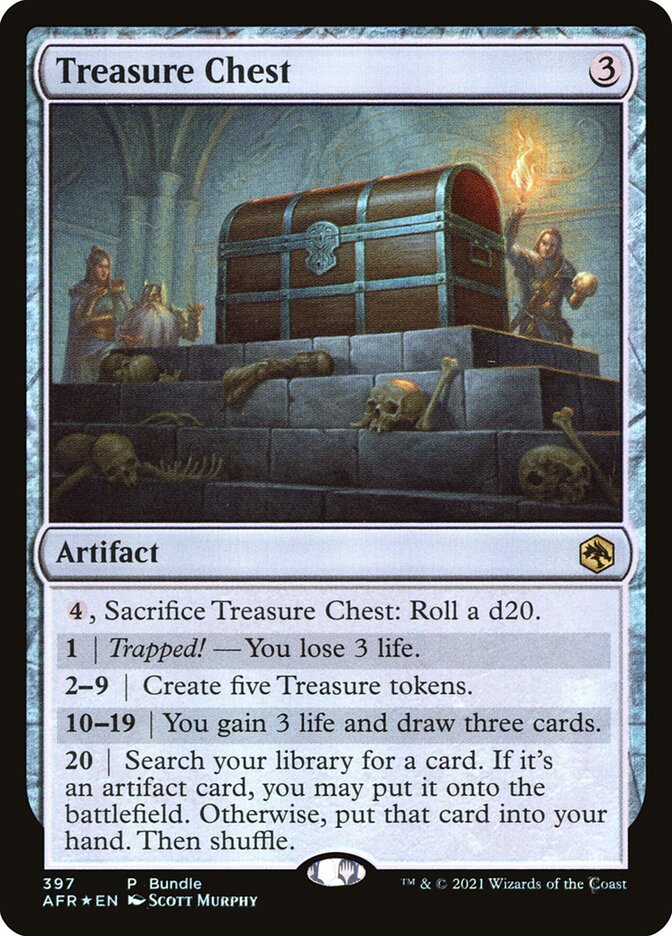 Treasure Chest
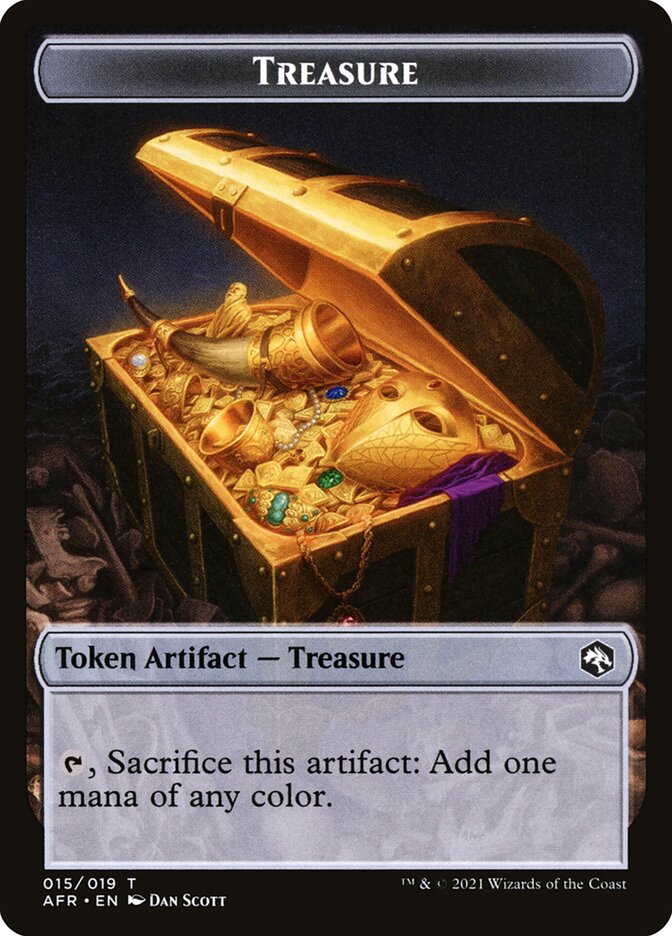 Treasure
You pay four mana and sacrifice Treasure Chest. You roll a 7. According to the results table (2-9), you create five Treasure tokens. These tokens can then be sacrificed at any time to produce mana, effectively netting you one additional mana more than you spent to activate the chest, while also providing mana fixing.
 Arcane Signet
After rolling a natural 20, you search your library. You find Arcane Signet. Since it is an artifact, you may put it directly onto the battlefield. This allows you to bypass the mana cost of the Signet entirely.
 Swiftfoot Boots
You roll a 20 and search for Swiftfoot Boots. Although it is an artifact, you decide you don't want your opponent to know what you found yet. You choose the 'otherwise' path and put the card into your hand. Because it is going to your hand, you do not have to reveal that you chose the Boots.
Guide written with AI from the official text and rulings. Official English text prevails.
How it works : Treasure Chest
Original English text — Wizards of the Coast / Scryfall
- #1· Wizards of the Coast
The “otherwise” in the last ability refers to whether or not you put it onto the battlefield, not whether or not it's an artifact card. You may put it into your hand even if it's an artifact card.
No other card is named in this ruling.
- #2· Wizards of the Coast
If you choose to put the card into your hand, you don't need to reveal it.
No other card is named in this ruling.
- #3· Wizards of the Coast
Dice are identified by the number of faces each one has. For example, a d20 is a twenty-sided die.
No other card is named in this ruling.
- #4· Wizards of the Coast
Dice used must have equally likely outcomes and the roll must be fair. Although physical dice are recommended, digital substitutes are allowed, provided they have the same number of equally likely outcomes as specified in the original roll instruction.
No other card is named in this ruling.
- #5· Wizards of the Coast
An ability that tells you to roll a die will also specify what to do with the result of that roll. Most often, this is in the form of a “results table” in the card text.
No other card is named in this ruling.
- #6· Wizards of the Coast
The instruction to roll a die and the effect that occurs because of the result are all part of the same ability. Players do not get the chance to respond to the ability after knowing the result of the roll.
No other card is named in this ruling.
- #7· Wizards of the Coast
An effect that says “choose a target, then roll a d20” or similar still uses the normal process of putting an ability on the stack and resolving it. Choosing targets is part of putting the ability on the stack and rolling the d20 happens later, as the ability resolves.
No other card is named in this ruling.
- #8· Wizards of the Coast
Some effects may modify the result of a die roll. This may be part of the instruction to roll a die or it may come from other cards. Anything that references the “result” of a die roll is looking for the result after these modifications. Anything that is looking for the “natural result” is looking for the number shown on the face of the die before these modifications.
No other card is named in this ruling.
- #9· Wizards of the Coast
Some abilities, like that of Pixie Guide and Barbarian Class, replace rolling a die with rolling extra dice and ignoring the lowest roll. The ignored rolls are not considered for the effect that instructed you to roll a die, and do not cause abilities to trigger. For all intents and purposes, once you determine which dice count, any extra dice were never rolled.
No other card is named in this ruling.
- #10· Wizards of the Coast
Some effects instruct you to roll again. This uses the same number and type of dice as the original roll, and that roll will use the same set of possible outcomes.
No other card is named in this ruling.
- #11· Wizards of the Coast
While playing Planechase, rolling the planar die will cause any ability that triggers whenever a player rolls one or more dice to trigger. However, any effect that refers to a numerical result will ignore the rolling of the planar die.
No other card is named in this ruling.
- #12· Wizards of the Coast
Tournament events have more specific rules regarding dice and die-rolling. For more information, please see the most recent version of the Magic Tournament Rules at https://wpn.wizards.com/en/document/magic-gathering-tournament-rules.
No other card is named in this ruling.
Related cards and tokens
Legal formats
Commentaires
- Sois le premier à commenter cette carte.
Read next
Meta decks with Treasure Chest
No archived Top 8 deck with this card yet.