
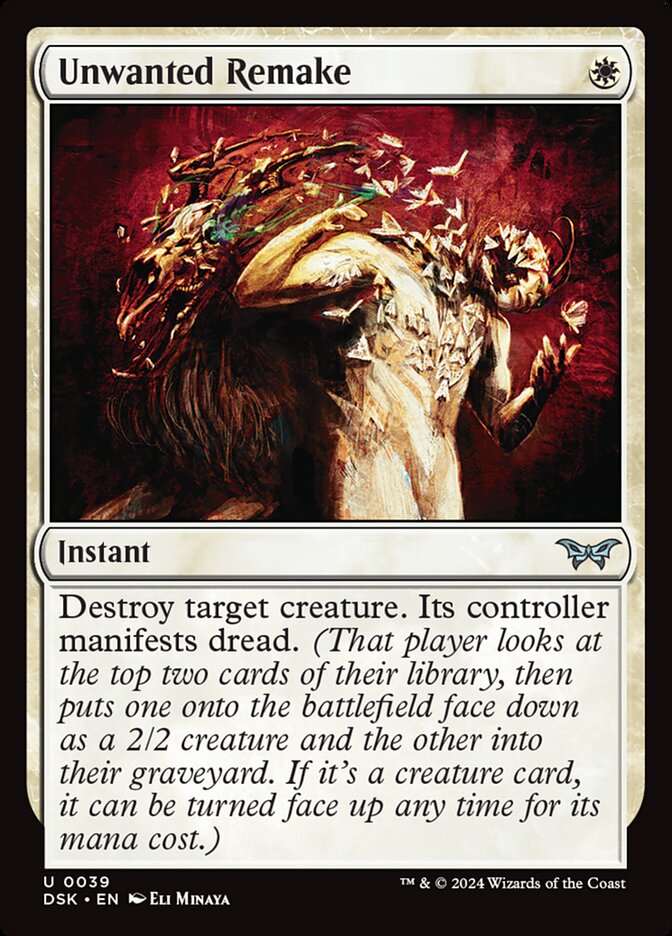
Unwanted Remake is one of those cards players keep asking about. Here is, in plain words, what its official text says, the rulings published by Wizards of the Coast, and the combos players actually run.
Official card text
Destroy target creature. Its controller manifests dread. (That player looks at the top two cards of their library, then puts one onto the battlefield face down as a 2/2 creature and the other into their graveyard. If it's a creature card, it can be turned face up any time for its mana cost.)
Complete guide
Unwanted Remake is a powerful white removal spell that offers a low mana cost in exchange for a mysterious replacement on the battlefield. It allows you to eliminate a major threat while forcing your opponent to gamble on the top of their library through the manifest dread mechanic.
What it Does
Unwanted Remake destroys a target creature for just a single white mana. As part of the resolution, that creature's controller performs the 'manifest dread' action. This means they look at the top two cards of their library, put one onto the battlefield face down as a 2/2 colorless creature, and put the other into their graveyard. If the face-down card is a creature, it can be turned face up later by paying its mana cost.
How it Resolves Step-by-Step
1. You cast Unwanted Remake and choose a legal target creature. 2. Upon resolution, check if the target is still legal; if it isn't (for example, it gained Hexproof), the spell fails and nothing happens. 3. If the target is legal, destroy the creature. 4. The creature's controller looks at the top two cards of their library. They choose one to place face down as a 2/2 creature and the other goes to the graveyard. If the library has only one card, they manifest that card; if zero, they do nothing.
Common Mistakes
A common error is forgetting that manifest dread happens even if the creature is indestructible. While the creature won't be destroyed, its controller still follows the instructions to manifest dread. Additionally, players often forget that the face-down card has no name or mana cost (a mana value of 0), and turning it face up is a special action that does not use the stack and cannot be countered.
When to Play it
This card is best used when you need to remove a high-impact creature that your opponent spent significant resources on. Since the resulting 2/2 creature is unknown, it is safer to use when your opponent's library is unlikely to have a massive creature on top. It is also an excellent tool in decks that care about the graveyard, as you might use it on your own creature to selectively mill a card while keeping board presence.
Interaction examples
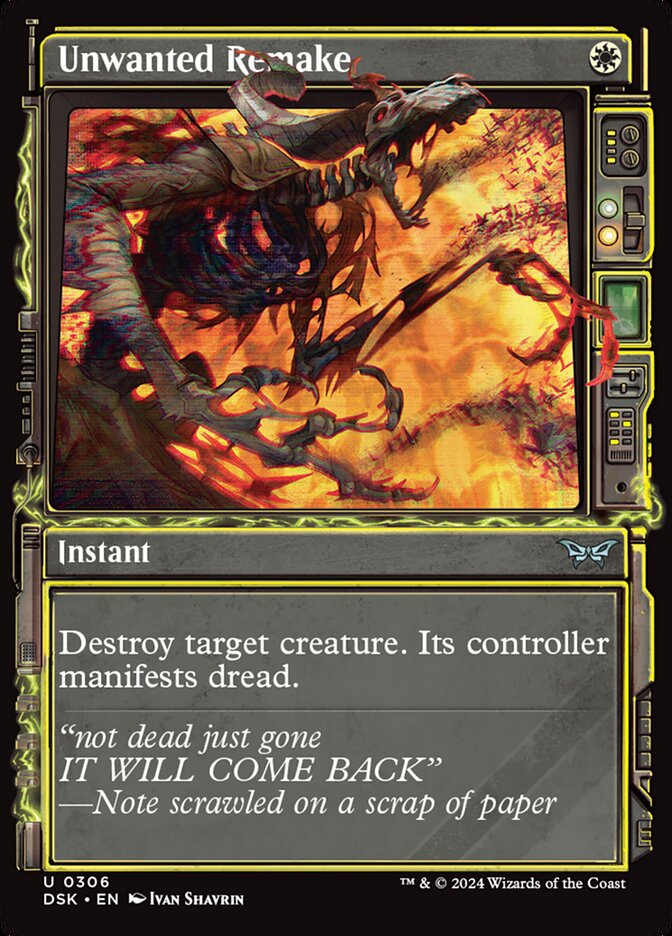 Unwanted Remake
 Swords to Plowshares
 Path to Exile
Unlike Swords to Plowshares, which gives your opponent life, or Path to Exile, which ramps their mana, Unwanted Remake leaves them with a 2/2 creature. While the 2/2 is a board presence, it is often less valuable than the extra life or land, especially in aggressive decks where you want to keep the opponent off their resources.
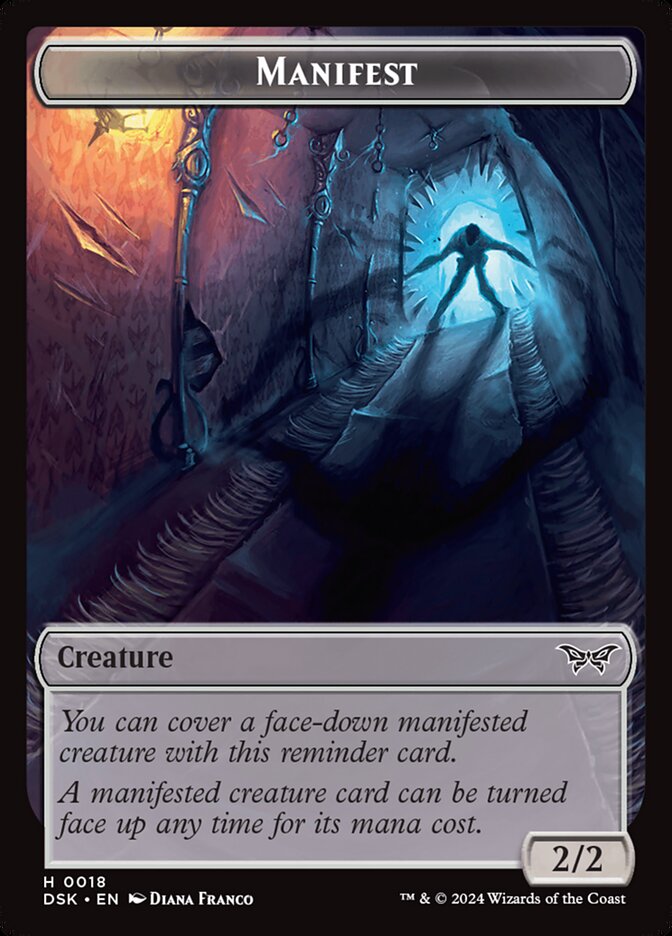 Manifest
If you target an opponent's creature with Unwanted Remake, they use the Manifest mechanic. If they find a powerful creature card in their top two cards, they can later pay its mana cost to flip it. This means you might destroy a threat only for it to be replaced by an even larger one later in the game.
Guide written with AI from the official text and rulings. Official English text prevails.
How it works : Unwanted Remake
Original English text — Wizards of the Coast / Scryfall
- #1· Wizards of the Coast
If the target creature is an illegal target as Unwanted Remake tries to resolve, it won't resolve and none of its effects will happen. The creature's controller won't manifest dread.
Card named in this ruling
- #2· Wizards of the Coast
To manifest dread, look at the top two cards of your library. Manifest one (by putting it onto the battlefield face down) and put the other into your graveyard. The card you put onto the battlefield becomes a 2/2 face-down creature with no name, mana cost, creature types, or abilities. It's colorless and has a mana value of 0. Other effects that apply to the permanent can still grant it any characteristics it doesn't have or change the characteristics it does have.
Card named in this ruling
- #3· Wizards of the Coast
Any time you have priority, you can turn a manifested permanent you control face up by revealing that it's a creature card (ignoring any copy effects or type-changing effects that might be applying to it) and paying its mana cost. This is a special action. It doesn't use the stack and can't be responded to.
Card named in this ruling
- #4· Wizards of the Coast
If a manifested creature would have disguise or morph if it were face up, you may also turn it face up by paying its disguise or morph cost, as appropriate.
Card named in this ruling
- #5· Wizards of the Coast
Unlike a face-down creature that was cast using a disguise or morph ability, a manifested creature may still be turned face up after it loses its abilities if it's a creature card.
Card named in this ruling
- #6· Wizards of the Coast
If a double-faced card is manifested, it will be put onto the battlefield face down. While face down, it can't transform. If the front face of the card is a creature card, you can turn it face up by paying its mana cost. If you do, its front face will be up.
Card named in this ruling
- #7· Wizards of the Coast
If your library contains only one card when you manifest dread, you'll look at that card and put it onto the battlefield face down. You won't have the option to put it into your graveyard instead. If your library contains no cards when you manifest dread, you won't do anything.
Card named in this ruling
- #8· Wizards of the Coast
Some cards in the Duskmourn release have abilities that trigger "whenever you manifest dread." In circumstances where you are instructed to manifest dread but can't perform some or all of the steps of manifesting dread (probably because your library has one or fewer cards in it), these abilities will still trigger.
Card named in this ruling
- #9· Wizards of the Coast
At any time, you can look at a face-down spell or permanent you control. You can't look at face-down permanents or spells you don't control unless an effect instructs or allows you to do so.
No other card is named in this ruling.
- #10· Wizards of the Coast
If a face-down creature loses its abilities, it can't be turned face up with a disguise or morph ability because it will no longer have that ability (or the associated cost) once face up.
No other card is named in this ruling.
- #11· Wizards of the Coast
Because the permanent is on the battlefield both before and after it's turned face up, turning a permanent face up doesn't cause any enters-the-battlefield abilities to trigger.
No other card is named in this ruling.
- #12· Wizards of the Coast
Because face-down creatures don't have a name, they can't have the same name as any other creature, even another face-down creature.
No other card is named in this ruling.
- #13· Wizards of the Coast
A permanent that turns face up or face down changes characteristics but is otherwise the same permanent. Spells and abilities that were targeting that permanent and Auras and Equipment that were attached to that permanent aren't affected unless the new characteristics of the object change the legality of those targets or attachments.
No other card is named in this ruling.
- #14· Wizards of the Coast
Turning a permanent face up or face down doesn't change whether that permanent is tapped or untapped.
No other card is named in this ruling.
- #15· Wizards of the Coast
If a face-down spell leaves the stack and goes to any zone other than the battlefield (if it was countered, for example), you must reveal it. Similarly, if a face-down permanent leaves the battlefield, you must reveal it. You must also reveal all face-down spells and permanents you control if you leave the game or the game ends.
No other card is named in this ruling.
- #16· Wizards of the Coast
You must ensure that your face-down spells and permanents can be easily differentiated from each other. You're not allowed to mix up the cards that represent them on the battlefield to confuse other players. The order in which they entered should remain clear, as well as what ability caused them to be face down. (This includes manifest, disguise, cloak, morph, and a few older effects that turn cards face down.) Common methods for doing this include using markers or dice, or simply placing them in order on the battlefield.
Card named in this ruling
- #17· Wizards of the Coast
If something tries to turn a face-down instant or sorcery card on the battlefield face up, reveal that card to show all players it's an instant or sorcery card. The permanent remains on the battlefield face down. Abilities that trigger when a permanent turns face up won't trigger, because even though you revealed the card, it never turned face up.
No other card is named in this ruling.
Related cards and tokens
Legal formats
Commentaires
- Sois le premier à commenter cette carte.
Read next
Meta decks with Unwanted Remake
No archived Top 8 deck with this card yet.