

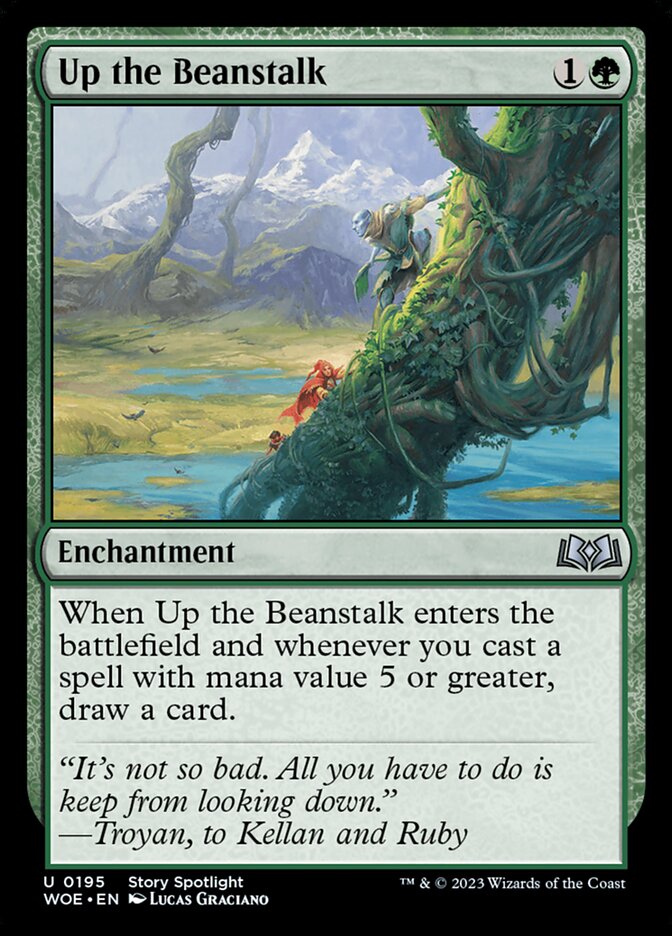
Up the Beanstalk is one of those cards players keep asking about. Here is, in plain words, what its official text says, the rulings published by Wizards of the Coast, and the combos players actually run.
Official card text
When this enchantment enters and whenever you cast a spell with mana value 5 or greater, draw a card.
Complete guide
Up the Beanstalk is a powerful value engine that rewards you for playing high-impact spells. This green enchantment ensures you never run out of gas by replacing itself immediately and then drawing cards for every heavy hitter you cast. It has become a staple for decks looking to maximize their mid-to-late game resources.
Continuous Value Generation
The beauty of Up the Beanstalk lies in its two-part triggered ability. The first part is an 'enters' trigger, meaning as soon as the enchantment successfully resolves and enters the battlefield, you draw a card. The second part is a cast trigger that looks at the mana value of every spell you cast. If that spell's mana value is 5 or greater, the ability triggers and goes on the stack on top of that spell.
Understanding Mana Value
To trigger the draw effect, the spell you cast must have a mana value of 5 or more. Mana value is determined by the total amount of mana in the upper right corner of the card. If a spell has {X} in its cost, the value chosen for X is added to the total mana value while the spell is on the stack. Note that the trigger happens when you cast the spell, so you will draw the card even if the spell is eventually countered by an opponent.
Common Mistakes
A frequent error is confusing 'mana value' with 'mana spent.' If you cast a spell that costs 7 mana but you only paid 2 mana because of a discount or alternative cost, the mana value remains 7, and Up the Beanstalk will trigger. Conversely, if you pay extra mana for taxes like Ward or Thalia, Guardian of Thraben, the mana value does not increase; it is strictly based on the card's printed cost and any chosen value for X.
When to Play It
You should aim to play Up the Beanstalk early in the game, ideally on turn two, to set up your engine. Because it draws a card upon entering, it is a low-risk investment. It shines brightest in 'Big Mana' or 'Control' shells where your deck is naturally packed with expensive spells that ensure you are consistently drawing extra cards every turn.
Interaction examples
You spend one green and one generic mana to cast Up the Beanstalk. Once it resolves and enters the battlefield, its first ability triggers. You put the trigger on the stack, and when it resolves, you draw one card. The enchantment now sits on the field waiting for your next big spell.
 Garruk's Uprising
With Up the Beanstalk already on the battlefield, you cast Garruk's Uprising. Since Garruk's Uprising has a mana value of 3, Up the Beanstalk does not trigger. However, Garruk's Uprising has its own 'enters' trigger; if you control a creature with power 4 or greater when it enters, you will draw a card from the Uprising's effect, though not from the Beanstalk.
 Hardened Scales
If you cast Hardened Scales while Up the Beanstalk is on the battlefield, no draw occurs. Hardened Scales has a mana value of 1, which is less than the required 5. Up the Beanstalk ignores small utility spells like this, focusing only on your larger plays to provide card advantage.
Guide written with AI from the official text and rulings. Official English text prevails.
How it works : Up the Beanstalk
Original English text — Wizards of the Coast / Scryfall
- #1· Wizards of the Coast
If a spell has
 in its mana cost, use the value chosen for that X to determine the mana value of that spell.
No other card is named in this ruling.
Legal formats
Commentaires
- Sois le premier à commenter cette carte.
Read next
Meta decks with Up the Beanstalk
No archived Top 8 deck with this card yet.