

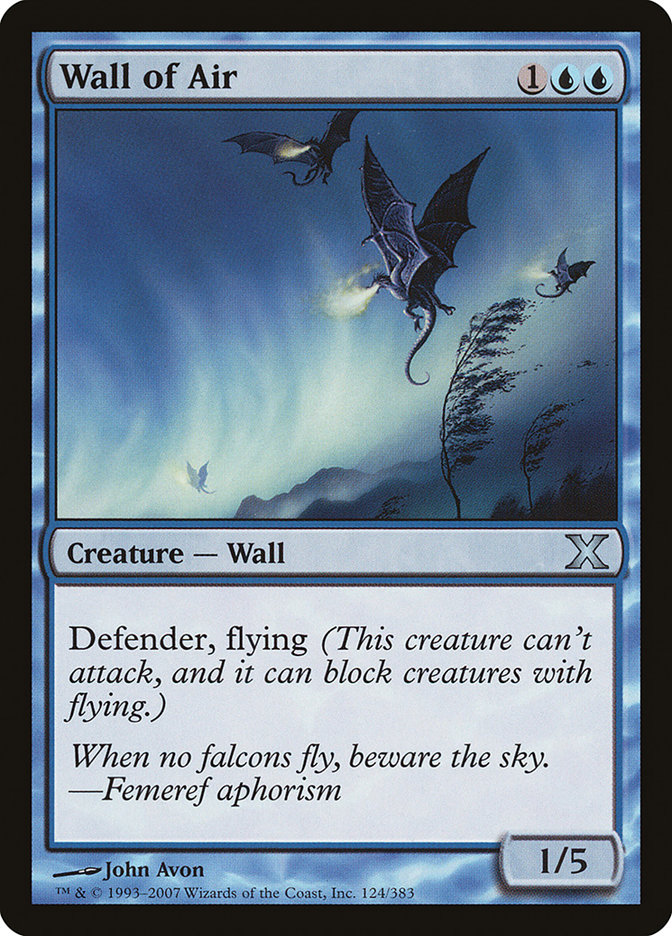
Wall of Air is one of those cards players keep asking about. Here is, in plain words, what its official text says, the rulings published by Wizards of the Coast, and the combos players actually run.
Official card text
Defender, flying (This creature can't attack, and it can block creatures with flying.)
Complete guide
Wall of Air is a classic defensive staple that provides an imposing barrier against both ground and aerial threats. Its high toughness and keyword abilities make it a reliable choice for blue mages looking to stabilize their board position. As a Wall, it serves as a literal fortress that stops aggressive opponents in their tracks.
Built-in Protection
Wall of Air possesses two key keywords: Defender and Flying. Defender is a keyword ability that prevents the creature from being declared as an attacker, meaning its primary purpose is staying back to protect your life total. Flying allows it to block creatures that also have flying, which many other ground-based defenders cannot do. With four toughness, it survives combat against most early-game threats.
Resolution and Blocking
When you cast Wall of Air, it enters the battlefield like any other creature. Once it is on the field, it can be declared as a blocker during the 'Declare Blockers' step of your opponent's combat phase. Because it has Flying, it can block creatures both with and without Flying. However, it cannot block creatures with Landwalk if the condition is met, nor can it block creatures with Protection from Blue.
Common Mistakes
A frequent error is trying to attack with Wall of Air if its creature type is changed or if it gains a power boost. Even if you give it 10 power, the Defender keyword prevents it from attacking unless another effect, such as an 'allows it to attack as though it didn't have defender' ability, is applied. Additionally, remember that while it can block flyers, having Flying does not make it immune to ground-based attackers.
Strategic Timing
Deploy Wall of Air early in the game to discourage opponents from swinging with low-power creatures. It is particularly effective in decks that need time to set up complex combos or reach high mana totals for late-game spells. By forcing an opponent to use a removal spell on a simple defender, you protect your more valuable utility creatures.
Interaction examples
 Solemn Simulacrum
If your opponent attacks with Solemn Simulacrum, you can block it with Wall of Air. Since the Simulacrum has 2 power and the Wall has 4 toughness, the Wall survives the combat. This allows you to preserve your life total while your opponent's creature remains on the board, potentially delaying the card-draw trigger the opponent would get if the Simulacrum died.
 Roaming Throne
If you cast Roaming Throne and choose 'Wall' as the creature type, the Throne becomes a Wall in addition to its other types. While Wall of Air doesn't have triggered abilities for Roaming Throne to double, the Throne itself could benefit from other Wall-related synergies you might control. However, both creatures will stand side-by-side as formidable defenders, though Roaming Throne can actually attack because it lacks the Defender keyword.
Guide written with AI from the official text and rulings. Official English text prevails.
How it works : Wall of Air
Original English text — Wizards of the Coast / Scryfall
No additional ruling has been published for this card.
Legal formats
Commentaires
- Sois le premier à commenter cette carte.
Read next
Meta decks with Wall of Air
No archived Top 8 deck with this card yet.