

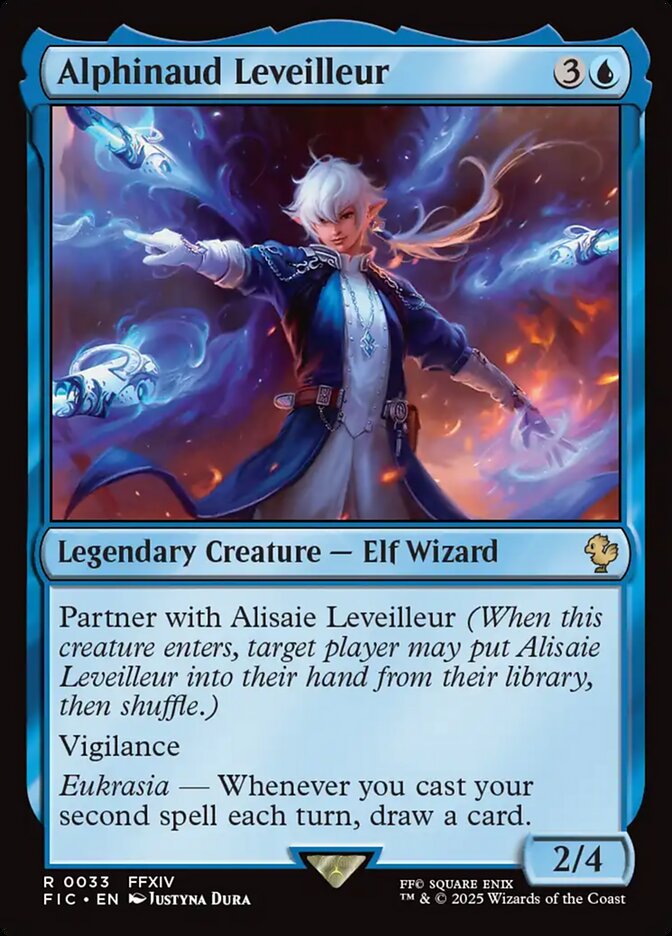
Alphinaud Leveilleur is one of those cards players keep asking about. Here is, in plain words, what its official text says, the rulings published by Wizards of the Coast, and the combos players actually run.
Official card text
Partner with Alisaie Leveilleur (When this creature enters, target player may put Alisaie Leveilleur into their hand from their library, then shuffle.) Vigilance Eukrasia — Whenever you cast your second spell each turn, draw a card.
Complete guide
Alphinaud Leveilleur is a brilliant tactician from the world of Final Fantasy XIV, brought to life as a powerful engine in Magic: The Gathering. As a Legendary Elf Wizard, he excels at resource management and coordinating with his twin sister, Alisaie. This card rewards careful sequencing, turning your second spell each turn into a valuable card-draw opportunity.
What It Does
Alphinaud Leveilleur has three distinct components. First, he has 'Partner with Alisaie Leveilleur,' which allows you to fetch his sister from your library when he enters the battlefield. In Commander, this also permits both characters to serve as your commanders simultaneously. Second, he possesses Vigilance, letting him attack without tapping. Finally, his Eukrasia ability is a triggered ability that draws you a card specifically when you cast your second spell of the turn.
How It Resolves Step by Step
When you cast your second spell of the turn while Alphinaud is on the battlefield, the Eukrasia ability triggers and is placed on the stack on top of that spell. The draw ability resolves first, meaning you get the new card before the spell that triggered it actually happens. This remains true even if the spell itself is later countered. It is important to note that if Alphinaud was the first spell you cast in a turn, he will see the very next spell you cast as the second one, triggering the draw.
Common Mistakes
A common point of confusion involves the 'Partner with' search. Even though the reminder text is brief, the official rules dictate that the target player must reveal the card found in the library before putting it into their hand. Additionally, players often forget that the second spell count includes spells cast before Alphinaud entered the battlefield. If you cast a cheap instant and then cast Alphinaud, Alphinaud enters but does not trigger off himself because he was the second spell; however, he will be ready to trigger on future turns.
When to Play It
Alphinaud is best utilized in decks that can reliably cast multiple spells per turn. Because his ability triggers on the second spell specifically, you should aim to pair him with low-cost spells, cantrips, or cost-reducers to ensure you hit that 'second spell' milestone every turn cycle, including on your opponents' turns if you have enough instants.
Interaction examples
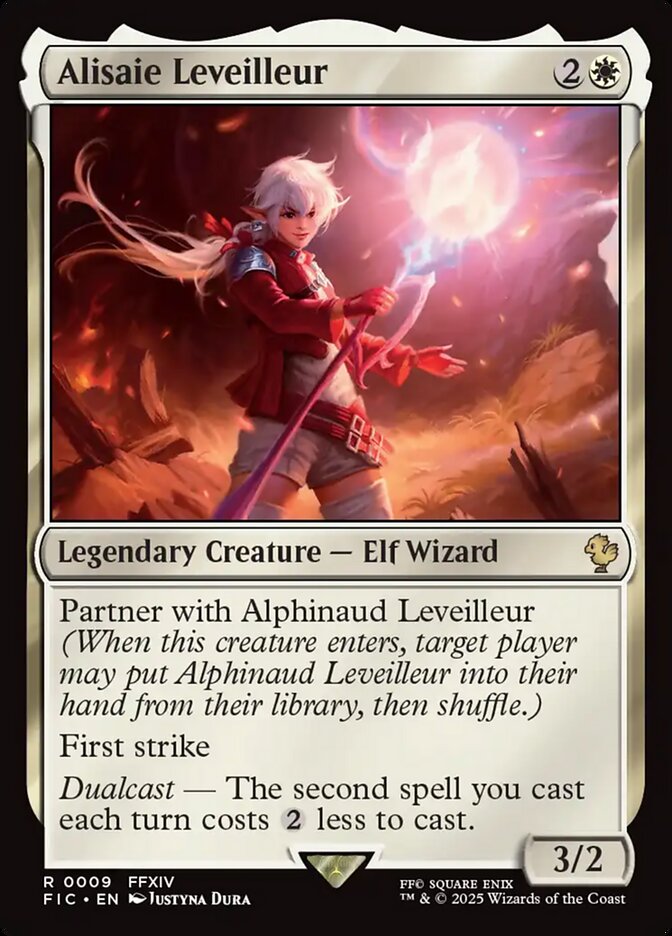
 Alisaie Leveilleur
 Alphinaud Leveilleur
With Alphinaud on the battlefield, you cast a small spell as your first spell. Then, you cast Alisaie Leveilleur as your second spell. Because Alisaie is the second spell, Alphinaud's Eukrasia triggers, allowing you to draw a card. Simultaneously, Alisaie's Dualcast ability makes herself cost {2} less to cast, demonstrating how the twins work in tandem to provide both mana efficiency and card advantage.
 Roaming Throne
If you control Roaming Throne with 'Wizard' chosen as the creature type, Alphinaud's abilities are enhanced. When you cast your second spell of the turn, Eukrasia triggers twice because Alphinaud is a Wizard. You will draw two cards instead of one before your second spell resolves.
 Solemn Simulacrum
On your turn, you first cast Solemn Simulacrum. Once it resolves, you cast a second spell. Alphinaud senses this is the second spell of the turn and triggers Eukrasia, drawing you a card. This sequence ensures you get the land from the Golem and the extra card from Alphinaud's tactical oversight.
Guide written with AI from the official text and rulings. Official English text prevails.
How it works : Alphinaud Leveilleur
Original English text — Wizards of the Coast / Scryfall
- #1· Wizards of the Coast
If your Commander deck has two commanders, you can only include cards whose own color identities are also found in your commanders' combined color identities. If Alisaie Leveilleur and Alphinaud Leveilleur are your commanders, your deck may contain cards with white and/or blue in their color identity, but not black, red, or green.
Card named in this ruling
- #2· Wizards of the Coast
"Partner with [name]" represents two abilities. The first is a triggered ability: "When this permanent enters, target player may search their library for a card named [name], reveal it, put it into their hand, then shuffle."
No other card is named in this ruling.
- #3· Wizards of the Coast
Alphinaud Leveilleur's last ability resolves before the spell that caused it to trigger. It resolves even if that spell is countered or otherwise leaves the stack.
No other card is named in this ruling.
- #4· Wizards of the Coast
The triggered ability of the "partner with" keyword still triggers in a Commander game. If your other commander has somehow ended up in your library, you can find it. You can also target another player, whether or not they have that card in their library.
No other card is named in this ruling.
- #5· Wizards of the Coast
The second ability represented by the "partner with [name]" keyword modifies the rules for deck construction in the Commander variant and has no function outside of that variant. If a legendary creature card with "partner with [name]" is designated as your commander, the named legendary creature card can also be designated as your commander.
No other card is named in this ruling.
- #6· Wizards of the Coast
Both commanders start in the command zone, and the remaining 98 cards (or 58 cards in a Commander Draft game) of your deck are shuffled to become your library.
No other card is named in this ruling.
- #7· Wizards of the Coast
Once the game begins, your two commanders are tracked separately. If you cast one, you won't have to pay an additional
 the first time you cast the other. A player loses the game after having been dealt 21 damage from one of them, not from both of them combined. Command Beacon's effect puts one into your hand from the command zone, not both.
No other card is named in this ruling.
- #8· Wizards of the Coast
Spells that were cast before Alphinaud Leveilleur entered count. If Alphinaud Leveilleur was the first spell you cast this turn, the next spell you cast this turn is your second spell.
No other card is named in this ruling.
- #9· Wizards of the Coast
To have two commanders, both must have the partner ability or corresponding "partner with" abilities as the game begins. A creature with a "partner with" ability can't partner with any creature other than its designated partner. Losing a partner ability during the game doesn't cause either to cease to be your commander.
No other card is named in this ruling.
- #10· Wizards of the Coast
Note that the target player searches their library (which may be affected by effects such as that of Stranglehold) and that the card they find is revealed, even though these words aren't included in the ability's reminder text.
No other card is named in this ruling.
- #11· Wizards of the Coast
An effect that checks whether you control your commander is satisfied if you control one or both of your two commanders.
No other card is named in this ruling.
Interactions with other cards
These cards' text mentions Alphinaud Leveilleur.
Related cards and tokens
Legal formats
Commentaires
- Sois le premier à commenter cette carte.
Read next
Meta decks with Alphinaud Leveilleur
No archived Top 8 deck with this card yet.