

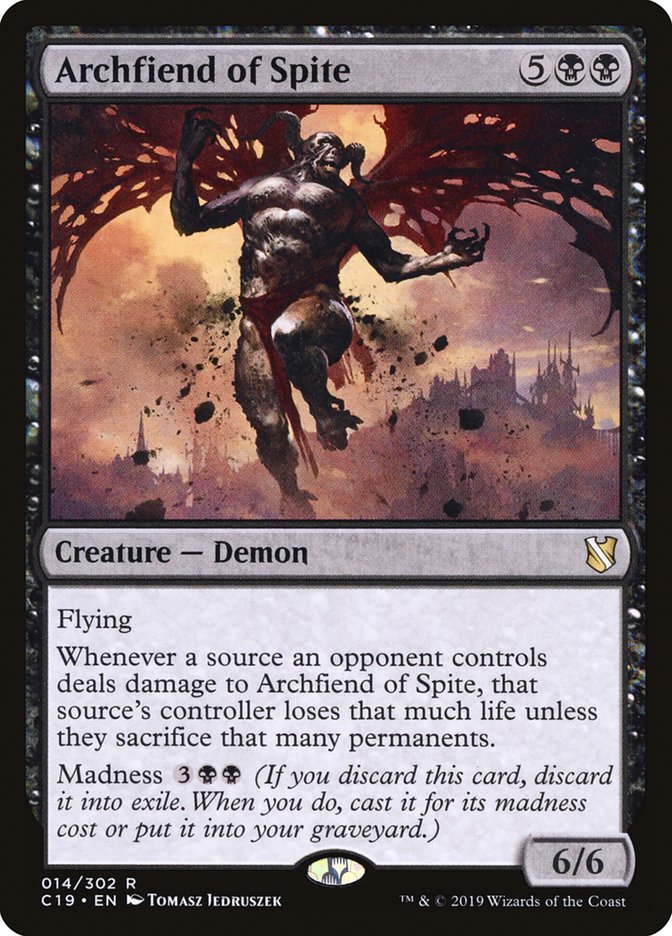
Archfiend of Spite is one of those cards players keep asking about. Here is, in plain words, what its official text says, the rulings published by Wizards of the Coast, and the combos players actually run.
Official card text
Flying Whenever a source an opponent controls deals damage to this creature, that source's controller loses that much life unless they sacrifice that many permanents of their choice. Madness(If you discard this card, discard it into exile. When you do, cast it for its madness cost or put it into your graveyard.)

Complete guide
Archfiend of Spite is a flying Demon that makes damaging it costly: an opposing source’s controller must sacrifice permanents or lose life. Madness offers a cheaper way to cast it, but only when a discard actually happens.
What It Does
Archfiend of Spite costs {5}{B}{B} and has flying, so it can be blocked only by creatures with flying or reach. Whenever a source an opponent controls deals damage to it, its triggered ability makes that source’s controller lose that much life unless they sacrifice that many permanents of their choice. The choice is all or nothing. For 3 damage, the player must sacrifice three permanents or lose 3 life; they cannot sacrifice one permanent and lose 2 life. If they cannot sacrifice enough permanents, they must lose the life. Even if they can sacrifice enough, they may decline. Its madness cost is {3}{B}{B}. Paying that alternative cost does not change its mana value, which remains 7.
How It Resolves, Step by Step
For the damage ability: 1. A source an opponent controls deals damage to Archfiend of Spite. The ability triggers for the amount actually dealt. 2. State-based actions are checked before the trigger goes onto the stack. Lethal damage can destroy Archfiend of Spite, but that does not stop its trigger. 3. When the trigger resolves, determine who controls the damage source. If it has left the zone it occupied when it dealt damage, use its last known information. 4. That player sacrifices the full number of permanents or loses that much life. The ability does not target those permanents. For madness: 1. When you discard Archfiend of Spite, it goes into exile rather than your graveyard. It still counts as discarded. 2. Its madness ability triggers. If you discarded it during a resolving spell or ability, finish that resolution before putting the madness trigger onto the stack. 3. When the madness trigger resolves, you may cast Archfiend of Spite for {3}{B}{B}, subject to applicable cost increases and reductions. This permission works even during an opponent’s turn. 4. If you cast it, it becomes a spell on the stack and can be responded to or countered. If you do not cast it, put it into your graveyard; madness does not let you save that casting opportunity for later. If you discard it to pay a spell or activated ability’s cost, the madness trigger goes above that spell or ability. If you cast Archfiend of Spite through that trigger, its spell also resolves before the spell or ability whose cost you paid.
Common Mistakes: Damage, Death, and Sacrifice
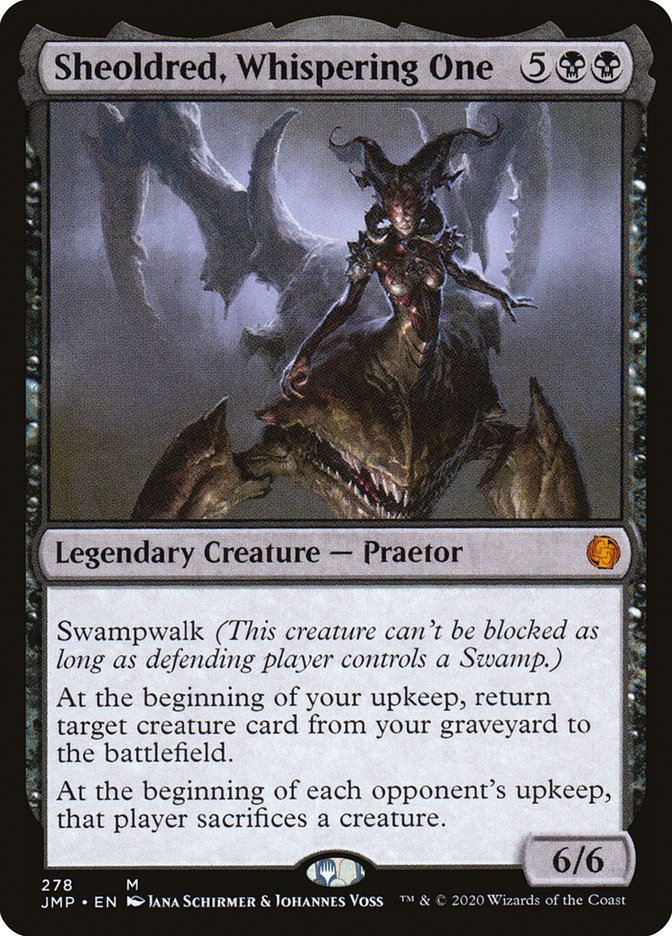
Damage, toughness reduction, and sacrifice are different events. Archfiend of Spite triggers only from damage dealt to it by a source an opponent controls—not simply because it dies. Example 1 — An opponent’s Massacre Wurm: 1. Massacre Wurm enters under an opponent’s control, and its enters ability resolves. 2. Your Archfiend of Spite gets -2/-2 until end of turn. This is not damage, so its damage ability does not trigger. 3. If Archfiend of Spite subsequently dies while that opponent controls Massacre Wurm, the Wurm’s death trigger makes you lose 2 life when it resolves. That life loss is not damage either. Example 2 — An opponent’s Sheoldred, Whispering One: 1. At the beginning of your upkeep, the opponent’s Sheoldred, Whispering One triggers, requiring you to sacrifice a creature. 2. When that ability resolves, you may choose Archfiend of Spite if you control it. 3. Sacrificing it does not deal damage, so its damage ability does not trigger. You also cannot discard Archfiend of Spite whenever you like just to access madness. A rule, cost, or effect must allow or require the discard.
When to Play It
Archfiend of Spite can make damage-based answers and combat damage costly, even when the damage kills it. It does not offer the same punishment against sacrifice or toughness reduction. Madness reduces its starting casting cost by two generic mana, but you still need a discard opportunity and enough mana when the madness trigger resolves. Example 3 — Pairing it with your Massacre Wurm: 1. You control Archfiend of Spite and Massacre Wurm. An opponent’s source deals 3 damage to Archfiend of Spite. 2. When Archfiend of Spite’s trigger resolves, that opponent chooses between sacrificing three permanents and losing 3 life. 3. If they sacrifice three creatures and those creatures die, Massacre Wurm triggers three times. Those triggers go onto the stack after Archfiend of Spite’s ability finishes resolving and each makes that opponent lose 2 life. Sacrificing noncreature permanents does not trigger the Wurm’s death ability. Example 4 — Returning it with your Sheoldred, Whispering One: 1. Archfiend of Spite is in your graveyard as your upkeep begins. Your Sheoldred, Whispering One triggers, and you choose Archfiend of Spite as its target. 2. If the target remains legal, the ability returns Archfiend of Spite directly to the battlefield. 3. This is not casting it, so you pay neither its mana cost nor its madness cost. Putting it into the graveyard from somewhere other than your hand would not have triggered madness in the first place.
Guide written with AI from the official text and rulings. Official English text prevails.
How it works : Archfiend of Spite
Original English text — Wizards of the Coast / Scryfall
- #1· Wizards of the Coast
If you discard a card with madness while a spell or ability is resolving, it moves immediately to exile. Continue resolving that spell or ability, noting that the card you discarded is not in your graveyard at this time. Its madness triggered ability will be placed onto the stack once that spell or ability has completely resolved.
No other card is named in this ruling.
- #2· Wizards of the Coast
A spell cast for its madness cost is put onto the stack like any other spell. It can be countered, copied, and so on. As it resolves, it's put onto the battlefield if it's a permanent card or into its owner's graveyard if it's an instant or sorcery card.
No other card is named in this ruling.
- #3· Wizards of the Coast
Casting a spell with madness ignores the timing rules based on the card's card type. For example, you can cast a sorcery with madness if you discard it during an opponent's turn.
No other card is named in this ruling.
- #4· Wizards of the Coast
To determine the total cost of a spell, start with the mana cost or alternative cost (such as a madness cost) you're paying, add any cost increases, then apply any cost reductions. The mana value of the spell is determined by only its mana cost, no matter what the total cost to cast that spell was.
No other card is named in this ruling.
- #5· Wizards of the Coast
If you choose not to cast a card with madness when the madness triggered ability resolves, it's put into your graveyard. Madness doesn't give you another chance to cast it later.
No other card is named in this ruling.
- #6· Wizards of the Coast
If you discard a card with madness to pay the cost of a spell or activated ability, that card's madness triggered ability (and the spell that card becomes, if you choose to cast it) will resolve before the spell or ability the discard paid for.
No other card is named in this ruling.
- #7· Wizards of the Coast
Cards are discarded in a Magic game only from a player's hand. Effects that put cards into a player's graveyard from anywhere else do not cause those cards to be discarded.
No other card is named in this ruling.
- #8· Wizards of the Coast
Madness works independently of why you're discarding the card. You could discard it to pay a cost, because a spell or ability tells you to, or because you have too many cards in your hand during your cleanup step. You can't discard a card with madness just because you want to, though.
No other card is named in this ruling.
- #9· Wizards of the Coast
A card with madness that's discarded counts as having been discarded even though it's put into exile rather than a graveyard. If it was discarded to pay a cost, that cost is still paid. Abilities that trigger when a card is discarded will still trigger.
No other card is named in this ruling.
- #10· Wizards of the Coast
The source's controller must either sacrifice permanents or lose life. They can't choose to sacrifice some permanents and lose some life.
No other card is named in this ruling.
- #11· Wizards of the Coast
If the player doesn't control enough permanents that they can sacrifice, they must lose life.
No other card is named in this ruling.
- #12· Wizards of the Coast
The player may always choose not to sacrifice permanents, even if they will end up losing more life than they have or if an effect (such as that of Platinum Emperion) says that they can't lose life.
No other card is named in this ruling.
- #13· Wizards of the Coast
The player who loses life or permanents is the player who controls the source as Archfiend of Spite's triggered ability resolves. In some rare cases, this may not be the same player who controlled the source as it dealt damage. If the source is no longer in the zone it was in as it dealt damage, the source's last known information is used to determine who controlled it.
No other card is named in this ruling.
- #14· Wizards of the Coast
Archfiend of Spite's triggered ability will trigger even if it is dealt lethal damage. For example, if Archfiend of Spite blocks a 7/7 creature, its ability will trigger when combat damage is dealt and the attacking player will sacrifice seven permanents or lose 7 life.
No other card is named in this ruling.
Legal formats
Commentaires
- Sois le premier à commenter cette carte.
Read next

Meta decks with Archfiend of Spite
No archived Top 8 deck with this card yet.