

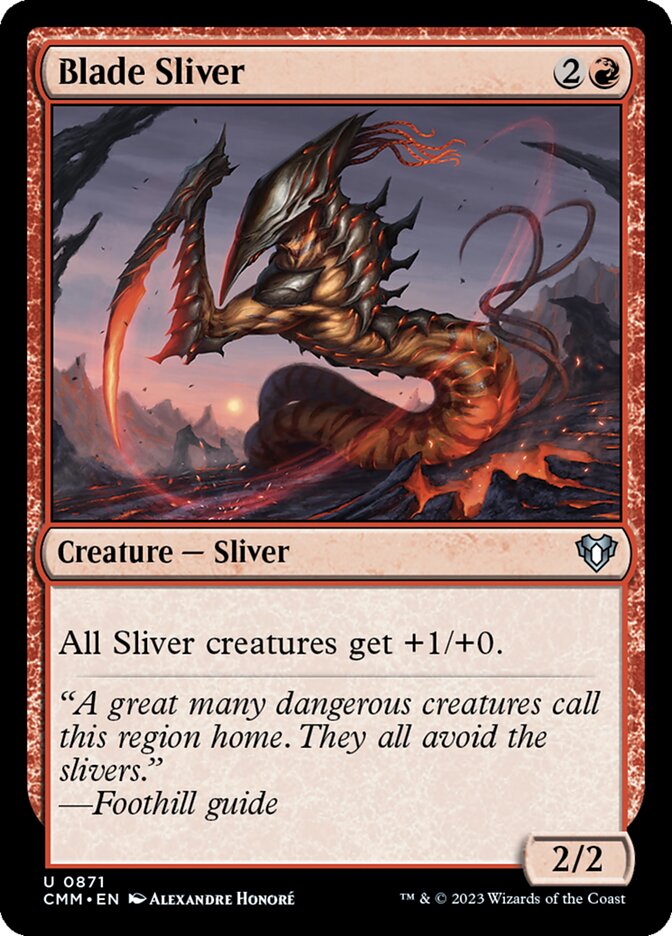
Blade Sliver is one of those cards players keep asking about. Here is, in plain words, what its official text says, the rulings published by Wizards of the Coast, and the combos players actually run.
Official card text
All Sliver creatures get +1/+0.
Complete guide
Blade Sliver is a classic red addition to any Sliver hive, providing a straightforward power boost to all Sliver creatures on the battlefield. This creature serves as an aggressive anthem, ensuring your swarm hits harder regardless of who controls the Slivers. Understanding its static ability is key to mastering the combat math of your Sliver deck.
A Collective Sharpness
Blade Sliver features a static ability that continuously modifies the power of all Sliver creatures. Unlike triggered abilities that use the stack, this effect is always active as long as Blade Sliver is on the battlefield and remains a Sliver. It affects itself and all other Slivers controlled by any player, turning a group of small creatures into a much more lethal threat.
Calculating the Bonus
The +1/+0 bonus provided by Blade Sliver is cumulative. If you control multiple copies of Blade Sliver, each one contributes its own bonus to the hive. For example, two Blade Slivers will grant all Sliver creatures a total of +2/+0. This bonus applies immediately the moment a Sliver enters the battlefield and persists until the Sliver or the Blade Sliver leaves the battlefield.
Type Dependencies
The ability specifically checks for the 'Sliver' creature type. If a spell or effect changes a creature's type so that it is no longer a Sliver, it will lose the bonus immediately. Conversely, if a non-Sliver creature gains the Sliver type through an external effect, it will instantly receive the +1/+0 boost from Blade Sliver.
When to Deploy
Blade Sliver is best used in aggressive strategies where you want to increase your clock and force unfavorable blocks for your opponent. Since it doesn't provide a toughness boost, it won't help your creatures survive combat damage, but it will make even your utility Slivers dangerous enough to trade with larger blockers.
Interaction examples
 Solemn Simulacrum
If you control both Blade Sliver and Solemn Simulacrum, Blade Sliver is a 3/2 creature because it grants itself +1/+0. However, Solemn Simulacrum remains a 2/2 Golem because it does not have the Sliver creature type. If you were to use an effect to turn the Simulacrum into a Sliver, it would then become a 3/2.
 Roaming Throne
When Roaming Throne enters, you choose 'Sliver' as the creature type. Roaming Throne becomes a Sliver Golem. Because it is now a Sliver, Blade Sliver's static ability applies to it, making the Throne a 5/4. Note that Blade Sliver's ability is a static ability, not a triggered one, so Roaming Throne's double-trigger ability does not cause the +1/+0 bonus to double.
If you have two copies of Blade Sliver on the battlefield, each one generates a static effect that says 'All Sliver creatures get +1/+0.' These effects are cumulative. Every Sliver you control (including both Blade Slivers) will receive a total of +2/+0, making each Blade Sliver a 4/2 creature.
Guide written with AI from the official text and rulings. Official English text prevails.
How it works : Blade Sliver
Original English text — Wizards of the Coast / Scryfall
- #1· Wizards of the Coast
Abilities that Slivers grant, as well as power/toughness boosts, are cumulative. However, for some abilities, like flying, having more than one instance of the ability doesn’t provide any additional benefit.
No other card is named in this ruling.
- #2· Wizards of the Coast
If the creature type of a Sliver changes so it’s no longer a Sliver, it will no longer be affected by its own ability. Its ability will continue to affect other Sliver creatures.
No other card is named in this ruling.
Legal formats
Commentaires
- Sois le premier à commenter cette carte.
Read next
Meta decks with Blade Sliver
No archived Top 8 deck with this card yet.