

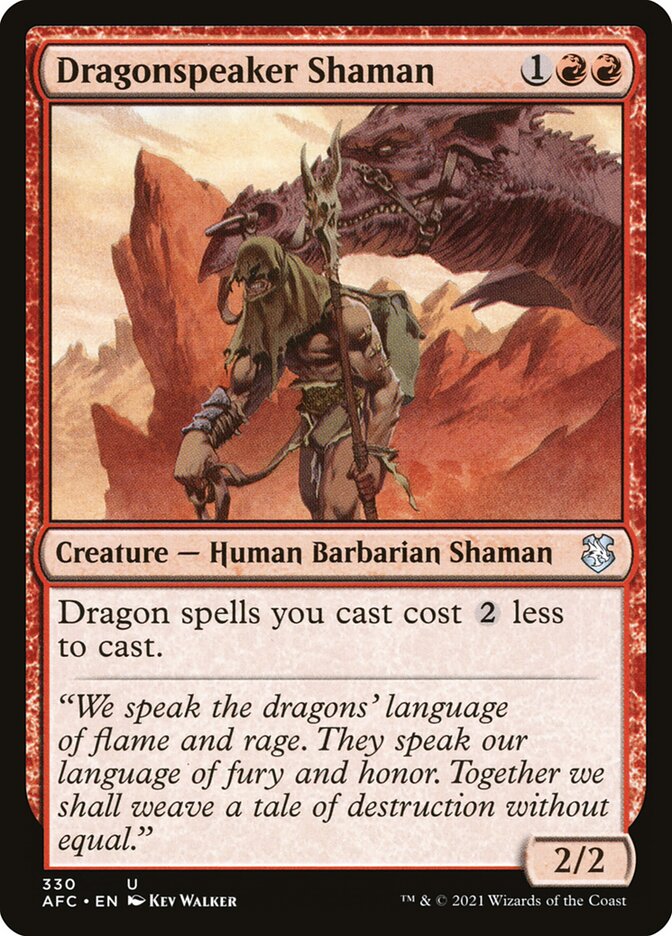
Dragonspeaker Shaman is one of those cards players keep asking about. Here is, in plain words, what its official text says, the rulings published by Wizards of the Coast, and the combos players actually run.
Official card text
Dragon spells you cast costless to cast.
Complete guide
Harness the primal energy of the skies with Dragonspeaker Shaman, a staple for any player looking to summon massive winged terrors ahead of schedule. By acting as a specialized conduit, this Human Barbarian Shaman significantly reduces the resource burden of your most powerful Dragon spells. Understanding how this cost reduction interacts with various card types and costs is key to dominating the battlefield.
What It Does
Dragonspeaker Shaman provides a static ability that reduces the cost of Dragon spells you cast by {2}. This reduction applies to the total cost of the spell, meaning it can satisfy two generic mana requirements. It does not change the mana value of the spell, only the amount of mana you must pay as you cast it. Note that this reduction only applies to spells that have the 'Dragon' creature type, whether they are creatures or other card types with that subtype.
How It Resolves Step by Step
When you cast a Dragon spell while Dragonspeaker Shaman is on the battlefield, you follow the standard casting process. First, you announce the spell and move it to the stack. Second, you determine the total cost: start with the mana cost or alternative cost, add any cost increases, and then apply cost reductions like the one from the Shaman. Finally, you pay the reduced cost. The Shaman must be on the battlefield at the moment you begin the casting process for the reduction to apply.
Common Mistakes
A frequent error is trying to apply the reduction to non-Dragon spells that look like Dragons or have 'Dragon' in the name but lack the actual subtype. Additionally, remember that Dragonspeaker Shaman only reduces generic mana; it cannot reduce the colored mana requirements (like Red, Blue, or Black) of a spell. If a Dragon costs {R}{R}, the Shaman will not reduce the cost at all because there is no generic mana to subtract from.
When to Play It
Dragonspeaker Shaman is most effective when played early, ideally on turn three, to set up a powerful turn four or five. Because it is a 2/2 creature, it is vulnerable to many removal spells. It is often best to hold your Dragons until you can cast them immediately after the Shaman, ensuring you get value from the reduction before your opponent can interact with your mana engine.
Interaction examples
 Roaming Throne
If you cast Roaming Throne and choose 'Dragon' as it enters the battlefield, the Throne becomes a Dragon creature. However, Dragonspeaker Shaman does not reduce the cost of Roaming Throne itself while it is being cast, because the creature type is chosen only as it enters the battlefield. Once on the field, the Throne is a Dragon, but it was not a Dragon spell on the stack.
 Solemn Simulacrum
When you have Dragonspeaker Shaman on the battlefield and attempt to cast Solemn Simulacrum, the cost is not reduced. Despite both being creatures, Solemn Simulacrum is a Golem and lacks the Dragon subtype. You must pay the full {4} mana to cast the Simulacrum.
Guide written with AI from the official text and rulings. Official English text prevails.
How it works : Dragonspeaker Shaman
Original English text — Wizards of the Coast / Scryfall
No additional ruling has been published for this card.
Legal formats
Commentaires
- Sois le premier à commenter cette carte.
Read next
Meta decks with Dragonspeaker Shaman
No archived Top 8 deck with this card yet.