

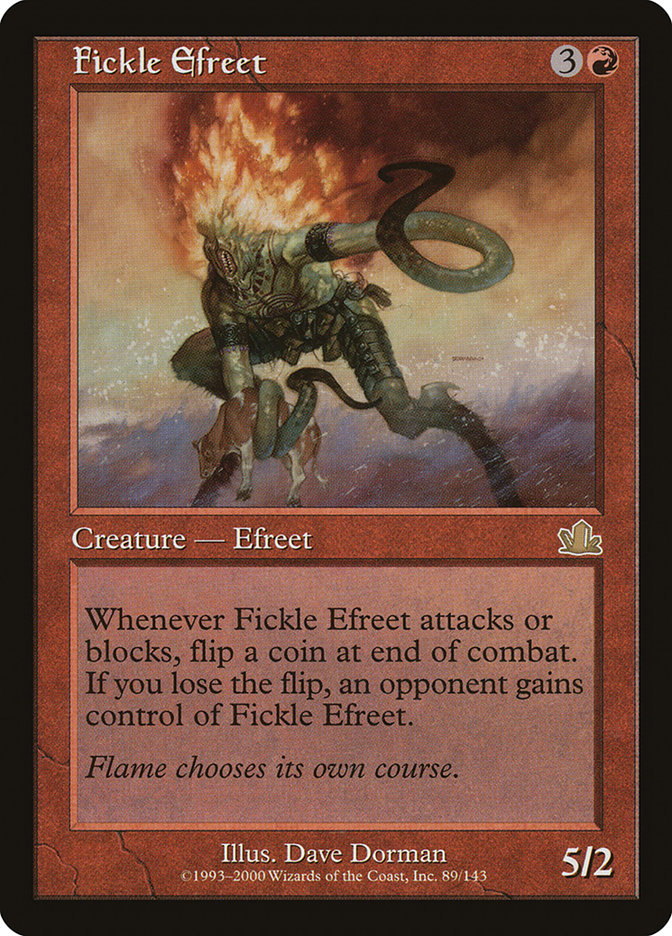
Fickle Efreet is one of those cards players keep asking about. Here is, in plain words, what its official text says, the rulings published by Wizards of the Coast, and the combos players actually run.
Official card text
Whenever this creature attacks or blocks, flip a coin at end of combat. If you lose the flip, an opponent gains control of this creature.
Complete guide
Fickle Efreet is a high-risk, high-reward attacker that forces players to gamble on its loyalty every time it enters the fray. This red creature brings the chaos of coin-flipping to the combat phase, where a single unlucky toss can hand your resource directly to your enemy. Understanding the timing of its 'end of combat' trigger is key to managing this unpredictable ally.
A Matter of Luck
Fickle Efreet features a mandatory triggered ability that triggers whenever it is declared as an attacker or a blocker. Unlike abilities that resolve during the declare attackers or blockers steps, this ability waits until the 'end of combat' step to actually be put onto the stack. If you lose the coin flip, the control-change effect is permanent; it does not wear off at the end of the turn.
How It Resolves Step by Step
First, you must declare Fickle Efreet as an attacker or blocker during the appropriate combat step. After damage is dealt, the game moves to the 'End of Combat' step, and Fickle Efreet's ability triggers and is placed on the stack. When the ability resolves, you flip a coin. If you win the flip, nothing happens and you retain control. If you lose, you choose an opponent to gain control of it immediately.
Common Mistakes and Timing
A common error is forgetting that the flip happens even if Fickle Efreet survives combat or if the creature it was interacting with leaves the battlefield. As long as it was legally declared as an attacker or blocker, the trigger will go on the stack. Also, note that if you lose the flip, the Efreet is removed from combat because it has changed controllers, though this usually doesn't matter as damage has already been dealt by the end of combat step.
When to Play It
Fickle Efreet is best used in decks that can mitigate the risk of losing control or those that benefit from chaotic board states. Because the trigger happens at the end of combat, you will always get to deal damage with it before there is a chance of losing it. If you have ways to sacrifice it or return it to your hand before the end of combat step, you can bypass the flip entirely.
Interaction examples
 Roaming Throne
If you have Roaming Throne on the battlefield with 'Efreet' chosen as the creature type, Fickle Efreet's ability will trigger an additional time at the end of combat. This means you must flip two separate coins. If you lose either flip, an opponent gains control of the Efreet. If you lose the first flip, an opponent gains control, and then you still resolve the second flip (though you are flipping for a permanent you no longer control).
 Solemn Simulacrum
Suppose your opponent attacks with Solemn Simulacrum and you block with Fickle Efreet. After combat damage is dealt, Fickle Efreet's ability triggers. Even if Fickle Efreet's 5 power kills the Simulacrum, you still must flip the coin. If you lose the flip, your opponent will get to draw a card from their Simulacrum dying and then take control of your Fickle Efreet as a replacement for their lost creature.
Guide written with AI from the official text and rulings. Official English text prevails.
How it works : Fickle Efreet
Original English text — Wizards of the Coast / Scryfall
No additional ruling has been published for this card.
Legal formats
Commentaires
- Sois le premier à commenter cette carte.
Read next
Meta decks with Fickle Efreet
No archived Top 8 deck with this card yet.