

Goldlust Triad is one of those cards players keep asking about. Here is, in plain words, what its official text says, the rulings published by Wizards of the Coast, and the combos players actually run.
Official card text
Flying Myriad (Whenever this creature attacks, for each opponent other than defending player, you may create a token copy that's tapped and attacking that player or a planeswalker they control. Exile the tokens at end of combat.) Whenever this creature deals combat damage to a player, create a Treasure token.
Complete guide
Goldlust Triad is a high-flying Dragon that brings the Myriad mechanic to the table, turning a single attack into a swarm of riches. This creature not only pressures every opponent at once but also fuels your economy by generating Treasure tokens for every successful strike.
Scaling Your Wealth
Goldlust Triad features two primary abilities: Myriad and a triggered ability that creates a Treasure token whenever it deals combat damage to a player. Myriad allows you to create temporary copies of the Triad for each opponent other than the one you are currently attacking. Because these tokens are copies of the original card, they also possess the ability to generate Treasures, potentially netting you a massive influx of mana in a single turn.
Step-by-Step Resolution
First, you declare Goldlust Triad as an attacker. The Myriad ability triggers and goes on the stack. When it resolves, you create tapped and attacking tokens for each other opponent. During the combat damage step, each Triad that connects with a player's life total will trigger its own individual Treasure-generating ability. Finally, at the end of combat, all tokens created by the Myriad ability are exiled, though any Treasure tokens they created remain on the battlefield under your control.
Important Interactions and Limits
It is crucial to remember that Myriad tokens enter the battlefield already attacking; they are never 'declared' as attackers. This means if you have an effect that triggers 'whenever a creature attacks,' the tokens will not trigger it. Additionally, while the tokens inherit the Treasure-generating ability, they do not inherit any temporary buffs or counters on the original Goldlust Triad. They are fresh copies of the printed card.
When to Deploy the Triad
Goldlust Triad is most effective in multiplayer games where you have three or more opponents. Since it costs five mana, you want to ensure the way is clear for its Flying evasion to work. If you can land hits on multiple players, the Treasure tokens generated will effectively pay back a large portion of the mana spent to cast the Dragon, allowing for explosive follow-up plays.
Interaction examples
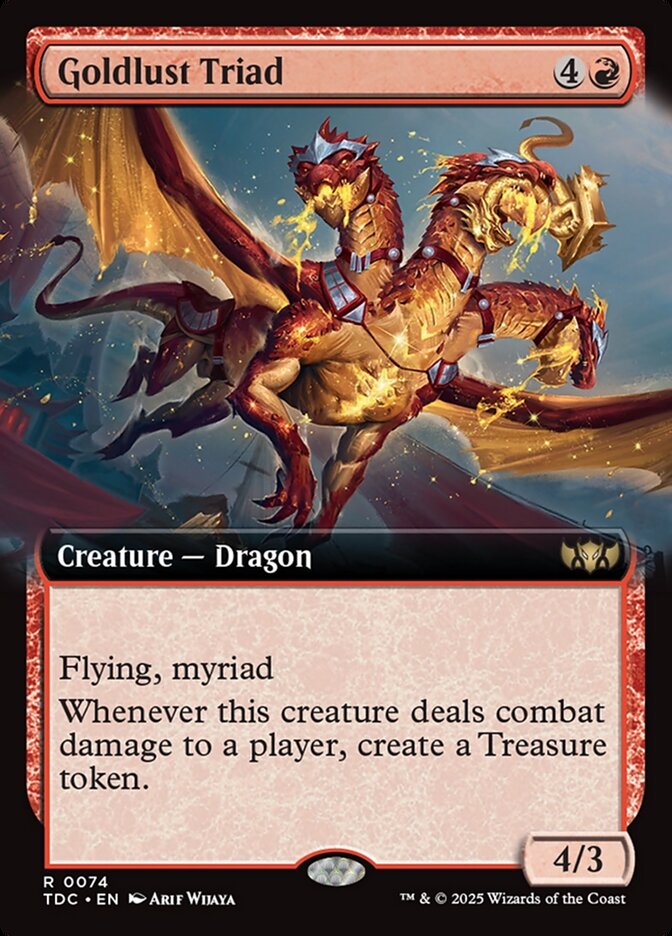 Goldlust Triad
 Treasure
In a four-player game, you attack Player A with Goldlust Triad. Myriad triggers, creating two tokens—one attacking Player B and one attacking Player C. If all three Dragons deal combat damage to their respective players, three separate triggers occur, resulting in three Treasure tokens being placed on the battlefield.
 Roaming Throne
If you control Roaming Throne with 'Dragon' chosen as the creature type, Goldlust Triad's abilities trigger an additional time. When the Triad attacks, Myriad triggers twice, creating two tokens for each other opponent. Furthermore, if the original Triad deals combat damage to a player, it triggers twice to create two Treasure tokens instead of one.
When the Myriad ability of Goldlust Triad resolves, you can choose to have the created tokens attack a player or a planeswalker that player controls. Note that if a token deals combat damage to a planeswalker instead of a player, the ability to create a Treasure token will not trigger, as that ability specifically requires damage to be dealt to a player.
Guide written with AI from the official text and rulings. Official English text prevails.
How it works : Goldlust Triad
Original English text — Wizards of the Coast / Scryfall
- #1· Wizards of the Coast
The term “defending player” in the myriad rules (or any other ability of an attacking creature) refers to the player the creature with myriad was attacking, the controller of the planeswalker it was attacking, or the protector of the battle it was attacking at the time the ability resolves. If that creature is no longer attacking, it refers to the appropriate player based on who or what the creature was last attacking.
No other card is named in this ruling.
- #2· Wizards of the Coast
If the defending player is your only opponent, no tokens are put onto the battlefield.
No other card is named in this ruling.
- #3· Wizards of the Coast
You choose whether each token is attacking the player or a planeswalker they control as the token is created. If it’s attacking a planeswalker, you choose which one. You can’t have any of the tokens attack a battle.
No other card is named in this ruling.
- #4· Wizards of the Coast
Although the tokens enter attacking, they were never declared as attackers. Abilities that trigger whenever a creature attacks won’t trigger, including the myriad ability of the tokens. If there are any costs to have a creature attack, those costs won’t apply to the tokens.
No other card is named in this ruling.
- #5· Wizards of the Coast
The tokens created by a single instance of myriad all enter at the same time.
No other card is named in this ruling.
- #6· Wizards of the Coast
Each token copies exactly what was printed on the original creature and nothing else. It doesn’t copy whether that creature is tapped or untapped, whether it has any counters on it or Auras and Equipment attached to it, or any non-copy effects that have changed its power, toughness, types, color, and so on.
No other card is named in this ruling.
- #7· Wizards of the Coast
Any “enters” abilities of the copied creature will trigger when the tokens enter. Any “as [this creature] enters” or “[this creature] enters with” abilities of the copied creature will also work.
No other card is named in this ruling.
- #8· Wizards of the Coast
If an instance of myriad creates more than one token for any given player (due to an effect such as the one Doubling Season creates), you may choose separately for each token whether it’s attacking the player or a planeswalker they control.
No other card is named in this ruling.
Popular combos
Real combos played by the community, sorted by popularity.
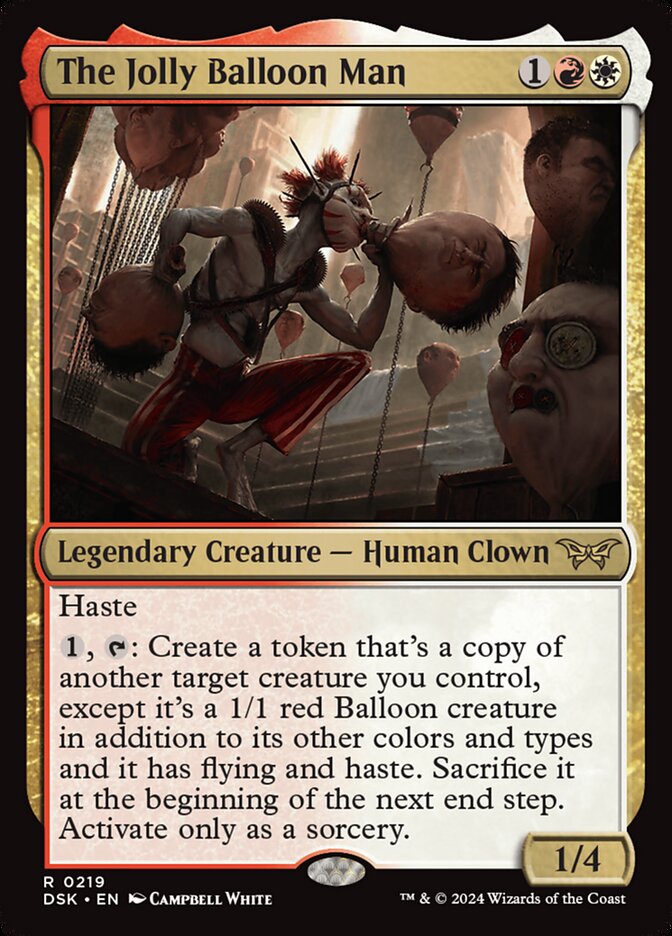
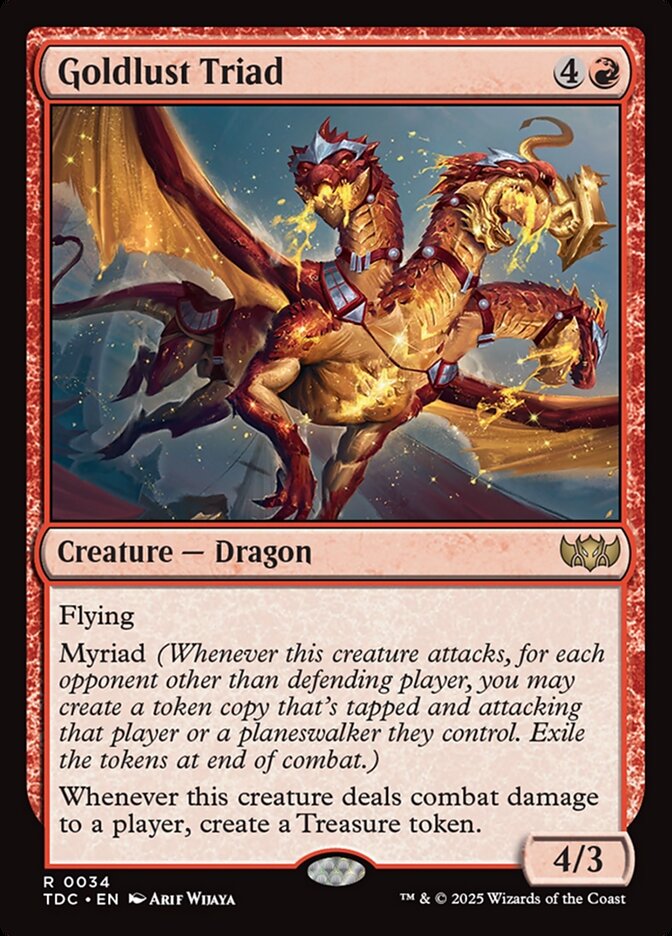
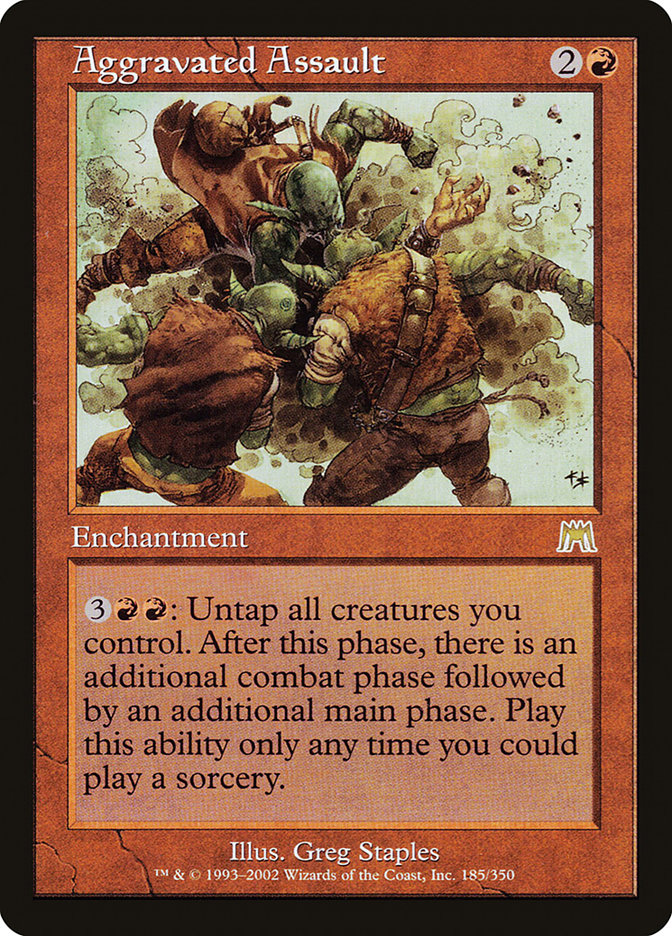
The Jolly Balloon Man + Goldlust Triad + Aggravated Assault
- 1Activate The Jolly Balloon Man by paying
 and tapping it, creating a copy of Goldlust Triad that is a 1/1 Balloon creature token with flying and haste.
- 2Declare Goldlust Triad and the Goldlust Triad token as attackers, triggering their myriad abilities, creating two Goldlust Triad tokens attacking each other opponent.
- 3Deal combat damage with all Goldlust Triads, triggering their abilities, creating that many Treasure tokens.
- 4Move to your postcombat main phase, and activate six Treasure tokens by tapping and sacrificing them, adding

 .
- 5Activate Aggravated Assault by paying
 , causing you to untap all creatures you control and to get an additional combat and main phase after this one.
- 6Repeat.
Related cards and tokens
Legal formats
Commentaires
- Sois le premier à commenter cette carte.
Read next

Meta decks with Goldlust Triad
No archived Top 8 deck with this card yet.