


Spider-Sense is one of those cards players keep asking about. Here is, in plain words, what its official text says, the rulings published by Wizards of the Coast, and the combos players actually run.
Official card text
Web-slinging(You may cast this spell for
Complete guide
Spider-Sense is a versatile blue instant that brings a unique cost-reduction mechanic called Web-slinging to the table. By bouncing one of your own tapped creatures, you gain the ability to shut down not just spells, but triggered abilities as well. This makes it a flexible tool for reactive players looking to maintain tempo while disrupting their opponents.
Understanding Web-slinging
Web-slinging is an alternative cost that allows you to cast Spider-Sense for just one blue mana. To use this, you must return a creature you control that is already tapped to your hand as part of the casting process. Note that if you are using another effect to cast the spell for free or for a different alternative cost, you cannot choose to use Web-slinging simultaneously. You must still follow all timing rules, but the creature only needs to be tapped at the moment you pay the cost, not necessarily before you began the casting process.
Resolution Step-by-Step
When you cast Spider-Sense, you first choose your target, which can be an instant spell, a sorcery spell, or a triggered ability. If you use Web-slinging, the creature returns to your hand immediately as a cost. Once the spell resolves, the targeted spell or ability is removed from the stack and put into its owner's graveyard (or simply ceases to exist if it was a triggered ability). If the targeted spell or ability becomes illegal before Spider-Sense resolves, Spider-Sense will fail to resolve and be put into your graveyard with no effect.
Identifying Triggered Abilities
Spider-Sense is unique because it can target triggered abilities, which are recognized by the words "when," "whenever," or "at." This includes keyword abilities like Prowess or Ward. Unlike standard counterspells that only hit spells, Spider-Sense can stop a detrimental effect that has already triggered from a permanent remaining on the battlefield.
Strategic Timing
Use Spider-Sense when you need to protect your board state from powerful sorceries or to stop a game-ending triggered ability. The Web-slinging cost is particularly effective after you have attacked with a creature or used its tap ability, effectively 'saving' that creature from potential removal while countering an opponent's play for a single mana.
Interaction examples
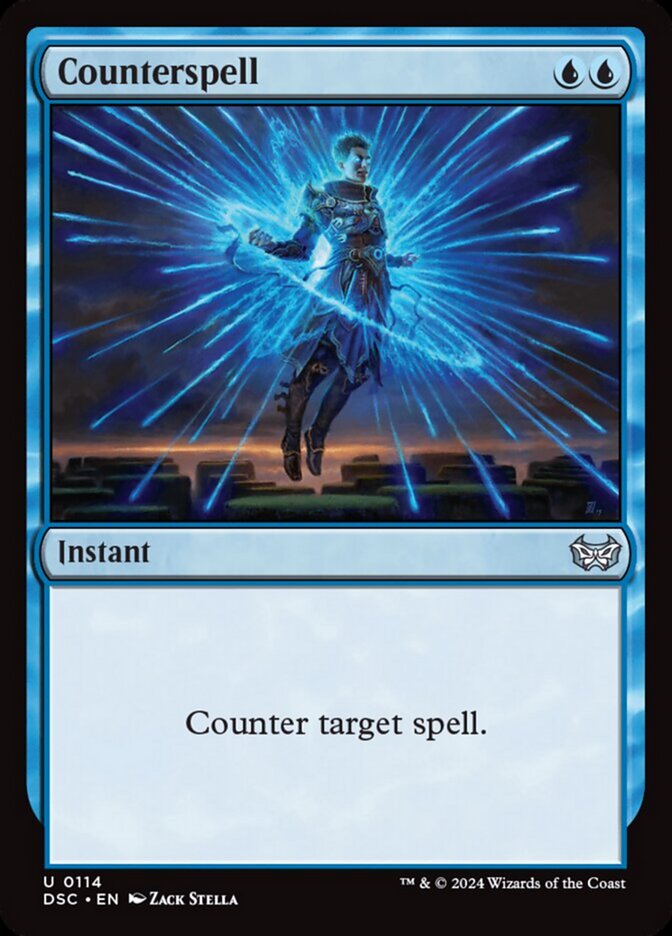 Counterspell
If your opponent casts Counterspell targeting one of your permanents, you can cast Spider-Sense for its full mana cost of {1}{U} or its Web-slinging cost of {U}. Since Counterspell is an instant, it is a legal target. Spider-Sense resolves first, countering Counterspell and allowing your original permanent to remain safe.
 An Offer You Can't Refuse
Suppose you cast a spell and your opponent responds with An Offer You Can't Refuse. You can respond by casting Spider-Sense. By returning a tapped creature to your hand via Web-slinging, you pay only {U}. Spider-Sense counters An Offer You Can't Refuse, and your opponent does not get to create any Treasure tokens because their spell never resolved.
Guide written with AI from the official text and rulings. Official English text prevails.
How it works : Spider-Sense
Original English text — Wizards of the Coast / Scryfall
- #1· Wizards of the Coast
If any permanent has an ability that triggers when the permanent you return leaves the battlefield, that ability will be put on the stack after you finish casting the spell, and it will resolve before that spell.
No other card is named in this ruling.
- #2· Wizards of the Coast
Triggered abilities use the words "when," "whenever," or "at." They're often written as "[Trigger condition], [effect]." Some keyword abilities (such as prowess) are triggered abilities and will have "when," "whenever," or "at the beginning of" in their reminder text.
No other card is named in this ruling.
- #3· Wizards of the Coast
You must follow all normal timing rules when casting a spell with web-slinging. For creatures, that usually means you must cast it during a main phase of your turn while the stack is empty.
No other card is named in this ruling.
- #4· Wizards of the Coast
The creature you return must be tapped at the time you pay costs, but doesn't necessarily need to be tapped before you start casting the spell. For example, if you tap a creature with a mana ability to pay part of the spell's web-slinging cost, you could also return that creature to your hand to pay the cost.
No other card is named in this ruling.
- #5· Wizards of the Coast
Web-slinging represents an alternative cost. If another effect allows you to play a card for a different alternative cost, including "without paying its mana cost," you can't also choose to pay its web-slinging cost. If any additional costs from other sources are applied, you must pay those.
No other card is named in this ruling.
Legal formats
Commentaires
- Sois le premier à commenter cette carte.
Read next
Meta decks with Spider-Sense
No archived Top 8 deck with this card yet.