

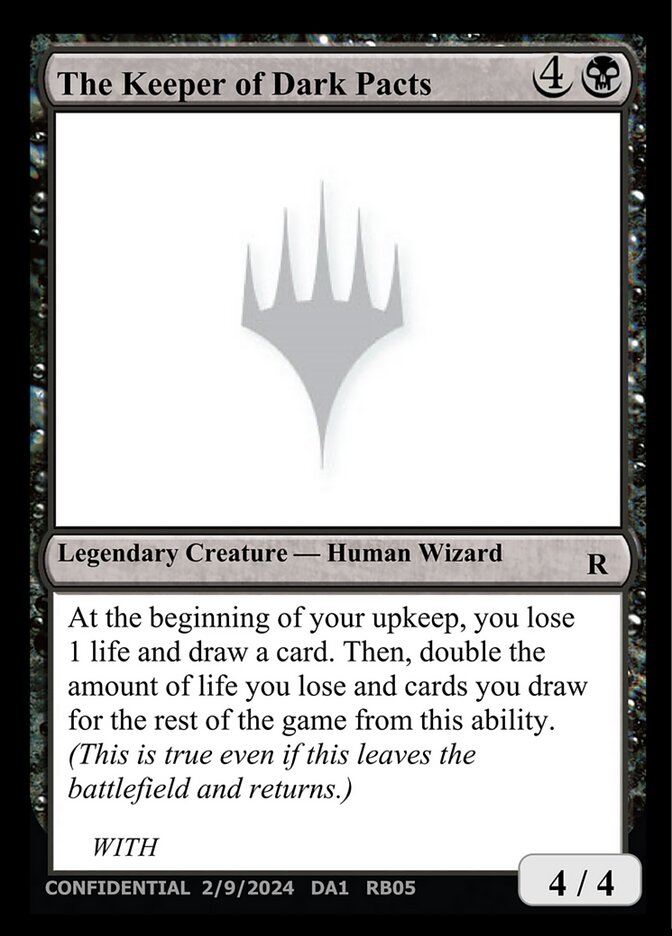
The Keeper of Dark Pacts is one of those cards players keep asking about. Here is, in plain words, what its official text says, the rulings published by Wizards of the Coast, and the combos players actually run.
Official card text
At the beginning of your upkeep, you lose 1 life and draw a card. Then, double the amount of life you lose and cards you draw for the rest of the game from this ability. (This is true even if this leaves the battlefield and returns.)
Complete guide
The Keeper of Dark Pacts is a high-risk, high-reward legendary creature that turns your upkeep into a source of exponential power. By trading your life force for forbidden knowledge, it ensures that your hand is always full, provided you can survive the escalating cost. This Human Wizard represents a clock that ticks faster every turn it remains on the battlefield.
Exponential Growth Explained
The primary mechanic of The Keeper of Dark Pacts is its self-modifying triggered ability. Unlike most cards that have a fixed effect, this creature tracks its own history. Every time the ability resolves, it updates the 'multiplier' for all future instances of that specific ability for the rest of the game. Even if the creature is destroyed and later reanimated or cast again, the game remembers how many times this effect has doubled.
Step-by-Step Resolution
First, the ability triggers at the start of your upkeep and goes on the stack. Upon resolution, you lose life and draw cards based on the current accumulated value (starting at 1 life and 1 card). Finally, the ability sets a new value for the next time it triggers by doubling the current amounts. Because the doubling happens 'for the rest of the game,' the effect persists even if The Keeper of Dark Pacts is removed from the battlefield before your next upkeep.
Common Mistakes
A frequent error is assuming that blinking or flickering The Keeper of Dark Pacts resets the life loss and card draw back to 1. Because the text explicitly states the doubling persists even if it leaves and returns, the count continues to climb. Additionally, players often forget that the life loss is not a cost you can choose not to pay; it is a mandatory part of the effect. If your life total hits zero during your upkeep because of this ability, you lose the game before you can use the cards you just drew.
Strategy and Timing
You should play The Keeper of Dark Pacts when you have a stable board state or a high enough life total to sustain at least three or four turns of its effect. Since the growth is exponential (1, 2, 4, 8, 16), the card becomes lethal to the owner very quickly. It is best used in decks that can capitalize on a massive hand size immediately or decks that feature ways to gain life to offset the dark bargain.
Interaction examples
 Roaming Throne
If you have Roaming Throne on the battlefield naming 'Human' or 'Wizard', The Keeper of Dark Pacts will trigger twice during your upkeep. The first resolution will cause you to lose 1 life and draw 1 card, then double the future values to 2. The second resolution (from the same upkeep) will then cause you to lose 2 life and draw 2 cards, doubling the future values again to 4. By the time you reach your next upkeep, you will be losing 4 life and drawing 4 cards.
 Solemn Simulacrum
While Solemn Simulacrum provides a land and a single card draw upon death, it helps stabilize your mana base to cast the spells you draw from The Keeper of Dark Pacts. If you draw into your Simulacrum using the Keeper's ability, you can play it to ensure you have the mana to cast the increasing number of cards you will draw in subsequent turns, while also providing a blocker to protect your life total from enemy attacks.
Guide written with AI from the official text and rulings. Official English text prevails.
How it works : The Keeper of Dark Pacts
Original English text — Wizards of the Coast / Scryfall
No additional ruling has been published for this card.
Commentaires
- Sois le premier à commenter cette carte.
Read next
Meta decks with The Keeper of Dark Pacts
No archived Top 8 deck with this card yet.