

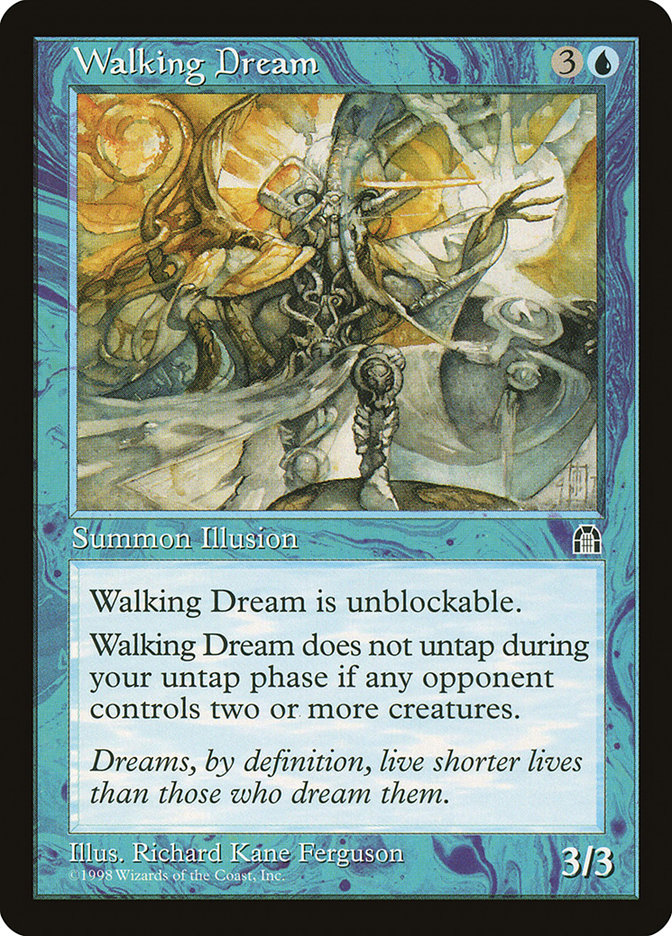
Walking Dream is one of those cards players keep asking about. Here is, in plain words, what its official text says, the rulings published by Wizards of the Coast, and the combos players actually run.
Official card text
This creature can't be blocked. This creature doesn't untap during your untap step if an opponent controls two or more creatures.
Complete guide
Walking Dream is a spectral Illusion that excels at slipping past enemy defenses with its natural unblockable ability. While it can pressure your opponents relentlessly, it requires a clear board to maintain its stamina. Navigating its drawback is the key to mastering this ethereal creature in your blue decks.
Understanding the Unblockable Dream
Walking Dream has a static ability that makes it completely unblockable, meaning no creature can be declared as a blocker against it regardless of their abilities. However, it also features a conditional static ability that affects your untap step. If at least one opponent controls two or more creatures when your untap step begins, Walking Dream will remain tapped, effectively stalling your offense.
The Untap Step Resolution
The game checks the number of creatures your opponents control at the very start of your untap step. This is a continuous check; if the condition (an opponent having two or more creatures) is met, the game simply skips the untap action for Walking Dream. Since no player receives priority during the untap step, you cannot cast spells to destroy an opponent's creature in the middle of this process to force Walking Dream to untap.
Strategic Considerations
To keep Walking Dream active, you must prioritize board control. Using removal or bounce spells to keep your opponents below the two-creature threshold is essential. Alternatively, you can use external effects to untap it manually, bypassing its own restriction entirely.
Common Pitfalls
A common mistake is thinking you can respond to the untap restriction. Because it is a static ability that modifies the untap step rules, there is no trigger to respond to. Another mistake is forgetting that the count is per opponent; if you have two opponents who each control only one creature, Walking Dream will still untap because no single opponent meets the 'two or more' requirement.
Interaction examples
 Solemn Simulacrum
 Roaming Throne
If your opponent controls both a Solemn Simulacrum and a Roaming Throne, the condition for Walking Dream is met. During your untap step, the game sees an opponent controls two creatures, and Walking Dream remains tapped. You will need to remove one of these creatures before your next turn to allow it to untap naturally.
You attack an opponent who controls a Solemn Simulacrum. Because Walking Dream 'can't be blocked,' your opponent cannot use their Golem to stop the damage. The damage will be dealt directly to the player, regardless of how many creatures they have standing ready to defend.
You control Walking Dream and play Roaming Throne, choosing 'Illusion.' While Roaming Throne doubles triggered abilities, Walking Dream only has static abilities (unblockable and the untap restriction). Therefore, Roaming Throne does not change how Walking Dream functions on the battlefield.
Guide written with AI from the official text and rulings. Official English text prevails.
How it works : Walking Dream
Original English text — Wizards of the Coast / Scryfall
No additional ruling has been published for this card.
Legal formats
Commentaires
- Sois le premier à commenter cette carte.
Read next
Meta decks with Walking Dream
No archived Top 8 deck with this card yet.