

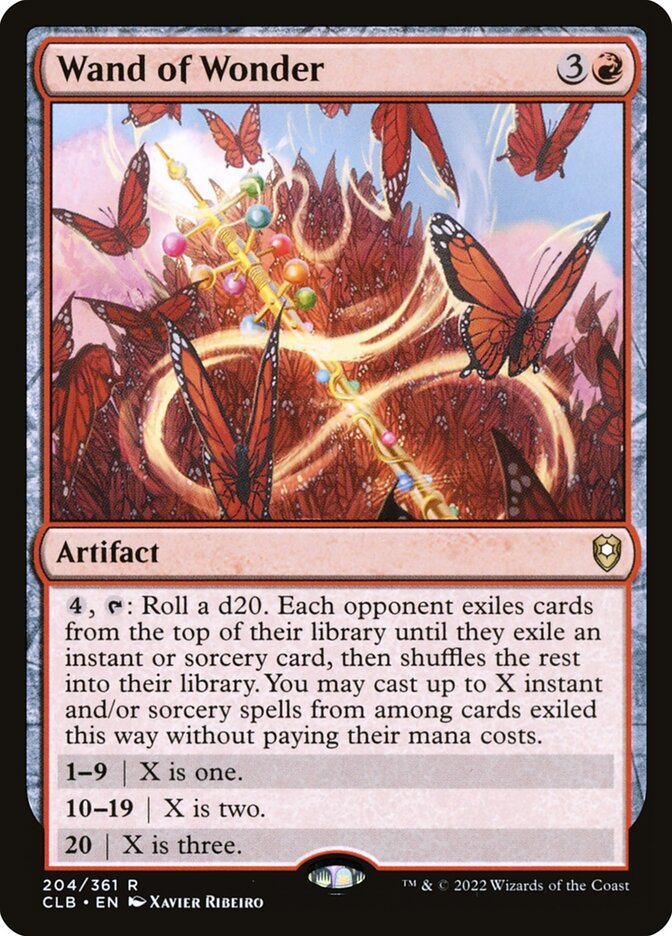
Wand of Wonder is one of those cards players keep asking about. Here is, in plain words, what its official text says, the rulings published by Wizards of the Coast, and the combos players actually run.
Official card text
,
: Roll a d20. Each opponent exiles cards from the top of their library until they exile an instant or sorcery card, then shuffles the rest into their library. You may cast up to X instant and/or sorcery spells from among cards exiled this way without paying their mana costs. 1—9 | X is one. 10—19 | X is two. 20 | X is three.
Complete guide
Wand of Wonder is a chaotic and powerful artifact that lets you plunder your opponents' libraries for magical secrets. By rolling a d20, you force your foes to reveal their spells, giving you the chance to cast them for free. It is the perfect tool for players who love unpredictable turns and high-stakes gambling.
Unpacking the Wand's Magic
When you activate Wand of Wonder for four mana and tap it, you roll a twenty-sided die (d20). Every opponent must then exile cards from the top of their library until they hit an instant or sorcery. Once those spells are found, all other cards revealed this way are shuffled back into their respective libraries. Depending on your roll result (1-9, 10-19, or a natural 20), you can choose to cast one, two, or three of those exiled spells without paying their mana costs.
Step-by-Step Resolution
First, you pay the activation cost and roll the die. Second, opponents begin exiling cards simultaneously; if an opponent has no instants or sorceries in their library, they exile their entire library and then shuffle nothing back. Third, you look at the exiled instant and sorcery cards and choose which ones to cast based on your X value. You must cast them while the ability is resolving; you cannot save them for later in the turn. Any cards you choose not to cast remain in exile indefinitely.
Timing and Restrictions
A common mistake is forgetting that you must follow all normal timing rules for the cards you are casting, except for the fact that you are casting them during the resolution of an ability. If a spell has additional costs (like 'discard a card'), you must still pay those, but you ignore the mana cost entirely. If you roll a 20 but your opponents only revealed two spells total, you can only cast those two.
Strategic Deployment
Use Wand of Wonder when your opponents are playing deck archetypes heavy on spells, such as Control or Spellslinger builds. Since it hits every opponent in a multiplayer game, the value scales significantly with more players. It is best used when you have open mana to threaten an activation during an opponent's end step, ensuring you have the best information before committing your resources.
Interaction examples
You activate the Wand in a 4-player game and roll a 15. Each of your three opponents exiles cards until they hit an instant or sorcery. Opponent A finds a Lightning Bolt, Opponent B finds a Counterspell, and Opponent C finds a Ponder. Because you rolled a 15, X is two. You choose to cast the Lightning Bolt and the Ponder for free, while the Counterspell remains in exile.
 Commander's Sphere
 Solemn Simulacrum
While Solemn Simulacrum and Commander's Sphere help you ramp into the 4-mana activation cost, note that Wand of Wonder specifically looks for instants and sorceries. If an opponent exiles Solemn Simulacrum while looking for a spell, that creature will be shuffled back into their library and cannot be cast by the Wand.
Guide written with AI from the official text and rulings. Official English text prevails.
How it works : Wand of Wonder
Original English text — Wizards of the Coast / Scryfall
No additional ruling has been published for this card.
Legal formats
Commentaires
- Sois le premier à commenter cette carte.
Read next
Meta decks with Wand of Wonder
No archived Top 8 deck with this card yet.