

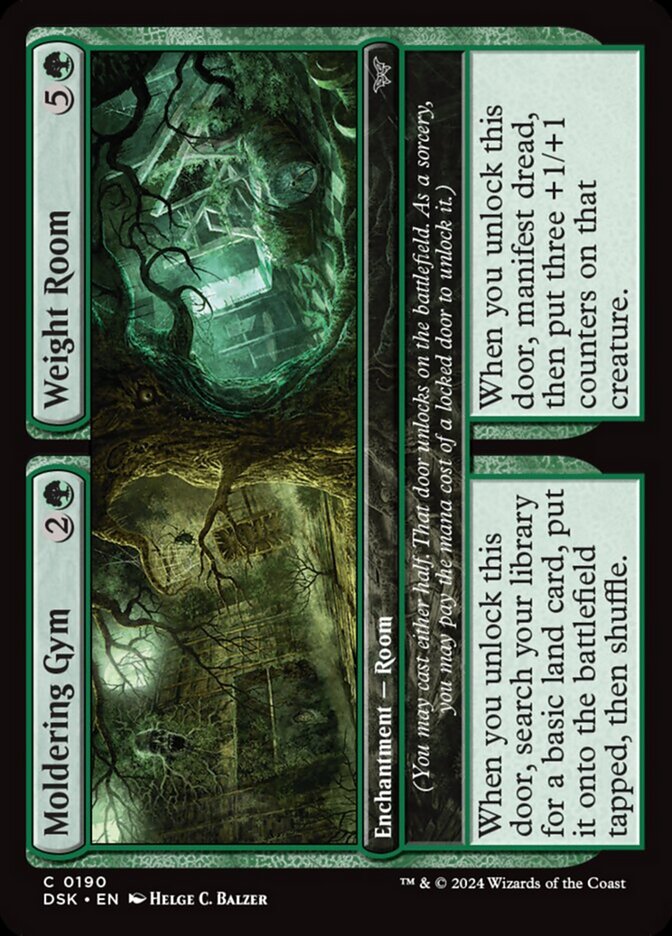
Moldering Gym // Weight Room is one of those cards players keep asking about. Here is, in plain words, what its official text says, the rulings published by Wizards of the Coast, and the combos players actually run.
Official card text
When you unlock this door, search your library for a basic land card, put it onto the battlefield tapped, then shuffle. (You may cast either half. That door unlocks on the battlefield. As a sorcery, you may pay the mana cost of a locked door to unlock it.) When you unlock this door, manifest dread, then put three +1/+1 counters on that creature. (You may cast either half. That door unlocks on the battlefield. As a sorcery, you may pay the mana cost of a locked door to unlock it.)
Complete guide
Moldering Gym // Weight Room is a versatile Room enchantment from Duskmourn that offers both early-game ramp and late-game board presence. By utilizing the new Room mechanic, this card allows you to fix your mana early or manifest a formidable threat when you have the resources.
What it does
This card is a Room enchantment with two 'doors.' Moldering Gym costs {2}{G} and, when unlocked, searches your library for a basic land card to put onto the battlefield tapped. Weight Room costs {5}{G} and, when unlocked, manifests dread (look at the top two cards, manifest one, graveyard the other) and puts three +1/+1 counters on that creature. You can cast either side from your hand; the chosen door enters unlocked while the other remains locked until you pay its cost as a sorcery.
How it resolves step by step
When you cast Moldering Gym, it enters the battlefield with that door unlocked, immediately triggering its ability. You search for a basic land, put it into play tapped, and shuffle. Later, while the card is on the battlefield, you may pay {5}{G} during your main phase when the stack is empty to unlock Weight Room. This is a special action that doesn't use the stack. Once unlocked, the 'when you unlock this door' ability triggers, allowing you to manifest dread and buff the resulting creature with counters.
Common Mistakes
A frequent error is miscalculating the mana value of the card while it is in your hand or library. In these zones, the mana value is the sum of both doors (9). However, if you are casting it, you only consider the side you are currently playing. Additionally, remember that if a Room enters the battlefield without being cast (such as through a blink effect), both doors start locked, and you must pay to unlock them individually to get their effects.
When to play it
Play Moldering Gym early if you are missing land drops or need to accelerate your mana production. Hold onto the card to cast the Weight Room side if you need a surprise blocker or a sudden 5/5 attacker (a 2/2 base creature plus three +1/+1 counters). It is exceptionally strong in decks that care about the graveyard, as manifest dread helps fuel delve or reanimation strategies.
Interaction examples
 Eldrazi Conscription
When you unlock Weight Room, you look at the top two cards of your library. If one is Eldrazi Conscription, you can put it into your graveyard and manifest a different card, or manifest the Conscription itself as a 2/2 creature. Weight Room then puts three +1/+1 counters on it, resulting in a 5/5 face-down creature. Even though Eldrazi Conscription is an Aura, it remains a 5/5 creature while face down.
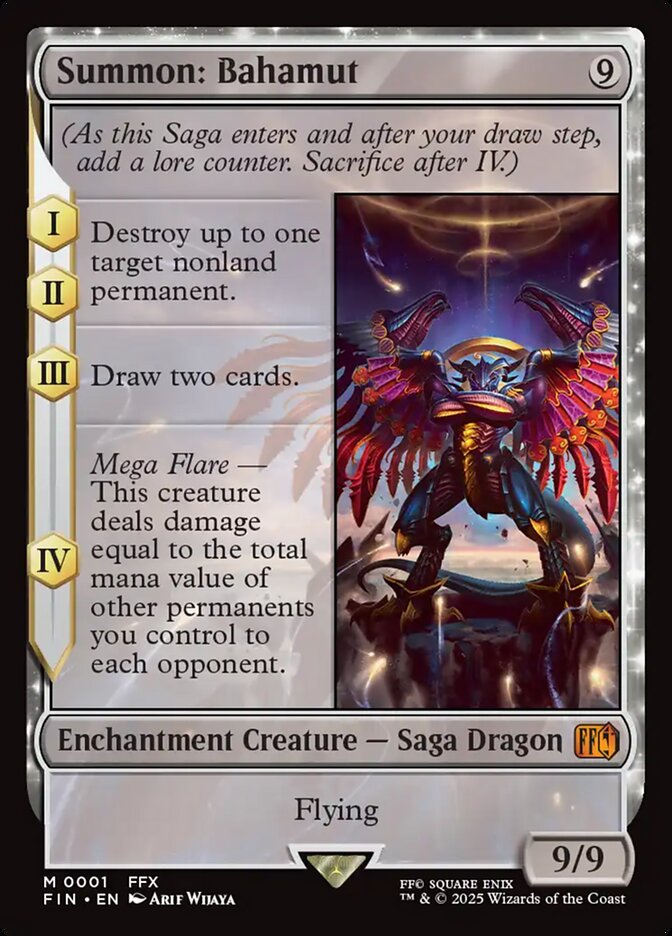 Summon: Bahamut
If you have Weight Room and Moldering Gym both unlocked, the card's total mana value on the battlefield is 9. If you then resolve the IV chapter of Summon: Bahamut (Mega Flare), this Room will contribute 9 damage to the total dealt to each opponent, as it counts the combined mana value of all its unlocked doors.
Guide written with AI from the official text and rulings. Official English text prevails.
How it works : Moldering Gym // Weight Room
Original English text — Wizards of the Coast / Scryfall
- #1· Wizards of the Coast
To cast a Room spell, choose a half (or "door") to cast. There's no way to cast both halves of a Room card. When the Room spell resolves, the corresponding door becomes unlocked as the Room enters.
No other card is named in this ruling.
- #2· Wizards of the Coast
Room cards have two card faces with a shared type line on a single card. The characteristics of the door you didn't cast are ignored while the spell is on the stack.
No other card is named in this ruling.
- #3· Wizards of the Coast
Each Room card is a single card. For example, if you discard a Room card, you've discarded one card, not two. If an effect counts the number of enchantment cards in your graveyard, Bottomless Pool // Locker Room counts once, not twice.
No other card is named in this ruling.
- #4· Wizards of the Coast
Each Room card has two names. If an effect instructs you to choose a card name, you may choose one of those names, but not both.
No other card is named in this ruling.
- #5· Wizards of the Coast
If an effect allows you to cast a spell with certain characteristics, consider only the characteristics of the door you're casting. For example, if an effect allows you to cast a permanent spell with mana value 3 or less from among cards in your graveyard, you could cast Bottomless Pool this way, but not Locker Room.
No other card is named in this ruling.
- #6· Wizards of the Coast
While in any zone other than the stack or the battlefield, a Room card's characteristics are a combination of its two doors. For example, Bottomless Pool // Locker Room has a mana value of 6 while it's in your library. If an effect allows you to search your library for a card with mana value 4 or less, you can't find Bottomless Pool // Locker Room.
No other card is named in this ruling.
- #7· Wizards of the Coast
While on the battlefield, a Room's characteristics are a combination of the characteristics of its unlocked doors. For example, if Bottomless Pool // Locker Room is on the battlefield with both doors unlocked, its names are Bottomless Pool and Locker Room, its mana value is 6, it's a Room Enchantment, and it has the abilities in each door's text box.
No other card is named in this ruling.
- #8· Wizards of the Coast
If a spell or ability would create a copy of a Room spell on the stack, the copy retains the choice of which door was cast but also retains the full characteristics of the spell. The characteristics of the door that wasn't cast are still ignored while the copy is on the stack, and when the copy resolves, the token it becomes will enter with the appropriate door unlocked.
No other card is named in this ruling.
- #9· Wizards of the Coast
If a Room enters from any zone other than the stack, it will enter with both halves locked.
No other card is named in this ruling.
- #10· Wizards of the Coast
If neither door of a Room is unlocked, it's a Room enchantment with no name and no abilities.
No other card is named in this ruling.
- #11· Wizards of the Coast
Any time you have priority during a main phase of your turn and the stack is empty, you may pay the mana cost of a locked door (also called its "unlock cost"). That door becomes unlocked. This is a special action. It doesn't use the stack and can't be responded to.
No other card is named in this ruling.
- #12· Wizards of the Coast
An ability that triggers "when you unlock this door" triggers when that door becomes unlocked. This can happen one of two ways: (1) the door becomes unlocked on the battlefield or (2) the door becomes unlocked as the Room enters the battlefield because you cast the corresponding half. In the latter case, since the door becoming unlocked is what causes the ability to trigger, effects that cause abilities that trigger when a permanent enters to trigger an additional time (such as that of Panharmonicon) won't apply.
No other card is named in this ruling.
- #13· Wizards of the Coast
Some abilities allow you to unlock a door of a Room you control. You can't choose to unlock a door that's already unlocked with such an ability. If such an ability requires a target, you can target a Room even if both of its doors are unlocked, but the ability won't do anything when it resolves.
No other card is named in this ruling.
- #14· Wizards of the Coast
Some abilities allow you to lock a door of a Room you control. You can't choose to lock a door that's already locked with such an ability. If such an ability requires a target, you can target a Room even if both of its doors are locked, but the ability won't do anything when it resolves.
No other card is named in this ruling.
- #15· Wizards of the Coast
Some doors have abilities that trigger whenever you unlock that door and require one or more targets. You can unlock that door even if there would be insufficient legal targets for that triggered ability. The triggered ability won't go on the stack.
No other card is named in this ruling.
- #16· Wizards of the Coast
An ability that triggers "whenever you fully unlock a Room" triggers when a door becomes unlocked and the other door of that Room is already unlocked, or when both doors of that Room become unlocked simultaneously.
No other card is named in this ruling.
- #17· Wizards of the Coast
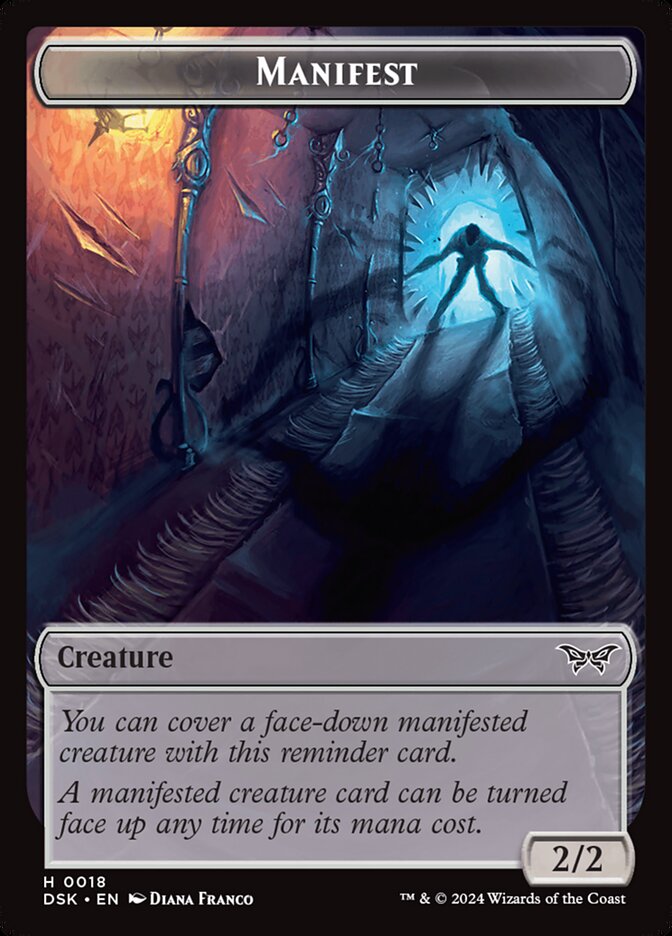
To manifest dread, look at the top two cards of your library. Manifest one (by putting it onto the battlefield face down) and put the other into your graveyard. The card you put onto the battlefield becomes a 2/2 face-down creature with no name, mana cost, creature types, or abilities. It's colorless and has a mana value of 0. Other effects that apply to the permanent can still grant it any characteristics it doesn't have or change the characteristics it does have.
Card named in this ruling
- #18· Wizards of the Coast
Any time you have priority, you can turn a manifested permanent you control face up by revealing that it's a creature card (ignoring any copy effects or type-changing effects that might be applying to it) and paying its mana cost. This is a special action. It doesn't use the stack and can't be responded to.
Card named in this ruling
- #19· Wizards of the Coast
If a manifested creature would have disguise or morph if it were face up, you may also turn it face up by paying its disguise or morph cost, as appropriate.
Card named in this ruling
- #20· Wizards of the Coast
Unlike a face-down creature that was cast using a disguise or morph ability, a manifested creature may still be turned face up after it loses its abilities if it's a creature card.
Card named in this ruling
- #21· Wizards of the Coast
If a double-faced card is manifested, it will be put onto the battlefield face down. While face down, it can't transform. If the front face of the card is a creature card, you can turn it face up by paying its mana cost. If you do, its front face will be up.
Card named in this ruling
- #22· Wizards of the Coast
If your library contains only one card when you manifest dread, you'll look at that card and put it onto the battlefield face down. You won't have the option to put it into your graveyard instead. If your library contains no cards when you manifest dread, you won't do anything.
Card named in this ruling
- #23· Wizards of the Coast
Some cards in the Duskmourn release have abilities that trigger "whenever you manifest dread." In circumstances where you are instructed to manifest dread but can't perform some or all of the steps of manifesting dread (probably because your library has one or fewer cards in it), these abilities will still trigger.
Card named in this ruling
- #24· Wizards of the Coast
At any time, you can look at a face-down spell or permanent you control. You can't look at face-down permanents or spells you don't control unless an effect instructs or allows you to do so.
No other card is named in this ruling.
- #25· Wizards of the Coast
If a face-down creature loses its abilities, it can't be turned face up with a disguise or morph ability because it will no longer have that ability (or the associated cost) once face up.
No other card is named in this ruling.
- #26· Wizards of the Coast
Because the permanent is on the battlefield both before and after it's turned face up, turning a permanent face up doesn't cause any enters-the-battlefield abilities to trigger.
No other card is named in this ruling.
- #27· Wizards of the Coast
Because face-down creatures don't have a name, they can't have the same name as any other creature, even another face-down creature.
No other card is named in this ruling.
- #28· Wizards of the Coast
A permanent that turns face up or face down changes characteristics but is otherwise the same permanent. Spells and abilities that were targeting that permanent and Auras and Equipment that were attached to that permanent aren't affected unless the new characteristics of the object change the legality of those targets or attachments.
No other card is named in this ruling.
- #29· Wizards of the Coast
Turning a permanent face up or face down doesn't change whether that permanent is tapped or untapped.
No other card is named in this ruling.
- #30· Wizards of the Coast
If a face-down spell leaves the stack and goes to any zone other than the battlefield (if it was countered, for example), you must reveal it. Similarly, if a face-down permanent leaves the battlefield, you must reveal it. You must also reveal all face-down spells and permanents you control if you leave the game or the game ends.
No other card is named in this ruling.
- #31· Wizards of the Coast
You must ensure that your face-down spells and permanents can be easily differentiated from each other. You're not allowed to mix up the cards that represent them on the battlefield to confuse other players. The order in which they entered should remain clear, as well as what ability caused them to be face down. (This includes manifest, disguise, cloak, morph, and a few older effects that turn cards face down.) Common methods for doing this include using markers or dice, or simply placing them in order on the battlefield.
Card named in this ruling
- #32· Wizards of the Coast
If something tries to turn a face-down instant or sorcery card on the battlefield face up, reveal that card to show all players it's an instant or sorcery card. The permanent remains on the battlefield face down. Abilities that trigger when a permanent turns face up won't trigger, because even though you revealed the card, it never turned face up.
No other card is named in this ruling.
Related cards and tokens
Legal formats
Commentaires
- Sois le premier à commenter cette carte.
Read next
Meta decks with Moldering Gym // Weight Room
No archived Top 8 deck with this card yet.