

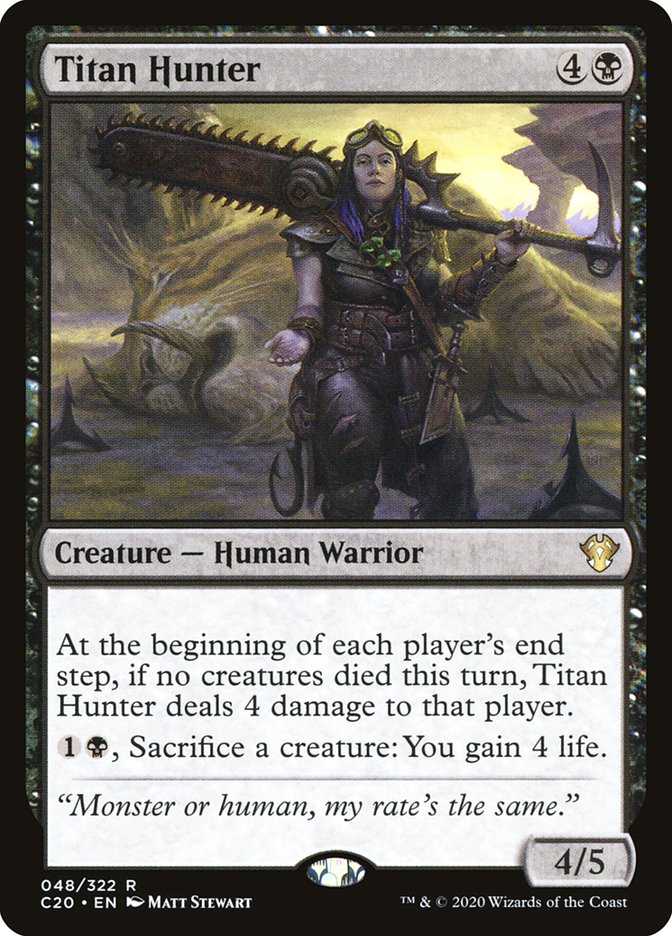
Titan Hunter is one of those cards players keep asking about. Here is, in plain words, what its official text says, the rulings published by Wizards of the Coast, and the combos players actually run.
Official card text
At the beginning of each player's end step, if no creatures died this turn, this creature deals 4 damage to that player., Sacrifice a creature: You gain 4 life.

Complete guide
Titan Hunter is a menacing Human Warrior that punishes hesitation and rewards sacrifice. It forces the game to move forward by threatening high damage to any player who fails to see a creature perish during their turn. By keeping the board bloody or using its own life-gaining ability, you can control the pace of the match.
Punishing Peace
Titan Hunter features an 'intervening if' clause in its triggered ability. At the beginning of every end step, the game checks if any creature has died that turn. If the graveyard has remained empty of new creature arrivals, the ability triggers and goes on the stack. If at least one creature died, the ability does not trigger at all.
Resolution Step-by-Step
When the end step begins, the game checks the condition: 'Did a creature die this turn?'. If no, the ability is placed on the stack targeting the active player. Before it resolves, players have a chance to respond. If a creature dies while the ability is still on the stack (perhaps due to a removal spell), the 'if' condition is re-checked. If a creature has now died, the ability does nothing. If still no creatures have died, the player takes 4 damage.
The Sacrifice Engine
Beyond its triggered ability, Titan Hunter provides a way to ensure its own condition isn't met while keeping you healthy. For one black and one generic mana, you can sacrifice a creature to gain 4 life. Notably, you can sacrifice Titan Hunter itself to this ability. This is a common way to avoid taking damage from your own Titan Hunter if you haven't managed to destroy an opponent's creature.
Strategic Timing
To maximize Titan Hunter, you want to ensure your opponents cannot resolve their end steps peacefully. If you have no way to kill an opponent's creature, you might choose to sacrifice one of your own creatures during your second main phase. This prevents you from taking 4 damage during your own end step, while still gaining life and potentially triggering other death effects.
Interaction examples
 Solemn Simulacrum
If it is your end step and no creatures have died, Titan Hunter's ability triggers. In response, you pay two mana and sacrifice Solemn Simulacrum. Because a creature has now died this turn, the 'if' clause on Titan Hunter's ability is no longer true when it tries to resolve, so you take no damage. Additionally, you gain 4 life from the Hunter and draw a card from the Simulacrum.
 Roaming Throne
With Roaming Throne on the battlefield naming 'Human', Titan Hunter's end-step ability triggers twice if no creatures died. During an opponent's end step, they would face two separate instances of 4 damage. However, if they manage to destroy a creature in response to the first trigger, the second trigger will check the condition, see that a creature died, and fail to deal any damage.
Guide written with AI from the official text and rulings. Official English text prevails.
How it works : Titan Hunter
Original English text — Wizards of the Coast / Scryfall
- #1· Wizards of the Coast
Titan Hunter’s triggered ability triggers at the beginning of each player’s end step, including yours, if no creatures died during that turn.
No other card is named in this ruling.
- #2· Wizards of the Coast
If a creature dies while Titan Hunter’s triggered ability is on the stack, Titan Hunter won’t deal damage to that player.
No other card is named in this ruling.
- #3· Wizards of the Coast
You can sacrifice Titan Hunter to pay the cost of its activated ability.
No other card is named in this ruling.
Legal formats
Commentaires
- Sois le premier à commenter cette carte.
Read next
Meta decks with Titan Hunter
No archived Top 8 deck with this card yet.