

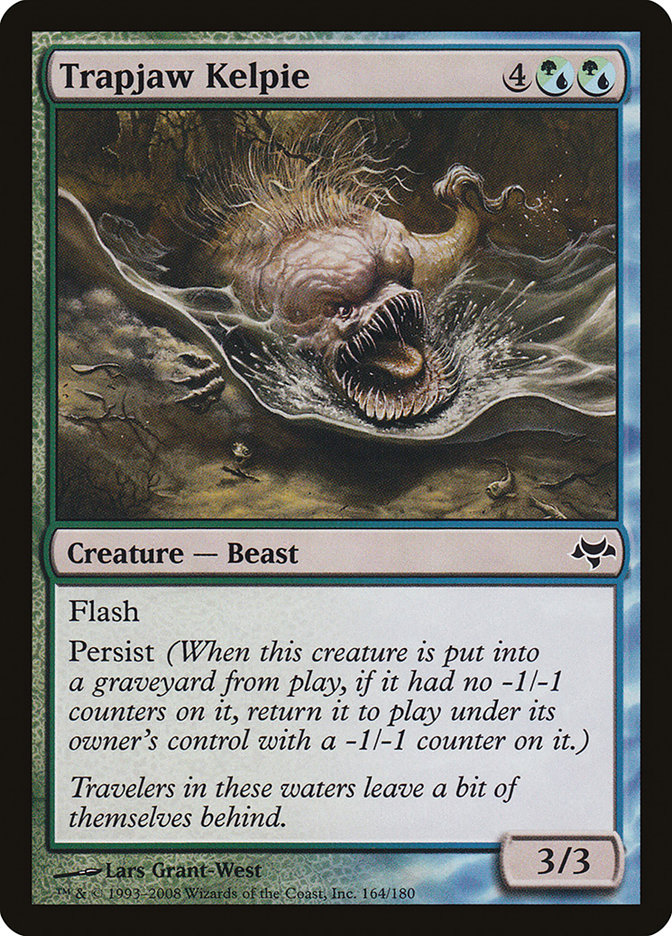
Trapjaw Kelpie is one of those cards players keep asking about. Here is, in plain words, what its official text says, the rulings published by Wizards of the Coast, and the combos players actually run.
Official card text
Flash Persist (When this creature dies, if it had no -1/-1 counters on it, return it to the battlefield under its owner's control with a -1/-1 counter on it.)
Complete guide
Trapjaw Kelpie is a versatile Beast that combines the speed of Flash with the durability of Persist. Whether you are ambushing an attacker or surviving a board wipe, this creature ensures your presence on the battlefield remains steady.
Understanding Flash and Persist
Flash allows you to cast Trapjaw Kelpie any time you could cast an instant, making it an excellent surprise blocker or a late-turn threat. Persist is a triggered ability that triggers when the creature dies; if it had no -1/-1 counters on it at the moment it left the battlefield, it returns to the battlefield with a -1/-1 counter. This effectively gives you two creatures for the price of one, provided you can manage the counters.
How Persist Resolves
When Trapjaw Kelpie is put into the graveyard, the game checks its last known information on the battlefield. If it didn't have a -1/-1 counter, the Persist ability goes on the stack. Upon resolution, the card is moved from the graveyard back to the battlefield. It is considered a completely new object with no memory of its previous existence, other than the new -1/-1 counter placed on it as part of the Persist effect.
Common Pitfalls
The most important rule to remember is that Persist only works if the creature had no -1/-1 counters at the time of its death. If an effect places a -1/-1 counter on Trapjaw Kelpie and that counter reduces its toughness to zero, it dies with a counter on it, and Persist will not trigger. Additionally, if the Kelpie has both a +1/+1 counter and a -1/-1 counter when it receives lethal damage, Persist will not trigger because the counters do not wipe each other out until state-based actions are checked, which is the same time the creature dies.
Strategic Timing
Because Trapjaw Kelpie has Flash, it pairs perfectly with 'draw-go' strategies. You can hold up mana for counterspells or removal, and if your opponent doesn't play anything worth responding to, you can simply cast the Kelpie at the end of their turn. This forces your opponent to deal with a 3/3 (or 2/2) threat that requires two removal spells to fully eliminate.
Interaction examples
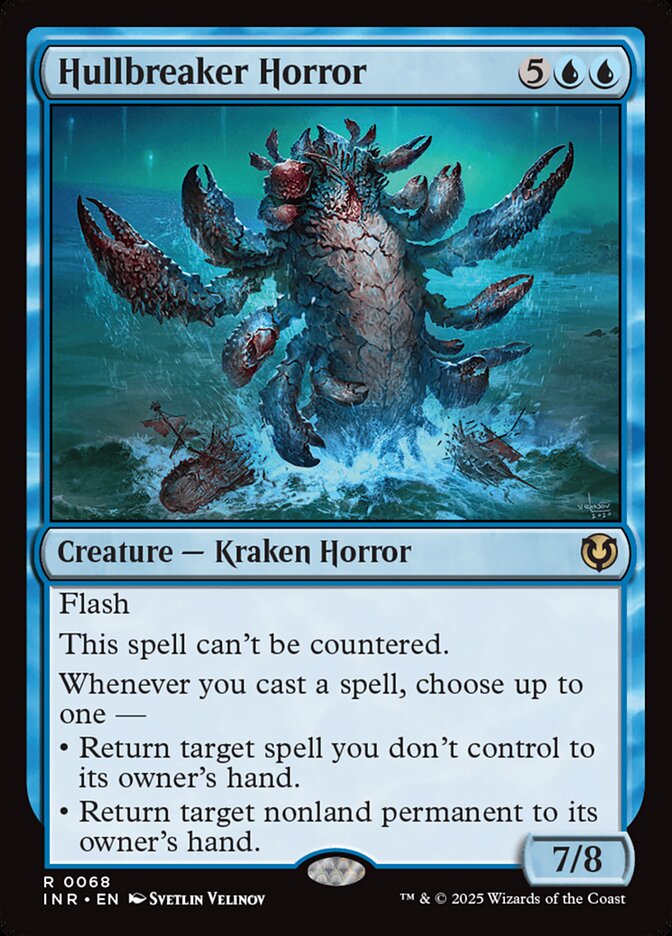 Hullbreaker Horror
1. You have Hullbreaker Horror on the battlefield. 2. Your opponent casts a spell. 3. In response, you cast Trapjaw Kelpie using Flash. 4. Hullbreaker Horror's ability triggers, allowing you to return a nonland permanent or a spell to its owner's hand. 5. Trapjaw Kelpie resolves and enters the battlefield, ready to block or strike on your next turn.
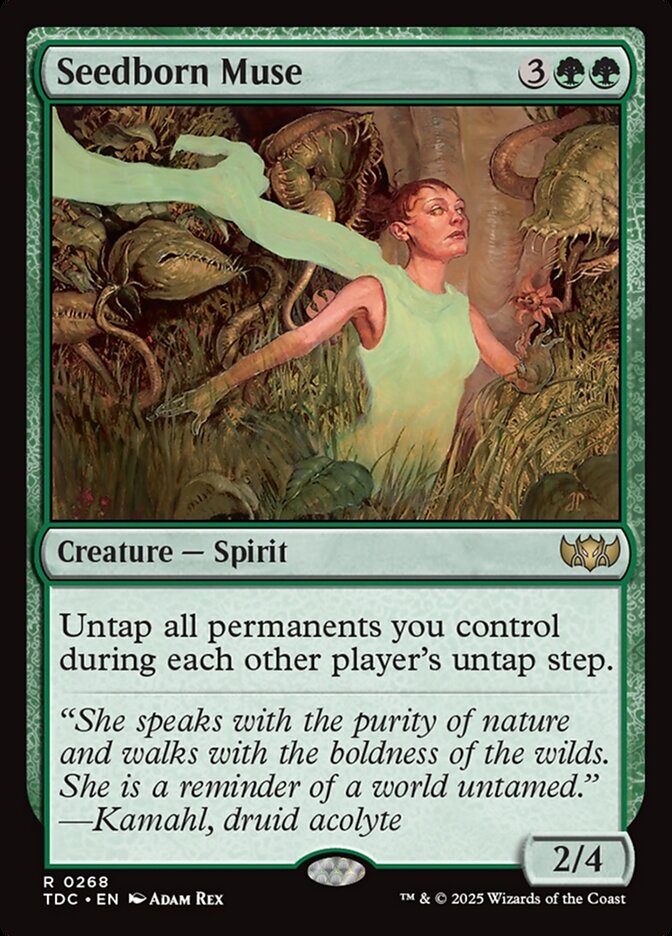 Seedborn Muse
1. With Seedborn Muse on the battlefield, all your lands untap during your opponent's untap step. 2. This allows you to keep your mana open every turn. 3. If your opponent attacks, you can cast Trapjaw Kelpie during their combat phase to block. 4. If the Kelpie dies during combat, it will Persist and return immediately, ready to be used again, while your mana remains refreshed for the next turn's actions.
Guide written with AI from the official text and rulings. Official English text prevails.
How it works : Trapjaw Kelpie
Original English text — Wizards of the Coast / Scryfall
- #1· Wizards of the Coast
If a creature with persist stops being a creature, persist will still work.
No other card is named in this ruling.
- #2· Wizards of the Coast
The persist ability triggers when the permanent is put into a graveyard. Its last known information (that is, how the creature last existed on the battlefield) is used to determine whether it had a -1/-1 counter on it.
No other card is named in this ruling.
- #3· Wizards of the Coast
If a permanent has multiple instances of persist, they’ll each trigger separately, but the redundant instances will have no effect. If one instance returns the card to the battlefield, the next to resolve will do nothing.
No other card is named in this ruling.
- #4· Wizards of the Coast
If a token with no -1/-1 counters on it has persist, the ability will trigger when the token is put into the graveyard. However, the token will cease to exist and can’t return to the battlefield.
No other card is named in this ruling.
- #5· Wizards of the Coast
When a permanent with persist returns to the battlefield, it’s a new object with no memory of or connection to its previous existence.
No other card is named in this ruling.
- #6· Wizards of the Coast
If multiple creatures with persist are put into the graveyard at the same time (due to combat damage or a spell that destroys all creatures, for example), the active player (the player whose turn it is) puts all of their persist triggers on the stack in any order, then each other player in turn order does the same. The last trigger put on the stack is the first one that resolves. That means that in a two-player game, the nonactive player’s persist creatures will return to the battlefield first, then the active player’s persist creatures do the same. The creatures return to the battlefield one at a time.
No other card is named in this ruling.
- #7· Wizards of the Coast
If a creature with persist that has +1/+1 counters on it receives enough -1/-1 counters to cause it to be destroyed by lethal damage or put into its owner’s graveyard for having 0 or less toughness, persist won’t trigger and the card won’t return to the battlefield. That’s because persist checks the creature’s existence just before it leaves the battlefield, and it still has all those counters on it at that point.
No other card is named in this ruling.
Legal formats
Commentaires
- Sois le premier à commenter cette carte.
Read next
Meta decks with Trapjaw Kelpie
No archived Top 8 deck with this card yet.