

Under the Skin is one of those cards players keep asking about. Here is, in plain words, what its official text says, the rulings published by Wizards of the Coast, and the combos players actually run.
Official card text
Manifest dread. (Look at the top two cards of your library. Put one onto the battlefield face down as a 2/2 creature and the other into your graveyard. Turn it face up any time for its mana cost if it's a creature card.) You may return a permanent card from your graveyard to your hand.
Complete guide
Under the Skin is a versatile sorcery that blends card advantage with field presence. By using the manifest dread mechanic, it allows you to sculpt your graveyard while simultaneously developing your board with a mysterious threat.
What It Does
When you cast Under the Skin, you perform two distinct actions in order. First, you manifest dread: you look at the top two cards of your library, putting one onto the battlefield face down as a 2/2 colorless creature and the other into your graveyard. Second, you have the optional ability to return any permanent card from your graveyard to your hand. This includes creatures, lands, enchantments, artifacts, or planeswalkers.
How It Resolves Step by Step
1. Look at the top two cards of your library. 2. Choose one card to be your face-down creature. This card has no name, no types, and no mana cost. 3. Put the remaining card into your graveyard. 4. Choose a permanent card in your graveyard (this can be the card you just milled or something that was already there). 5. Return that card to your hand. Note that if your library is empty, you skip the manifest dread portion but can still return a card from your graveyard.
Common Mistakes
A frequent error is trying to return an instant or sorcery to your hand; Under the Skin specifically targets 'permanent' cards. Another mistake involves turning the manifested card face up. You can only turn it face up if it is a creature card, and you must pay its mana cost to do so. If you manifest an instant or sorcery, it must remain face down as a 2/2 creature for the rest of its time on the battlefield.
When to Play It
Under the Skin is best played when you need to recover a key piece of your strategy while maintaining tempo. Because the graveyard recursion happens after the mill, it is a reliable way to 'tutor' a permanent from the top of your deck if you see something you need among the top two cards.
Interaction examples
 Under the Skin
 Cultivate
If you have Cultivate in your graveyard, you cannot return it with Under the Skin because Cultivate is a sorcery, not a permanent card. You must choose a card like a creature or land instead.
 Farseek
You cast Under the Skin and see Farseek and a Forest on top of your library. You manifest the Forest face down as a 2/2 creature and put Farseek into your graveyard. You then use the second part of Under the Skin to return the Forest (a permanent card) that was already in your graveyard from an earlier turn.
 Manifest
When you manifest dread, you can use a Manifest reminder card to represent your new 2/2 creature. If the face-down card is a creature, you can turn it face up by paying its mana cost at any time you have priority, which does not use the stack.
Guide written with AI from the official text and rulings. Official English text prevails.
How it works : Under the Skin
Original English text — Wizards of the Coast / Scryfall
- #1· Wizards of the Coast
The permanent card can be one you milled while manifesting dread, but it doesn't have to be.
Card named in this ruling
- #2· Wizards of the Coast
To manifest dread, look at the top two cards of your library. Manifest one (by putting it onto the battlefield face down) and put the other into your graveyard. The card you put onto the battlefield becomes a 2/2 face-down creature with no name, mana cost, creature types, or abilities. It's colorless and has a mana value of 0. Other effects that apply to the permanent can still grant it any characteristics it doesn't have or change the characteristics it does have.
Card named in this ruling
- #3· Wizards of the Coast
Any time you have priority, you can turn a manifested permanent you control face up by revealing that it's a creature card (ignoring any copy effects or type-changing effects that might be applying to it) and paying its mana cost. This is a special action. It doesn't use the stack and can't be responded to.
Card named in this ruling
- #4· Wizards of the Coast
If a manifested creature would have disguise or morph if it were face up, you may also turn it face up by paying its disguise or morph cost, as appropriate.
Card named in this ruling
- #5· Wizards of the Coast
Unlike a face-down creature that was cast using a disguise or morph ability, a manifested creature may still be turned face up after it loses its abilities if it's a creature card.
Card named in this ruling
- #6· Wizards of the Coast
If a double-faced card is manifested, it will be put onto the battlefield face down. While face down, it can't transform. If the front face of the card is a creature card, you can turn it face up by paying its mana cost. If you do, its front face will be up.
Card named in this ruling
- #7· Wizards of the Coast
If your library contains only one card when you manifest dread, you'll look at that card and put it onto the battlefield face down. You won't have the option to put it into your graveyard instead. If your library contains no cards when you manifest dread, you won't do anything.
Card named in this ruling
- #8· Wizards of the Coast
Some cards in the Duskmourn release have abilities that trigger "whenever you manifest dread." In circumstances where you are instructed to manifest dread but can't perform some or all of the steps of manifesting dread (probably because your library has one or fewer cards in it), these abilities will still trigger.
Card named in this ruling
- #9· Wizards of the Coast
At any time, you can look at a face-down spell or permanent you control. You can't look at face-down permanents or spells you don't control unless an effect instructs or allows you to do so.
No other card is named in this ruling.
- #10· Wizards of the Coast
If a face-down creature loses its abilities, it can't be turned face up with a disguise or morph ability because it will no longer have that ability (or the associated cost) once face up.
No other card is named in this ruling.
- #11· Wizards of the Coast
Because the permanent is on the battlefield both before and after it's turned face up, turning a permanent face up doesn't cause any enters-the-battlefield abilities to trigger.
No other card is named in this ruling.
- #12· Wizards of the Coast
Because face-down creatures don't have a name, they can't have the same name as any other creature, even another face-down creature.
No other card is named in this ruling.
- #13· Wizards of the Coast
A permanent that turns face up or face down changes characteristics but is otherwise the same permanent. Spells and abilities that were targeting that permanent and Auras and Equipment that were attached to that permanent aren't affected unless the new characteristics of the object change the legality of those targets or attachments.
No other card is named in this ruling.
- #14· Wizards of the Coast
Turning a permanent face up or face down doesn't change whether that permanent is tapped or untapped.
No other card is named in this ruling.
- #15· Wizards of the Coast
If a face-down spell leaves the stack and goes to any zone other than the battlefield (if it was countered, for example), you must reveal it. Similarly, if a face-down permanent leaves the battlefield, you must reveal it. You must also reveal all face-down spells and permanents you control if you leave the game or the game ends.
No other card is named in this ruling.
- #16· Wizards of the Coast
You must ensure that your face-down spells and permanents can be easily differentiated from each other. You're not allowed to mix up the cards that represent them on the battlefield to confuse other players. The order in which they entered should remain clear, as well as what ability caused them to be face down. (This includes manifest, disguise, cloak, morph, and a few older effects that turn cards face down.) Common methods for doing this include using markers or dice, or simply placing them in order on the battlefield.
Card named in this ruling
- #17· Wizards of the Coast
If something tries to turn a face-down instant or sorcery card on the battlefield face up, reveal that card to show all players it's an instant or sorcery card. The permanent remains on the battlefield face down. Abilities that trigger when a permanent turns face up won't trigger, because even though you revealed the card, it never turned face up.
No other card is named in this ruling.
Popular combos
Real combos played by the community, sorted by popularity.

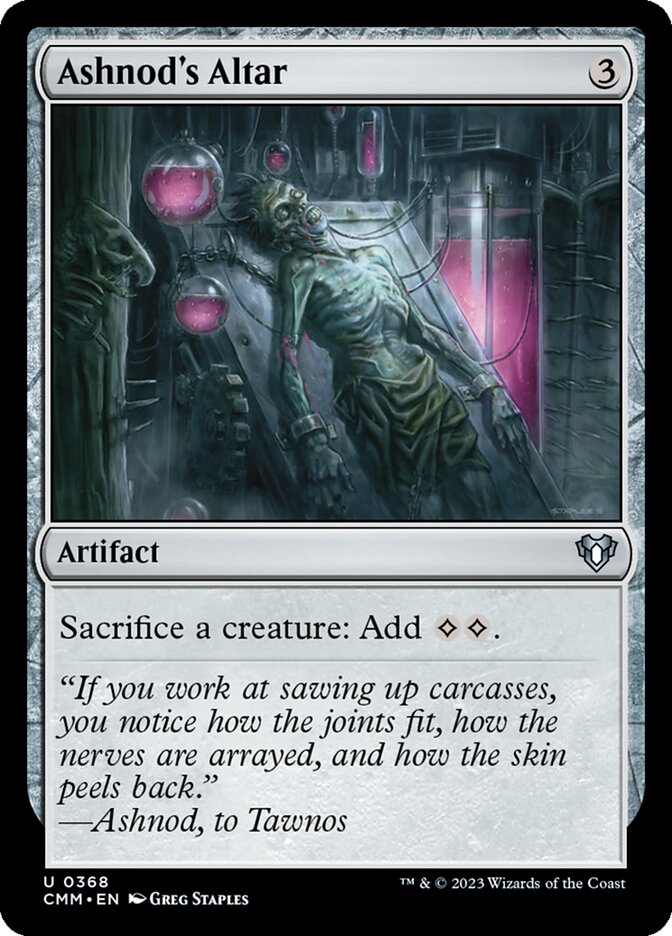


Kitsa, Otterball Elite + Ashnod's Altar + Intruder Alarm + Under the Skin
- 1Cast Under the Skin by paying its mana cost.
- 2Kitsa's prowess ability triggers, giving it +1/+1 until end of turn.
- 3Holding priority, activate Kitsa's second ability by paying
 and tapping it, copying Under the Skin.
- 4Resolve the copy of Under the Skin, causing you to put a card from your library onto the battlefield face-down as a 2/2 creature.
- 5When the creature enters, Intruder Alarm triggers, untapping all creatures.
- 6Holding priority, activate Ashnod's Altar by sacrificing the face-down creature, adding
 .
- 7Repeat from step 3
Related cards and tokens
Legal formats
Commentaires
- Sois le premier à commenter cette carte.
Read next
Meta decks with Under the Skin
No archived Top 8 deck with this card yet.