


Haunting Wind is one of those cards players keep asking about. Here is, in plain words, what its official text says, the rulings published by Wizards of the Coast, and the combos players actually run.
Official card text
Whenever an artifact becomes tapped or a player activates an artifact's ability withoutin its activation cost, this enchantment deals 1 damage to that artifact's controller.
Complete guide
Haunting Wind is a classic black enchantment that punishes artifact-heavy strategies by turning every gear and lever into a source of pain. It serves as a powerful deterrent against decks that rely on mana rocks, equipment, and repeatable utility artifacts to gain an advantage. By taxing both the usage and the activation of these items, it forces your opponents to reconsider their every move.
What It Does
Haunting Wind has a single triggered ability that watches for two specific events involving artifacts. First, it triggers whenever an artifact becomes tapped for any reason. Second, it triggers whenever a player activates an artifact's ability, provided that the activation cost of that ability does not include the tap symbol ({T}). In both cases, the enchantment deals 1 damage to the player who controls that artifact.
Resolving the Trigger Step-by-Step
When an artifact is tapped (such as for mana) or a qualifying ability is activated, Haunting Wind's ability is placed on the stack. The ability targets the artifact's controller at that specific moment. If multiple artifacts are tapped simultaneously, or if a player activates multiple abilities, each event creates a separate trigger on the stack. Players can respond to these triggers before they resolve and deal damage.
Common Mistakes
A common point of confusion involves abilities that DO require tapping the artifact. If an artifact's ability has {T} in its cost, Haunting Wind triggers because the artifact became tapped, not because the ability was activated. You do not deal 2 damage for a single activation that involves tapping; the 'without {T}' clause is specifically designed to catch 'untap' abilities or static activations (like mana sinks) so that the card covers all bases without double-dipping on a single action.
When to Play It
This enchantment is best utilized in slower, controlling decks that want to punish Treasure-heavy environments or decks utilizing artifacts like Sensei's Divining Top. Because it triggers on the artifact becoming tapped, it effectively adds a 'pay 1 life' tax to every mana rock on the board, which can quickly add up in long multiplayer games.
Interaction examples
If an opponent taps a Sol Ring for mana, the artifact has 'become tapped.' Haunting Wind triggers once and deals 1 damage to that opponent. Even though the ability was activated, the fact that it included a tap cost means only the 'becomes tapped' trigger condition is met.
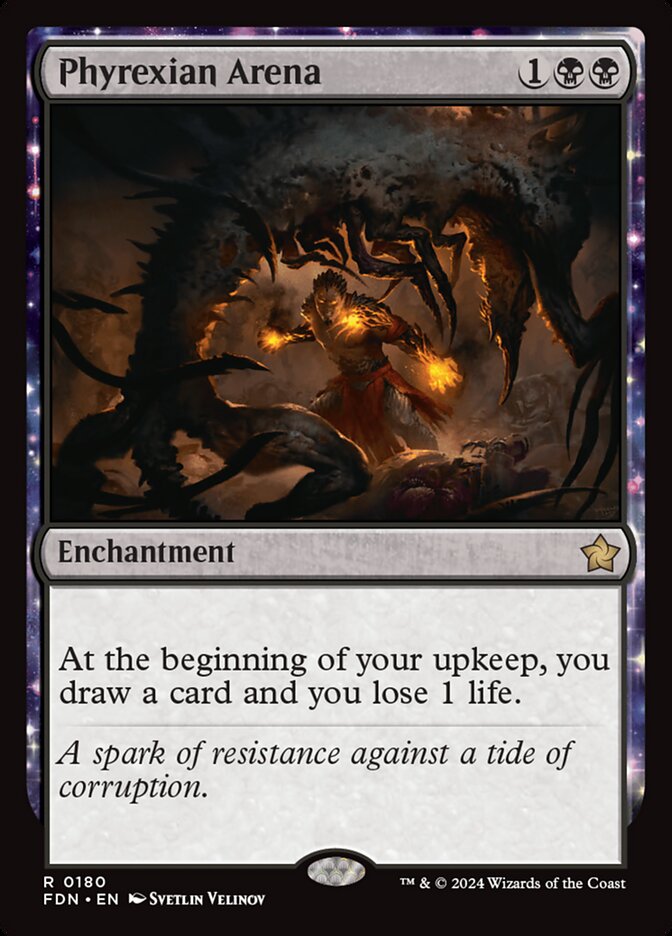 Phyrexian Arena
While Phyrexian Arena causes you to lose life during your upkeep, it is not an artifact and does not trigger Haunting Wind. However, if you use the extra cards drawn from the Arena to find more artifacts, Haunting Wind will ensure your opponents suffer for their board development while you maintain card advantage.
 Black Market Connections
If a player uses Black Market Connections to create a Treasure token, Haunting Wind remains silent. However, as soon as that player taps and sacrifices that Treasure for mana, the Treasure 'becomes tapped.' Haunting Wind triggers, dealing 1 damage to that player in addition to the life they may have already spent to create the token.
Guide written with AI from the official text and rulings. Official English text prevails.
How it works : Haunting Wind
Original English text — Wizards of the Coast / Scryfall
No additional ruling has been published for this card.
Legal formats
Commentaires
- Sois le premier à commenter cette carte.
Read next
Meta decks with Haunting Wind
No archived Top 8 deck with this card yet.