

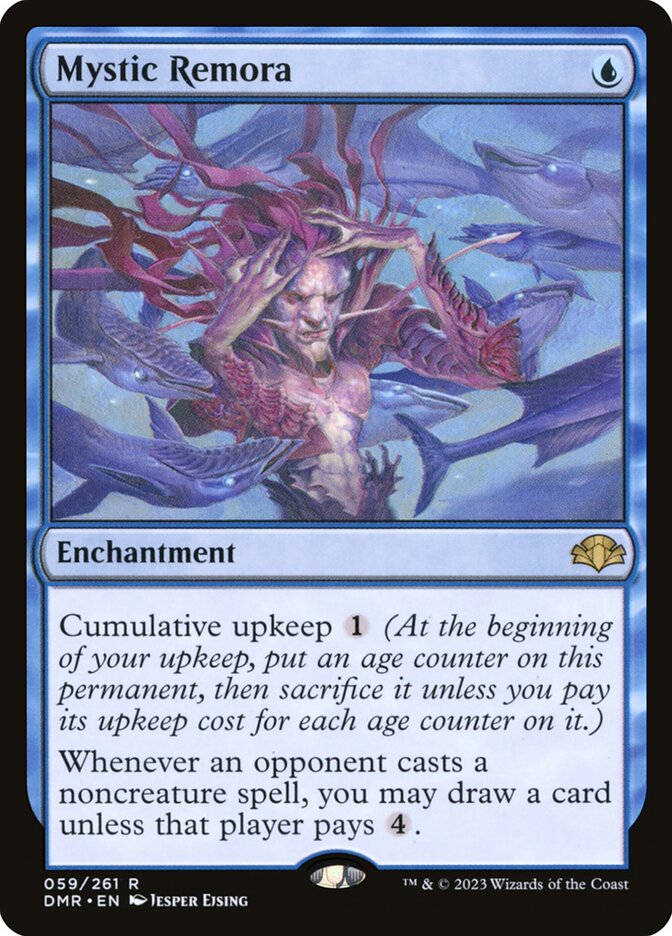
Mystic Remora is one of those cards players keep asking about. Here is, in plain words, what its official text says, the rulings published by Wizards of the Coast, and the combos players actually run.
Official card text
Cumulative upkeep(At the beginning of your upkeep, put an age counter on this permanent, then sacrifice it unless you pay its upkeep cost for each age counter on it.) Whenever an opponent casts a noncreature spell, you may draw a card unless that player pays
.
Complete guide
Mystic Remora is a powerhouse enchantment that can provide immense card advantage for a very small initial investment. Often referred to as 'The Fish' by veteran players, it forces your opponents to choose between stalling their game plan or fueling your hand. Understanding how to manage its increasing maintenance cost is key to mastering this card.
Understanding Cumulative Upkeep
Mystic Remora features the Cumulative upkeep mechanic. At the beginning of your upkeep, you put an age counter on the enchantment and then choose to either pay {1} for each age counter currently on it or sacrifice it. This means the cost grows every turn: {1} on the first upkeep, {2} on the second, and so on. You cannot make partial payments; you either pay the full amount or the Remora is sacrificed.
The Taxing Trigger
Whenever an opponent casts a noncreature spell, a triggered ability goes on the stack. This ability gives you the option to draw a card, but your opponent can prevent this by paying {4}. Note that this is a 'may' ability for you; if they don't pay, you still choose whether or not to draw. This taxing effect applies to Artifacts, Enchantments, Instants, Sorceries, and Planeswalkers.
When to Let Go
A common mistake is trying to keep Mystic Remora on the battlefield for too long. Because the cost increases exponentially relative to your available mana, there usually comes a point where paying the upkeep prevents you from casting your own spells. Since it only costs one blue mana to cast, it is often better to let it go and cast a new one later rather than choking your own mana development.
Interaction examples
 Urza's Saga
If your opponent plays Urza's Saga, Mystic Remora does NOT trigger. This is because Urza's Saga is a Land, and lands are played, not cast. However, if they were to cast a noncreature spell like a Sol Ring, you would trigger the draw unless they pay {4}.
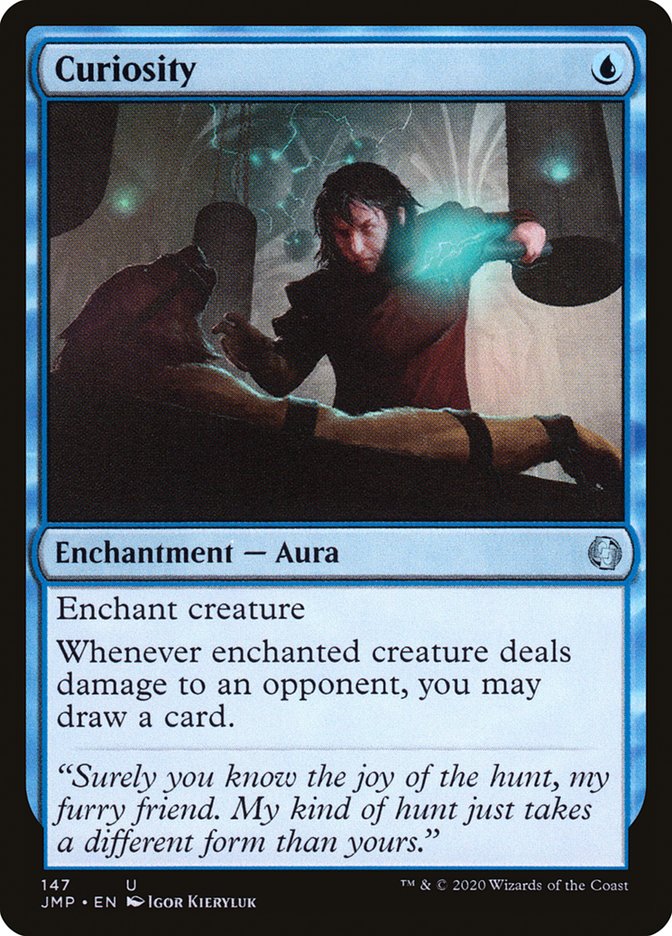 Curiosity
These two enchantments provide card draw in different ways. If you have Curiosity on a creature and attack an opponent, you draw a card when damage is dealt. If that same opponent then casts a noncreature spell to try and remove your creature, Mystic Remora triggers, potentially drawing you another card before their spell even resolves.
Guide written with AI from the official text and rulings. Official English text prevails.
How it works : Mystic Remora
Original English text — Wizards of the Coast / Scryfall
- #1· Wizards of the Coast
Paying cumulative upkeep is always optional. If it's not paid, the permanent with cumulative upkeep is sacrificed. Partial payments of the total cumulative upkeep cost can't be made. For example, if Mystic Remora has three age counters on it when its cumulative upkeep ability triggers, it gets another age counter and then its controller chooses to either pay
or sacrifice it.No other card is named in this ruling.
- #2· Wizards of the Coast
Cumulative upkeep is a triggered ability that imposes an increasing cost on a permanent. "Cumulative upkeep [cost]" means "At the beginning of your upkeep, if this permanent is on the battlefield, put an age counter on this permanent. Then you may pay [cost] for each age counter on it. If you don't, sacrifice it."
No other card is named in this ruling.
Legal formats
Commentaires
- Sois le premier à commenter cette carte.
Read next
Meta decks with Mystic Remora
No archived Top 8 deck with this card yet.