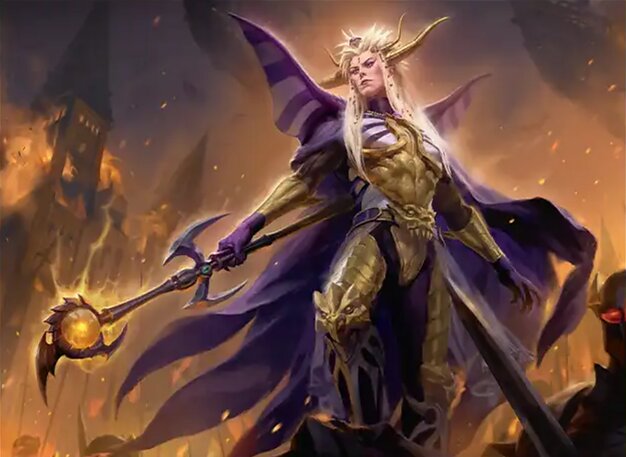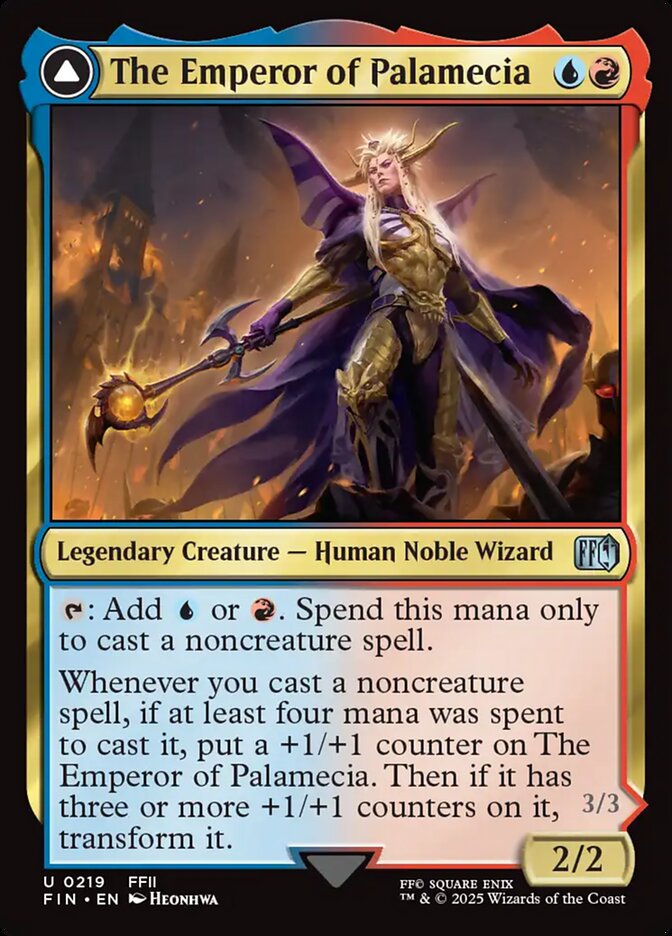
The Emperor of Palamecia // The Lord Master of Hell is one of those cards players keep asking about. Here is, in plain words, what its official text says, the rulings published by Wizards of the Coast, and the combos players actually run.
Official card text
: Add
or
. Spend this mana only to cast a noncreature spell. Whenever you cast a noncreature spell, if at least four mana was spent to cast it, put a +1/+1 counter on The Emperor of Palamecia. Then if it has three or more +1/+1 counters on it, transform it. Starfall — Whenever The Lord Master of Hell attacks, it deals X damage to each opponent, where X is the number of noncreature, nonland cards in your graveyard.
Complete guide
The Emperor of Palamecia is a powerful dual-faced engine that rewards you for casting high-cost noncreature spells. As you channel your magic, the Emperor grows in power until he eventually transforms into the devastating Lord Master of Hell. Once transformed, his Starfall ability punishes your opponents based on the size of your spellbook.
Tapping into Palamecian Power
The front side, The Emperor of Palamecia, functions as a mana accelerant specifically for noncreature spells. When you spend at least four mana on a noncreature spell, the Emperor triggers, gaining a +1/+1 counter. It is important to note that the total mana spent matters, not just the mana produced by the Emperor himself. Once he reaches three counters from this ability, he transforms into The Lord Master of Hell.
The Transformation Process
The transformation trigger resolves before the spell that caused it to trigger. If you cast a spell that puts the third counter on the Emperor, he will flip into his Demon form before your spell even resolves. On the reverse side, The Lord Master of Hell no longer provides mana but instead gains the Starfall ability, which deals damage to all opponents whenever he attacks based on noncreature, nonland cards in your graveyard.
Common Mistakes and Mana Values
A common mistake is forgetting that the mana value of this card is always 2 (based on the front face), even when it is flipped to its Demon side. Additionally, the Starfall ability calculates the value of X only once as the ability resolves. If your graveyard changes after the ability triggers but before it resolves, the damage dealt will reflect the count at the moment of resolution.
Strategy: When to Play
Play The Emperor of Palamecia early to maximize your mana ramp. Because he requires four mana to be spent on a spell to trigger his growth, he excels in decks featuring expensive artifacts, enchantments, or sorceries. Once he transforms, focus on filling your graveyard with spells to maximize the impact of Starfall during your combat phase.
Interaction examples
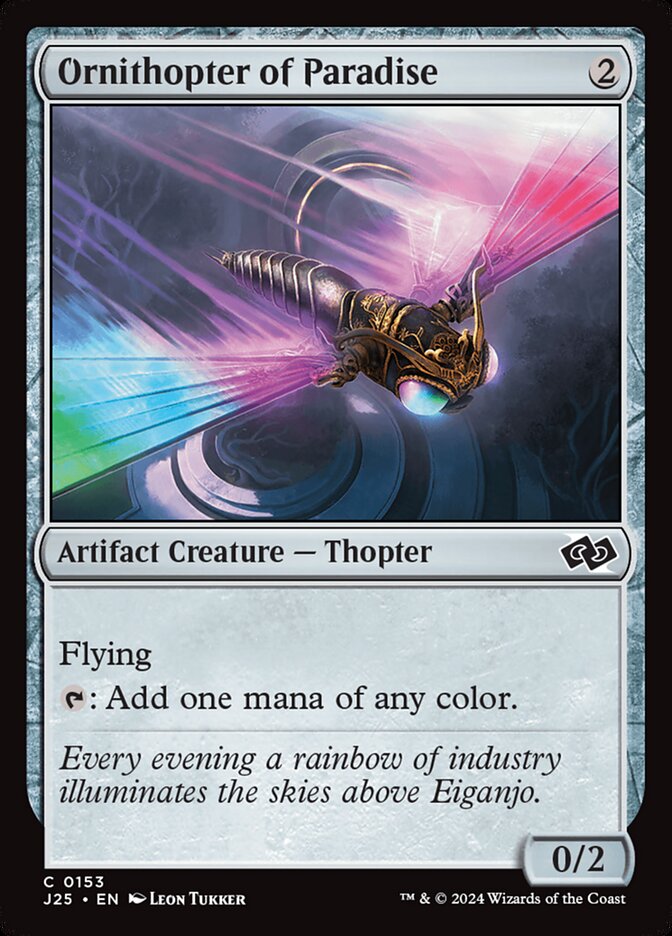 Ornithopter of Paradise
With The Emperor of Palamecia and Ornithopter of Paradise on the battlefield, you can tap both for mana. If you use that mana plus two other sources to cast a noncreature spell for 4 mana, the Emperor's ability triggers. You put a +1/+1 counter on him, moving him closer to his transformation.
 Professional Face-Breaker
If you have Professional Face-Breaker and attack with The Lord Master of Hell, Starfall triggers. Before it resolves, you might use the Face-Breaker to sacrifice a Treasure and exile a card. If that card is a noncreature spell you cast and it ends up in the graveyard before the Starfall ability resolves, it will increase the damage X dealt to each opponent.
Guide written with AI from the official text and rulings. Official English text prevails.
How it works : The Emperor of Palamecia // The Lord Master of Hell
Original English text — Wizards of the Coast / Scryfall
- #1· Wizards of the Coast
The Emperor of Palamecia's last ability resolves before the spell that caused it to trigger. It resolves even if that spell is countered or otherwise leaves the stack.
No other card is named in this ruling.
- #2· Wizards of the Coast
The value of X is calculated only once, as The Lord Master of Hell's ability resolves.
No other card is named in this ruling.
- #3· Wizards of the Coast
In the Commander variant, a double-faced card's color identity is determined by the mana costs and mana symbols in the rules text of both faces combined. If either face has a color indicator or basic land type, those are also considered. For example, Cecil, Dark Knight's color identity is black and white, since its front face is black and its back face has a white color indicator.
No other card is named in this ruling.
- #4· Wizards of the Coast
If you are instructed to put a card that isn't a double-faced card onto the battlefield transformed, it will not enter at all. In that case, it stays in the zone it was previously in. For example, if a single-faced card is a copy of Crystal Fragments, it will be exiled during the resolution of its second ability and remain in exile.
No other card is named in this ruling.
- #5· Wizards of the Coast
The back face of a nonmodal double-faced card usually has a color indicator that defines its color.
No other card is named in this ruling.
- #6· Wizards of the Coast
Each face of a nonmodal double-faced card has its own set of characteristics: name, types, subtypes, abilities, and so on. While a nonmodal double-faced permanent is on the battlefield, consider only the characteristics of the face that's currently up. The other set of characteristics is ignored.
No other card is named in this ruling.
- #7· Wizards of the Coast
The mana value of a nonmodal double-faced card is the mana value of its front face, no matter which face is up.
No other card is named in this ruling.
- #8· Wizards of the Coast
A token that is created as a copy of a double-faced permanent or a double-faced card in another zone is a double-faced token. It will have both the front face and back face of whatever object it's copying. If it's copying a double-faced permanent whose back face is up, the token will enter with its back face up. It can transform if instructed to do so.
No other card is named in this ruling.
- #9· Wizards of the Coast
Each nonmodal double-faced card in this release is cast face up. In every zone other than the battlefield, consider only the characteristics of its front face. If it is on the battlefield, consider only the characteristics of the face that's up; the other face's characteristics are ignored.
No other card is named in this ruling.
- #10· Wizards of the Coast
A nonmodal double-faced card enters with its front face up by default, unless a spell or ability instructs you to put it onto the battlefield transformed or allows you to cast it transformed, in which case it enters with its back face up.
No other card is named in this ruling.
Legal formats
Commentaires
- Sois le premier à commenter cette carte.
Read next
Meta decks with The Emperor of Palamecia // The Lord Master of Hell