

Unifying Theory is one of those cards players keep asking about. Here is, in plain words, what its official text says, the rulings published by Wizards of the Coast, and the combos players actually run.
Official card text
Whenever a player casts a spell, that player may pay. If the player does, they draw a card.
Complete guide
Unifying Theory is a symmetrical enchantment that invites every player at the table to invest in extra knowledge. By turning every spell cast into a potential card-draw opportunity, it changes the economic landscape of the game for both you and your opponents. This card excels in decks that can generate excess mana or those looking to foster a more cooperative, high-resource environment.
Universal Opportunity
Unifying Theory features a triggered ability that triggers whenever any player—including yourself—casts a spell. The ability goes on the stack on top of the spell that triggered it. When the ability resolves, the player who cast that spell has the option to pay {2}. If they do, they draw a card. This is a purely optional payment; if the player chooses not to pay, or cannot afford it, nothing happens and the ability simply finishes resolving.
Step-by-Step Resolution
First, a player announces and casts a spell, paying all necessary costs. This causes Unifying Theory to trigger. The trigger is put on the stack above the original spell. Players then have a chance to respond with other spells or abilities. When the Unifying Theory trigger finally resolves, the active player (or whoever cast the spell) decides whether to pay {2}. If the mana is paid, the card draw happens immediately during the resolution of the trigger, before the original spell itself actually resolves.
Avoiding Common Pitfalls
A common mistake is thinking you, as the owner of Unifying Theory, get to draw the cards. The text specifically states 'that player' may pay and 'they' draw the card, referring to the person who cast the spell. Additionally, remember that the payment happens upon resolution. You cannot pay the {2} later in the turn to draw the card; you must decide and pay right when the trigger resolves. If the spell is countered, the Unifying Theory trigger still resolves because the spell was still 'cast'.
Strategic Timing
Because Unifying Theory benefits your opponents, it is best played when you have a significant mana advantage or when you have other cards that tax your opponents' resources. It works well in 'Group Hug' formats where the goal is to accelerate the game state for everyone, or in combo decks that simply need one specific piece and have the mana to dig for it through their own spells.
Interaction examples
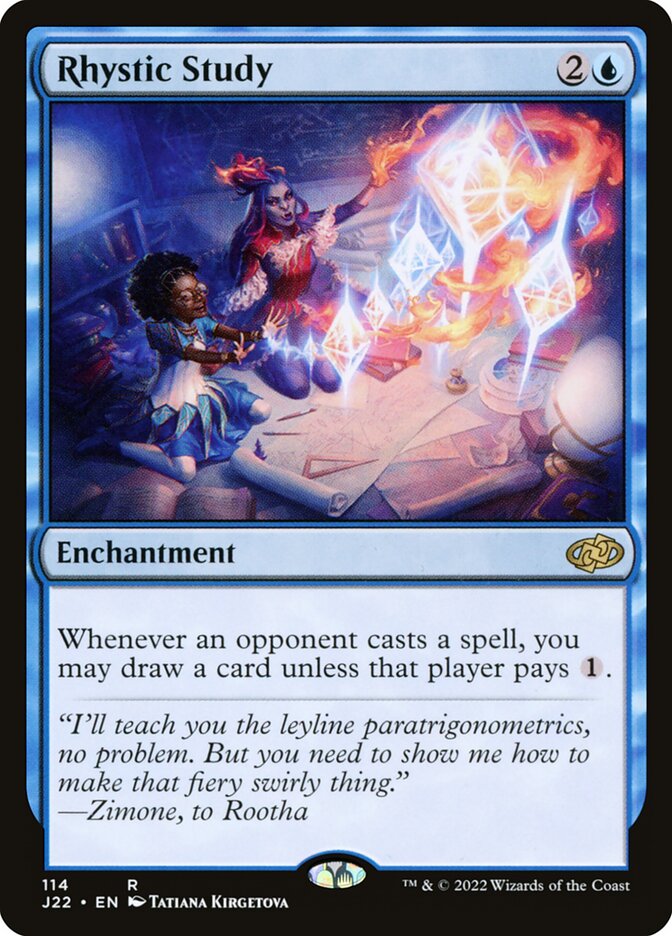 Rhystic Study
If you control both enchantments and an opponent casts a spell, two triggers go on the stack. You can order them so Rhystic Study resolves first, asking your opponent to pay {1} to prevent you from drawing. Then, Unifying Theory resolves, giving that same opponent the choice to pay {2} to draw a card themselves. This forces the opponent to manage their mana carefully between denying you a card and gaining one for themselves.
 Mystic Remora
When an opponent casts a noncreature spell, both enchantments trigger. The opponent faces a dilemma: they may pay {4} to prevent you from drawing a card via Mystic Remora, and then they must decide if they want to spend an additional {2} to draw a card from Unifying Theory. If they want to draw a card and stop you from drawing, they must spend a total of {6} extra mana on top of their spell's cost.
You cast a simple 1-mana cantrip. Unifying Theory triggers. You choose to pay {2} as the trigger resolves, drawing a card. Then, your original cantrip resolves, and you draw a second card. By spending {2} extra on your own turns, you effectively turn every cheap spell in your deck into a powerful draw engine.
Guide written with AI from the official text and rulings. Official English text prevails.
How it works : Unifying Theory
Original English text — Wizards of the Coast / Scryfall
No additional ruling has been published for this card.
Popular combos
Real combos played by the community, sorted by popularity.


Jadzi, Oracle of Arcavios // Journey to the Oracle + Meloku the Clouded Mirror + Phyrexian Altar + Unifying Theory
- 1Activate seven lands by tapping them, adding at least
 .
- 2Activate Meloku seven times by paying and returning the seven lands from the battlefield to your hand, creating seven 1/1 Illusion creature tokens.
- 3Activate Phyrexian Altar six times by sacrificing six Illusions, adding

 .
- 4Cast Journey to the Oracle by paying .
- 5Unifying Theory triggers, causing you to pay to draw a card.
- 6Resolve Journey to the Oracle, putting at least seven lands from your hand onto the battlefield, then causing you to discard a card and Journey to the Oracle to your hand.
- 7Repeat.
Legal formats
Commentaires
- Sois le premier à commenter cette carte.
Read next
Meta decks with Unifying Theory
No archived Top 8 deck with this card yet.